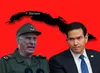

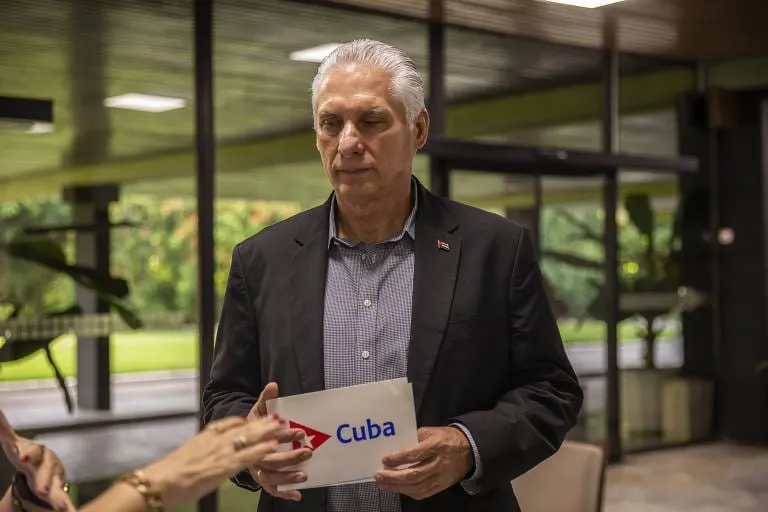
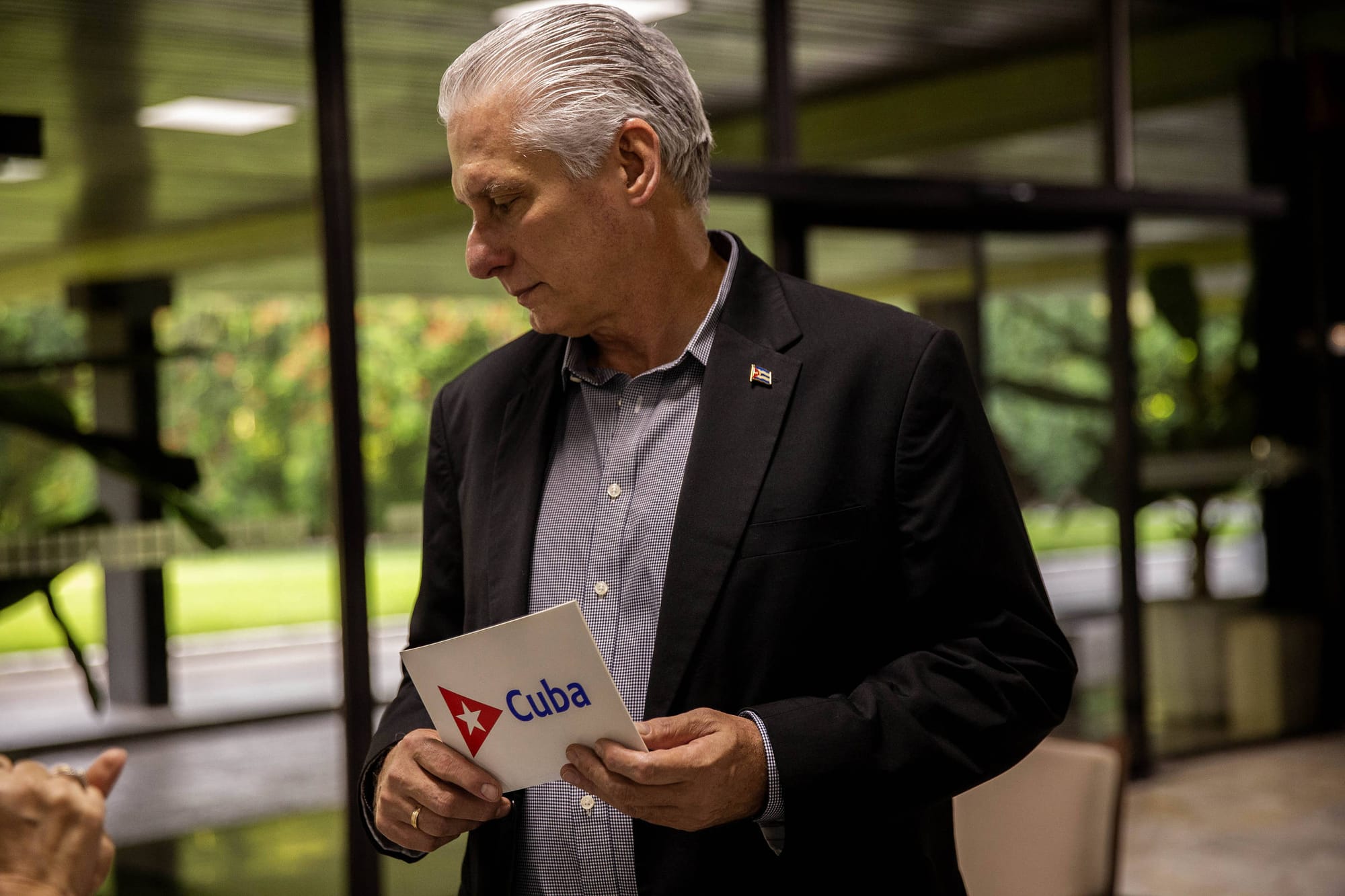
HAVANA — Cuban President Miguel Díaz-Canel used a weekend interview to flatly deny his government’s economic reforms represent any move toward capitalism, even as the island’s basic infrastructure continues to fail and the Trump administration escalates a sanctions campaign explicitly designed to force the political and economic change he insists is not happening.
In a roughly hour-long interview with Brazilian outlet Folha de S.Paulo published on Saturday, journalist Mônica Bergamo pressed Díaz-Canel directly on the existence of private property, private employers and employees, dollar-denominated stores, and growing inequality on the island. His response was unequivocal: “No hay reformas capitalistas” — “There are no capitalist reforms.”
Díaz-Canel characterized the changes as “necessary concessions” within an ongoing process of “socialist construction,” insisting the Communist Party guarantees the process will not result in what he called a “capitalist restoration.”
Pressed on his own family background and on U.S. sanctions targeting him personally, he added: “Yo no soy hijo de una élite, soy hijo de un obrero y una profesora” — “I am not the son of an elite, I am the son of a worker and a teacher” — and said the sanctions carry no personal weight for him since he holds no U.S. accounts or property.
The remarks referred specifically to a package of 176 economic measures Cuba’s National Assembly approved on an emergency basis in June 2026, which includes private banking, private currency exchange houses, elimination of the previous 100-worker cap on small and medium private businesses (mipymes), and expanded openness to foreign investment.
As of August 22, the government reported 134 of those 176 measures — 76.1% of the package — already had legal backing.
A Reality the Interview Doesn’t Address
Díaz-Canel’s insistence that Cuba remains firmly on a socialist path, resisting any political opening, unfolds against conditions that independent tracking suggests are worsening rather than stabilizing.
Cuba’s Observatorio Cubano de Conflictos recorded 1,415 protests, complaints, and public expressions of criticism in July 2026 alone — the highest monthly total in recent Cuban history, a figure that sits uneasily alongside Díaz-Canel’s closing statement in the interview that “vamos a superar este momento, porque además la justicia está de nuestra parte” — “we will overcome this moment, because justice is also on our side.”
The island’s basic infrastructure has continued to fail in parallel.
On August 20, the state water utility Aguas de La Habana announced an emergency shutdown affecting six municipalities — Plaza de la Revolución, Diez de Octubre, Cerro, Centro Habana, Habana Vieja, and part of Boyeros — after a rupture in a 78-inch main water conduit, compounded by additional leaks at the Cuenca Sur source. The company gave no timeline for restoring service. It was at least the third major rupture affecting Havana’s water system within weeks, part of a crisis that had already left more than 500,000 residents of the capital without regular access to potable water even before this latest failure — a crisis tied directly to the island’s chronic blackouts, since roughly 87% of Havana’s water system depends on electric pumping stations that fail whenever the power does.
How This Fits Into U.S. Strategy
Washington’s pressure campaign has been explicit about linking economic sanctions to a demand for genuine political change, not the internal “socialist perfecting” Díaz-Canel describes.
Secretary of State Marco Rubio said in May that the Trump administration would maintain pressure on Cuba’s government “until it implements political and economic reforms,” and warned again in early August that Havana would find no “válvula de escape” — no escape valve — from that pressure, telling Axios:
“What we’re trying to teach them is that there are no escape valves. Every time they create a new mechanism to try to get out from under the pressure, we simply block it.”
Rubio has also argued Cuba can no longer count on running out the clock until the end of Trump’s term, noting the island has effectively lost its traditional external sponsor following Venezuela’s own political transformation after Maduro’s January capture.
The sanctions themselves have escalated steadily and by design across specific institutional targets throughout 2026.
Trump signed Executive Order 14380 declaring the Cuban government’s policies an “unusual and extraordinary threat” to U.S. national security, authorizing additional tariffs against countries supplying oil to Cuba.
Subsequent rounds of sanctions have targeted, in sequence, Cuba’s legal and energy framework, the GAESA military conglomerate, the island’s intelligence and security apparatus, its political leadership directly, its international influence networks, and — as recently as August 21 — nine additional state entities and three officials tied to the Cuban Institute of Friendship with the Peoples (ICAP), which Rubio accused of using front groups “to infiltrate Americans, corrupt them, and radicalize them.”
Jeffrey Scott Shapiro, a former U.S. official who advised the Office of Cuba Broadcasting during Trump’s first term, described the pattern bluntly: “The totality of 2026’s sanctions reveals a gradual strategy to attack the fundamental pillars of the Cuban dictatorship.”
Miami’s Congressional Delegation Amplifies the Pressure
The administration’s approach has drawn explicit, sustained support from South Florida’s Cuban-American congressional delegation.
Representatives María Elvira Salazar, Mario Díaz-Balart, and Carlos Giménez, along with Senators Rick Scott and Ted Cruz, have consistently pressed that any U.S. policy toward Cuba must center on the island’s democratization, the release of political prisoners, and explicit support for the democratic opposition — a position that has shaped the administration’s public framing of its sanctions strategy throughout the year.
Two Incompatible Narratives
What emerges is a genuine standoff between two irreconcilable accounts of the same moment. Washington frames its sanctions as a deliberate, sequenced campaign to force Cuba’s government toward real political and economic reform, arguing the island can no longer avoid that pressure now that it lacks an external patron.
Havana, through Díaz-Canel, insists its own reforms are proceeding entirely on its own terms, explicitly rejecting capitalism and political pluralism as outcomes, and attributing the island’s economic collapse primarily to the U.S. embargo rather than internal management.
Neither account fully explains the other: Washington’s sanctions have yet to produce the political opening it says it’s seeking, while Díaz-Canel’s insistence that reforms remain purely socialist in character sits alongside a summer of record protest activity and infrastructure failures that go unaddressed in his framing.