
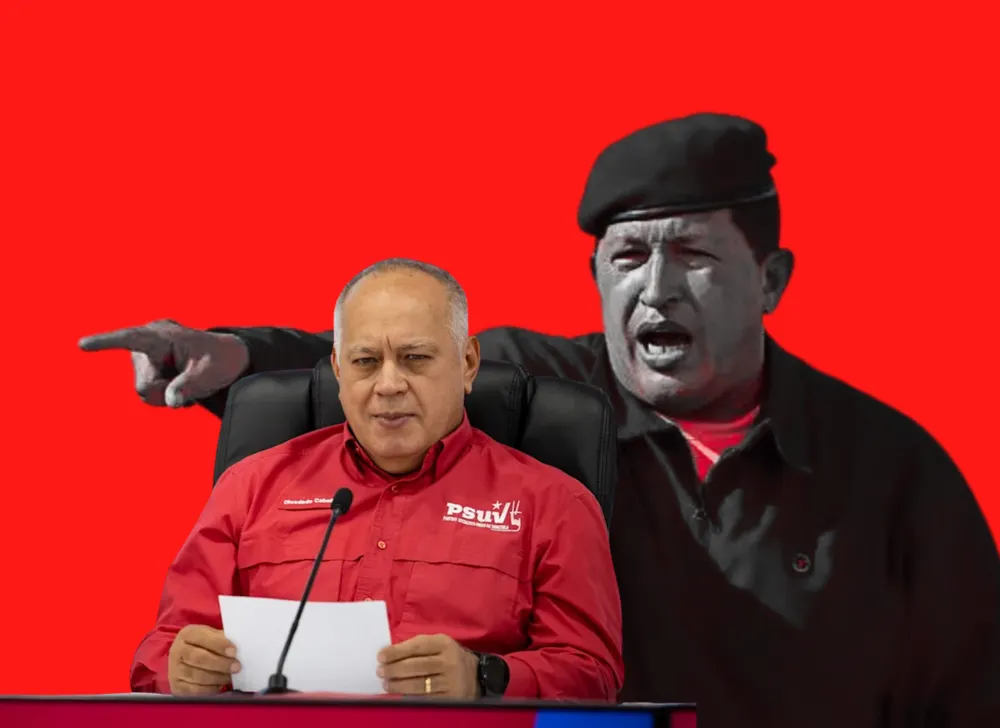
CARACAS — Venezuelan Interior Minister and PSUV Secretary General Diosdado Cabello denied on Monday, August 24, that the release of political prisoners has ever been part of the U.S.-brokered dialogue between the government and an opposition faction, even as the timing of recent excarcelaciones, prisoner release measures, and mounting pressure from human rights organizations have raised questions about that account.
Speaking at the ruling Partido Socialista Unido de Venezuela’s weekly press conference, Cabello was direct: “Jamás se han tocado esos temas dentro de la mesa,” — “Those topics have never been touched at the table.”
Asked specifically about the connection between the excarcelaciones and the ongoing mesa de diálogo, he insisted the negotiations have addressed a distinct, clearly defined set of issues that does not include the prisoner-release question. He went further, questioning the motives of the NGOs pressing for the inclusion of such issues, remarking that both opposition figures and human rights organizations “facturan y cobran, unos con plata y otros políticamente” — a characterization that dismissed NGO advocacy on the issue as self-interested rather than substantive.
Cabello’s denial arrives despite a pattern independent observers have flagged as at least suggestive of a connection.
Chavismo announced 131 prisoner release measures on August 14 — just days after the first cycle of the dialogue concluded on August 12. Foro Penal, the Venezuelan human rights organization that independently tracks such releases, initially confirmed 64 of them and later raised its count to 81.
Cabello has previously made a similar denial regarding the earlier, 2015-era National Assembly dialogue cycle, insisting the topic of presos políticos was never on that agenda either.
The Numbers, According to the Government
Acting President Delcy Rodríguez separately confirmed on Monday that 1,046 venezualans have been released since January 2026, under what her government calls the Programa de Convivencia Democrática y Paz, which began shortly after Nicolás Maduro’s January 3 capture by U.S. forces.
Rodríguez said an additional 12,000 people have received unspecified procedural benefits. She also confirmed her government is working with the International Committee of the Red Cross to review conditions inside detention centers — an announcement that followed sustained pressure from NGOs and prisoners’ families demanding the Red Cross be granted access.
Families Push Back in the Streets
The same day as Cabello’s remarks, relatives of political prisoners staged a protest in Caracas demanding a complete, verified list of everyone released.
Demonstrators, wearing white shirts and carrying signs bearing detained relatives’ names, chanted slogans including “Political prisoners are not a negotiation” and “Delcy releases them, the family awaits them.”
The march proceeded toward the Ministry of Interior, Justice and Peace — the ministry Cabello himself leads — where protesters explicitly named him as an obstacle to further releases.
A police barrier of metal fencing blocked the march from reaching the ministry’s building directly. Protesters submitted a document to the Attorney General’s Office asserting that roughly 300 political prisoners remain in state custody despite official release announcements.
A Minister Under His Own International Scrutiny
Cabello’s continued role overseeing this process comes despite his own significant legal exposure in the United States: he faces U.S. narco-trafficking charges and remains the subject of a $25 million bounty offered by Washington for information leading to his capture — a detail that has not gone unnoticed by protesters and opposition figures pressing the prisoner release issue.
With the dialogue table currently in recess following its first cycle, and no confirmed date yet for a resumption, the question of whether prisoner releases will formally enter the negotiating agenda remains unresolved.
Families and NGOs continue pressing for inclusion and for a verified accounting of who has actually been freed, while Cabello’s public position — that the issue was never on the table and that the organizations advocating for it lack genuine standing — leaves that demand, for now, formally unaddressed within the dialogue framework itself.