



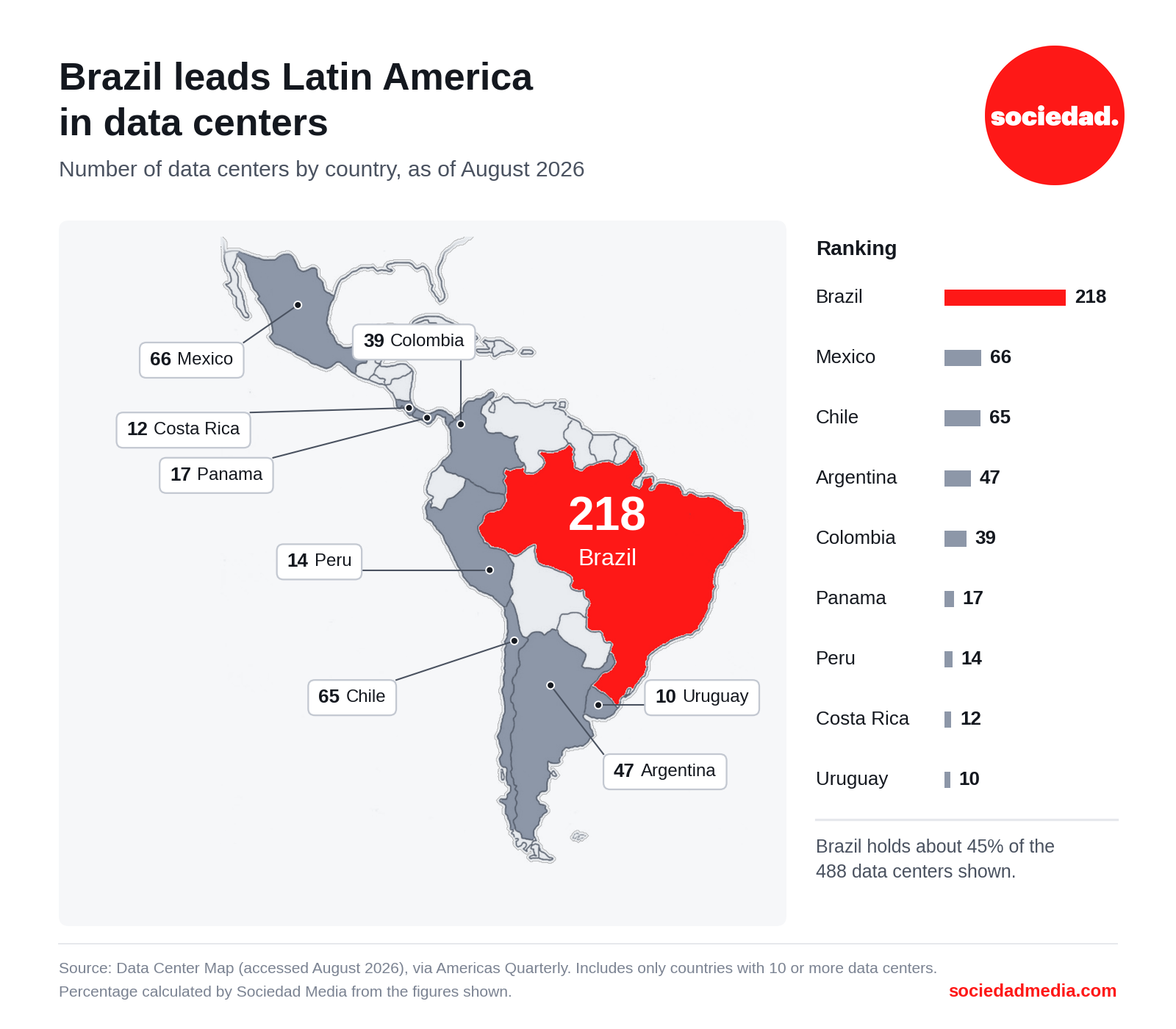
LATIN AMERICA — Brazil has 218 data centers, more than three times Mexico’s 66, as Latin America competes to host the infrastructure behind artificial intelligence.
Mexico, Chile and Argentina follow with 66, 65 and 47, according to Data Center Map figures as of August 2026 and published by Americas Quarterly (AQ). Colombia has 39, Panama 17, Peru 14, Costa Rica 12 and Uruguay 10. The chart covers only countries with at least 10 facilities.
Governments are courting the investment, but economists say the region should not expect the boom to transform its economies on its own.
Billions on the table
The region already hosts more than 500 data centers, including hyper-scale sites run by Amazon, Microsoft, Meta and Google, according to a October 7 AQ column by journalist Andrés Oppenheimer.
Brazil’s Finance Ministry projects about $377 billion in new investment over the next decade, and an executive order exempts key equipment from federal import taxes, Oppenheimer wrote.
The Mexican Data Center Association forecasts $82.5 billion in investment from 2026 to 2031. President Claudia Sheinbaum has celebrated a $4.8 billion plan for six data centers in Querétaro.
In Argentina, OpenAI and Sur Energy signed a letter of intent last October for a project of up to $25 billion in Patagonia, which would be built under the country’s RIGI incentive regime.
Data Center Dynamics reported that the plan envisions up to 500 megawatts, with a first 100-megawatt phase in 2027. A letter of intent is not binding. President Javier Milei told Oppenheimer that “data centers will generate a phenomenal acceleration of economic growth.”
Part of the push comes from abroad. Oppenheimer cited a Gallup poll showing 71% of Americans oppose a data center near them, which he suggested is driving Big Tech overseas.
Economist Eduardo Levy Yeyati, a former chief economist at Argentina’s central bank, calls data centers “an extractive industry, much like mining.” Companies earn profits and pay taxes, he said, but add little employment, and governments should not expect them to “save our countries.”
In a June AQ essay, Levy Yeyati wrote that most of the value flows to foreign companies that run the workloads, while the region supplies land, energy, connectivity and often tax incentives.
Hyper-scale campuses can create local spillovers, he said, but colocation sites that rent space to remote tenants create few jobs: “A bank in New York renting a server rack in Bogotá does not hire IT staff in Bogotá.” The region’s roughly 1,450 megawatts of installed capacity are less than a third of Northern Virginia’s 4,900. He urged governments to negotiate power commitments, local supplier and workforce targets and access for universities and startups before hyperscalers arrive. “Infrastructure without sovereignty is a service contract,” he wrote.
U.S. Reluctance Fuels Latin American Opportunity
Opposition to data centers has become a force in the United States. A Gallup poll from March found that 71% of Americans oppose an AI data center near their homes, and 48% oppose it strongly. That is more than the 53% who object to a nearby nuclear plant.
Opposition was highest in the Midwest (76%) and the South (75%). The resistance has gone beyond polling. Data Center Watch, a research firm, counted at least 75 projects worth more than $130 billion that were blocked or delayed in the first three months of 2026.
Active opposition groups grew from 396 at the end of 2025 to 833 by the end of March, across 49 states. About a dozen states have proposed construction moratoriums, and New York passed a one-year pause on large data center permits.
Some analysts see that backlash pushing Big Tech to look abroad. Reports suggest that this is one reason why tech firms are investing big in other regions like Latin America. The region offers what U.S. communities increasingly resist. Argentina’s president, Javier Milei tells reporters that his country’s energy, minerals, territory and cool climate make it a natural AI hub.
Chile has a surplus of northern power and fiber links to the United States. Brazil exempts key equipment from import taxes, and the region has attracted billions in announced projects, including a $25 billion OpenAI plan in Patagonia that so far is only a letter of intent.
Backlash is not the only force at work. Global data demand is growing about 20% a year, and U.S. construction continues despite the opposition. But rising U.S. costs and local resistance mean Latin American advantages are more visible to companies.
Water, Power & Local Doubts
Querétaro, which has received about $12 billion in data-center investment since 2022 from Microsoft, Google and Amazon, shows the tension. The Thomson Reuters Foundation’s Context reported in February that residents of Viborillas described water rationing, with some receiving water three days a week.
The state exempts data centers in industrial parks from environmental impact reports, which typically disclose water use. State official Marco del Prete said blaming shortages on data centers “simplifies” a problem that predates them.
Microsoft’s own figures showed 64 people working at one Mexican data center in 2025, Context reported, and residents said many jobs were temporary construction or security work.
In Chile, earlier reporting by Nearshore Americas said court documents showed Google’s second Cerrillos data center could use up to 7 billion liters of water a year, and an environmental court pushed the company toward fan-based cooling.
Power is another constraint. The Mexican Data Center Association has warned that projects are shifting to Brazil and Chile because Mexico’s energy planning has lagged, Levy Yeyati wrote.
Oppenheimer noted that Latin America received about 1.6% of global AI spending in 2023, according to a U.N. study, and he raised concerns about political instability, changing rules and grid reliability.
🚨🇧🇷🔌 TECH/ECONOMY: BRAZIL leads LATAM in Data Centers, but with Mexico 🇲🇽 & Argentina 🇦🇷 second & third respectively. But the question is: will it fuel a boom?
— Sociedad Media (@sociedadmedia) October 8, 2026
🇺🇸 U.S. reluctance 👎 gives Latin America opportunities ⚡️ pic.twitter.com/hthKuJs4zA