

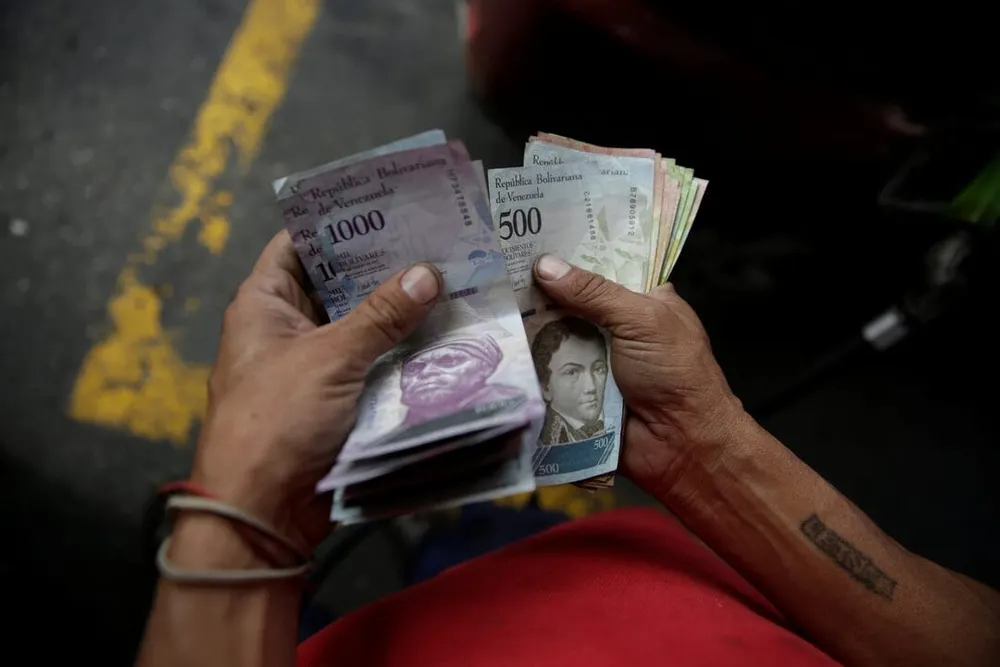
CARACAS, VENEZUELA — A legislative proposal to formally eliminate Venezuela’s bolívar and adopt the U.S. dollar as the country’s official currency has gained renewed public attention this month, as private estimates put annual inflation above 500% — though economists and Venezuela’s own leading economic academy caution the country lacks the conditions to actually carry it out.
The proposal, associated with opposition figure Antonio Ecarri and economist Steve Hanke, would eliminate the bolívar entirely and adopt the U.S. dollar as Venezuela’s sole official currency — not simply formalizing the widespread dollar use that already exists in practice, but replacing the bolívar as legal tender altogether.
Diario Bitcoin’s coverage described it as the most ambitious opposition effort yet to formally retire a currency that has lost nearly all of its value over the past several years and already shares much of its transactional role with foreign currencies and stablecoins like USDT.
Venezuela’s relationship with the dollar is often described by economists as “de facto” dollarization: widespread, informal, and driven by necessity rather than law.
Prices for food, clothing, and services are commonly quoted and paid in dollars across much of the country, a pattern that intensified after hyperinflation pushed households and businesses toward the U.S. currency around 2019.
But the bolívar remains Venezuela’s legal tender under the constitution, still used for tax payments, public utility bills, and state payroll.
As one Venezuelan outlet summarized the disconnect earlier this year: “Yes in the street, no in the law.”
Formal dollarization would require far more than a policy announcement. Venezuela’s Central Bank (BCV) would need to exchange the country’s entire circulating bolívar supply for dollars at an official rate — a currency swap that demands foreign reserves Venezuela is not currently positioned to supply.
The process would also require a constitutional reform, since the bolívar’s status as legal tender is written directly into Venezuela’s founding legal framework, and would effectively eliminate the Central Bank’s ability to issue debt in a national currency going forward.
A Formal Warning From Venezuela’s Economists
Venezuela’s National Academy of Economic Sciences (ANCE) issued a public statement on September 10 addressing the proposal directly. The academy said Venezuela needs to stabilize its economy but warned that full dollarization would not, on its own, resolve the country’s fiscal imbalances, nor would it preserve the flexibility a national currency provides to respond to future crises.
While acknowledging dollarization could help contain inflation, the ANCE said implementing it successfully would require macroeconomic and institutional conditions that Venezuela has not yet built.
A Debate That’s Circled Before
This is not the first time formal dollarization has surfaced as a live political question in Venezuela this year. In February, a video claiming that a law had already been signed to officially dollarize the economy starting March 1 — complete with salaries to be paid in dollars — went viral before independent fact-checkers at Efecto Cocuyo confirmed the claim was false; no such law existed, and no member of the Trump administration had floated the idea publicly, contrary to what the video suggested.
Institute of International Finance economist Jonathan Fortun addressed the broader question in January, telling Bloomberg Línea that while the dollar already performs central functions in Venezuela’s economy, turning that use into a full monetary regime requires conditions that still aren’t in place.
Supporters of dollarization frequently point to Ecuador, which abandoned its sucre for the dollar in 2000 during a severe economic crisis, and El Salvador, which followed a similar path in 2001. Both transitions were difficult in their early years but are generally credited with helping stabilize each country’s economy over the longer term — a precedent Venezuelan proponents argue could offer a similar path out of the country's own prolonged monetary crisis.
Venezuela has already undergone three major currency reconversions since 2008, eliminating a combined 14 zeros from its currency’s denomination without ever containing the underlying loss of purchasing power. That pattern — beginning with the “bolívar fuerte” under Hugo Chávez and continuing through ongoing discussion of a potential “bolívar digital” — reflects, according to independent economists, a structural erosion driven by hyperinflation, international sanctions, and years of de facto dollarization, rather than any single reform actually resolving the underlying instability.
With no formal government dollarization plan currently in place, and the ANCE explicitly warning that Venezuela lacks the institutional conditions to carry one out successfully, the Ecarri-Hanke proposal remains, for now, a matter of active political and economic debate rather than pending law.
Whether the proposal gains enough momentum to advance formally, particularly as inflation continues running above 500% annually, will likely depend on whether Venezuela’s government engages with the idea directly — something it has not yet done publicly, even as dollars continue quietly functioning as the currency Venezuelans actually use in daily life.