


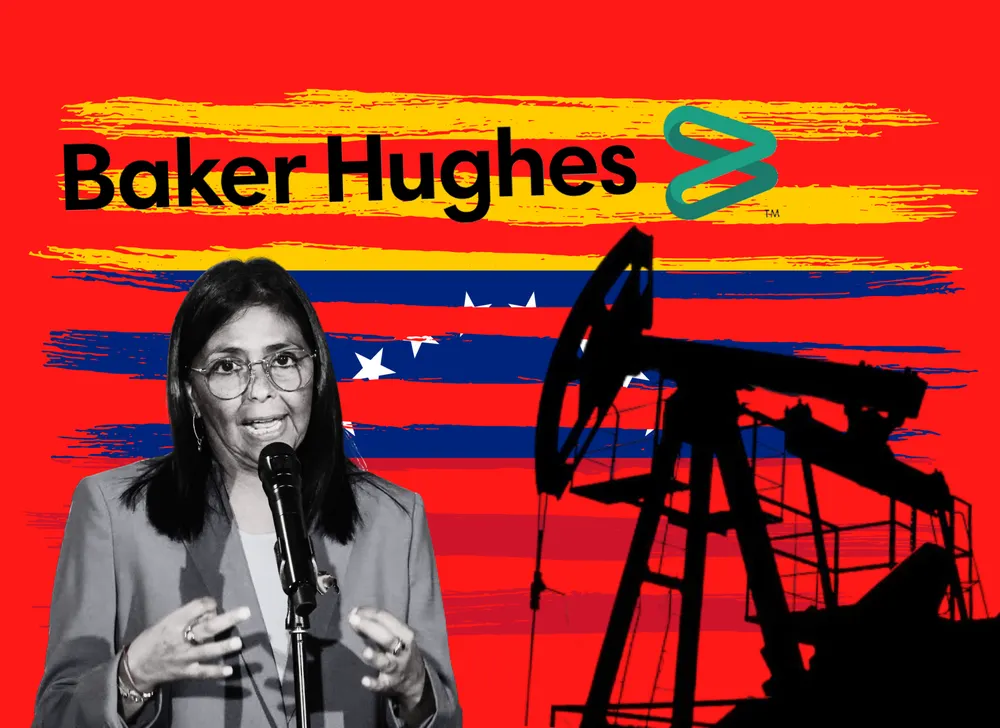
CARACAS — U.S. oilfield services giant Baker Hughes signed a strategic alliance on Monday with Venezuela’s state oil company PDVSA to rebuild and expand the country’s natural gas infrastructure.
The company says the agreement could eventually lead to the first liquefied natural gas (LNG) exports in Venezuelan history.
The Houston-based company also signed a separate memorandum of understanding with New Stratus Energy covering oil and gas prospects.
Financial terms were not disclosed, and neither agreement commits the parties to a specific project. Any individual project will need separate definitive agreements and approvals from the U.S. Treasury Department’s Office of Foreign Assets Control (OFAC).
Two Agreements, One Goal
The first agreement is a strategic alliance among Baker Hughes, PDVSA, Houston-based engineering firm Lindsayca and U.S. LNG developer Fulcrum LNG. It signed in Caracas on October 5. It covers the full gas value chain: upstream production, midstream processing and transport, and LNG commercialization.
The near-term focus is domestic. The partners plan to upgrade gas infrastructure to supply power generation and improve Venezuela’s electricity supply. Over the medium and long term, they plan open-access midstream and LNG infrastructure that could allow exports.
The second agreement is a memorandum of understanding with New Stratus Energy. It covers support for future oil and gas prospects, including subsurface evaluation, drilling, production, processing, digital operations, emissions reduction, power generation and LNG.
“The First LNG Molecules”
Baker Hughes Chairman and CEO Lorenzo Simonelli said the alliance aims at “the development of an integrated gas value chain capable of transforming Venezuela’s substantial natural gas resources into reliable domestic supply and future export opportunities, including the potential to export the first LNG molecules produced in Venezuela.”
Fulcrum LNG CEO Jesus Bronchalo called the alliance “a historic opportunity to maximize the use and value of Venezuela's natural gas resources.” He said it reflects the companies’ ability to develop “fully integrated gas value chains, from upstream production to end markets.”
Reuters reported that interim President Delcy Rodríguez received a Baker Hughes delegation in Caracas to evaluate possible alliances.
No remarks from her were included.
Deep Roots in Venezuela
Baker Hughes has operated in Venezuela for more than 60 years. The company says it has installed more than 1,200 oil production systems and 240 turbomachinery units across 23 sites in the country. Lindsayca has worked in Venezuela since 1986.
Venezuela sits on one of South America’s largest natural gas reserves, which is estimated at about 195 trillion cubic feet, alongside the world’s largest proven oil reserves. But the country has never exported gas at scale. Much of its associated gas has historically been flared or reinjected because of a lack of infrastructure.
Venezuela’s National Assembly approved a reform of the Organic Law on Hydrocarbons on January 29. The reform allows private operators to carry out upstream activity under new production-participation contracts and lets the Ministry authorize joint ventures and contractors to market hydrocarbons directly.
It also caps royalties at 30%. Joint ventures must still keep state ownership above 50%.
OFAC has also relaxed sanctions in steps through general licenses. In January and February it authorized downstream oil transactions, then upstream exploration and production, and then new joint ventures, subject to separate OFAC approval.
The agreements are frameworks, not final deals. PDVSA'’s history of delays in executing capital projects and the continued U.S. policy support Venezuela depends on remain uncertainties. Turning gas fields into exports would require large investments in processing, pipelines and liquefaction facilities that have not been committed.