

CARACAS — Venezuela’s political dialogue process is entering a new phase this month on two separate but connected fronts: the opposition delegation led by Dinorah Figuera is preparing to resume face-to-face talks with Chavismo in Caracas, as President Trump has left open the possibility of meeting acting President Delcy Rodríguez directly during the United Nations General Assembly in New York later this month.
The Dialogue Resumes in Caracas
Figuera, head of the opposition delegation and president of Venezuela’s 2015-elected National Assembly, announced from Madrid on Friday, September 11, that talks are set to resume starting September 15, though her press team clarified the date remains tentative.
The upcoming session marks the second formal cycle of a dialogue process that began August 1 as the ninth attempt at rapprochement between Chavismo and the opposition since 2014, according to Diario Las Américas — a track record that underscores how many prior efforts have failed to produce lasting results.
The first cycle ran August 6-12 in Caracas and concluded with two concrete agreements: a complete renewal of Venezuela’s Supreme Tribunal of Justice (TSJ), whose judges the opposition has long accused of answering to the ruling party, and a second modification to the TSJ law in 2026 alone, following an earlier May reform that expanded the court from 20 to 32 magistrates under its current president, Caryslia Rodríguez.
Ahead of the September 15 restart, the opposition delegation said this past week that it plans to focus specifically on political guarantees, a category that would include civil liberties and freedom of expression protections, among the issues still unresolved from the first cycle.
Elections Still Off the Table
Opposition sectors and non-governmental organizations have continued insisting that the question of actual elections must be formally added to the negotiating agenda, a demand that, as of this writing, has not been incorporated into the talks’ confirmed scope.
The European Union has expressed support for “all efforts” aimed at democratization through the dialogue process, according to reporting on the talks, even as the core issue driving international concern about Venezuela’s political future — when, or whether, genuine elections will actually occur — remains unresolved on the table itself.
The Process’s Original Trigger: An Earthquake
The current round of dialogue traces back to a phone call on August 1 between Jorge Rodríguez, president of Venezuela’s current, Chavista-controlled National Assembly and brother of Delcy Rodríguez, and Figuera, who returned briefly to Venezuela after nearly eight years in exile.
That first contact was explicitly framed around coordinating attention for victims of the devastating double earthquake that struck Venezuela on June 24, which left more than 5,500 dead according to official figures — before broadening into the wider agenda of “strengthening democracy” and political rights and guarantees that has defined the talks since.
As with the dialogue’s earlier phases, the process continues without the direct participation of Venezuela’s most internationally recognized opposition figures, María Corina Machado and President-elect Edmundo González Urrutia — both widely considered to have actually won Venezuela’s disputed 2024 election, according to Washington’s own position.
Their absence remains one of the process’s most significant structural limitations, even as Figuera’s delegation, representing the 2015 National Assembly, continues negotiating under what multiple outlets describe as direct U.S. mediation and design.
Trump Leaves the Door Open on New York
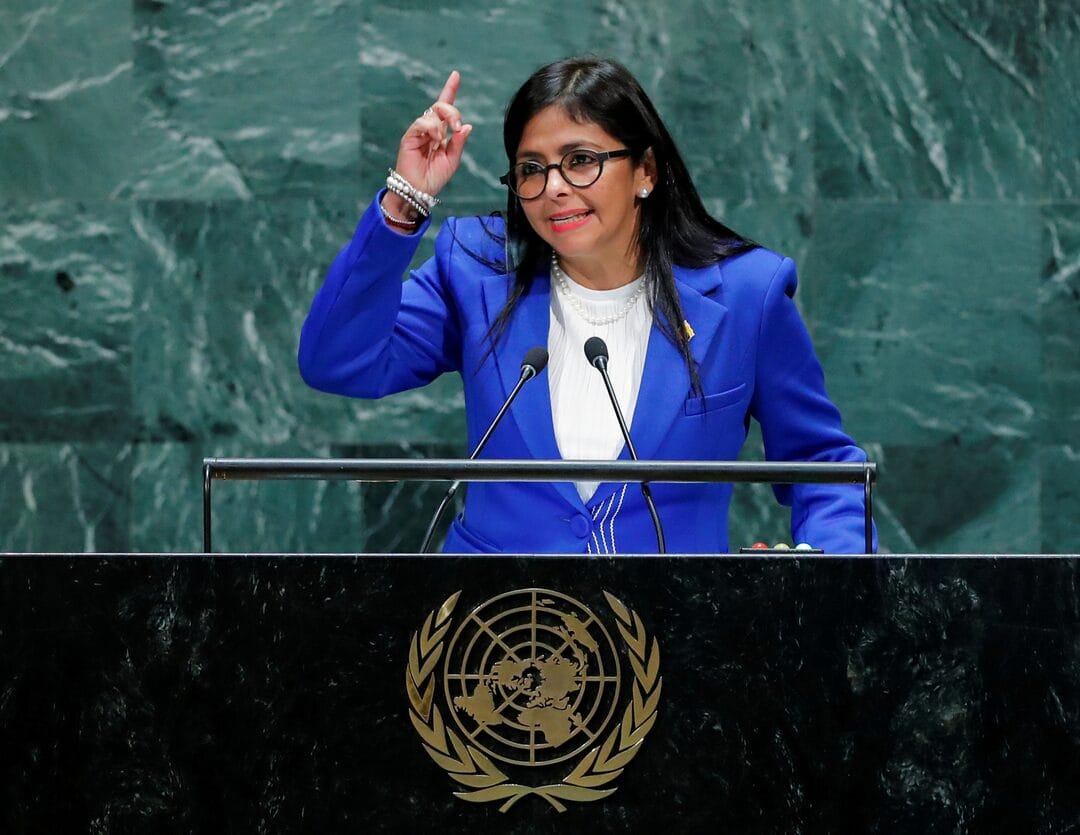
Separately, and on a different but related track, Trump signaled this weekend that he may meet directly with Rodríguez during the U.N. General Assembly’s high-level session in New York. Asked aboard Air Force One whether he planned to meet with Rodríguez to discuss oil matters, Trump responded: “Maybe. Well, now we have the oil. We’re receiving millions of barrels of oil per month.”
President Trump offered no further detail and did not confirm a specific date or format for any meeting.
The U.N.’s 81st General Assembly session opened September 8, with the high-level general debate running September 22-26 and 28.
Such a meeting would carry real historical weight: if it occurs, Rodríguez would become the first sitting Venezuelan president to visit the United States in more than a quarter century, aside from prior presidents attending U.N. meetings specifically in New York — a distinction reflecting just how dramatically the U.S.-Venezuela relationship has shifted since U.S. forces captured Nicolás Maduro on January 3 and flew him to New York to face drug trafficking charges.
Rodríguez has previously described her government’s approach to engagement with Washington as proceeding “without fear” — saying Venezuela is “in a process of dialogue, of working with the United States... to confront our differences and difficulties... and address them through diplomacy.”
Any meeting made on such an international platform would certainly provide Rodríguez — as interim president of Venezuela — an air of legitimacy that would undoubtedly compromise any good will of Venezuelan dissident groups toward the administration in Washington.
Also on Sunday, during a separate visit to Ireland, Trump was asked directly when Venezuela would hold democratic elections. His answer was notably open-ended: elections would happen “when they’re ready,” offering no timeline of his own despite his administration's stated interest in Venezuela’s democratic transition.
Taken together, the resumed Caracas dialogue and the possible Trump-Rodríguez meeting in New York reflect the same underlying dynamic that has defined U.S.-Venezuela relations since Maduro’s capture: parallel, seemingly disconnected tracks of political dialogue and economic engagement advancing simultaneously, without either one producing a concrete commitment to the elections both Venezuelan opposition sectors and international observers continue to demand.
The Caracas talks have generated real institutional agreements — a renewed Supreme Tribunal, procedural commitments on political guarantees — while the economic track between Washington and Rodríguez’s government has moved even faster, anchored by the $65 billion oil deal Trump announced in August and the formal contracts Chevron and Eni signed with PDVSA in early September.
With the opposition’s second dialogue cycle expected to begin around September 15, and Trump’s U.N. General Assembly travel bringing him to New York during the same window Rodríguez could plausibly attend as a head of state, the coming two weeks offer a genuine test of whether Venezuela’s political and economic normalization with Washington can produce anything beyond institutional gestures and oil contracts.
Whether either track — the Caracas dialogue’s “political guarantees” agenda or a potential face-to-face meeting in New York — finally puts a concrete electoral timeline on the table remains, as of this writing, an open question neither government has answered.


