

CARACAS — Venezuela’s government and an opposition faction closed the first cycle of formal political dialogue on Wednesday, August 12, reaching a new groundbreaking agreement on judicial renewal and frozen international assets — even as the country’s most prominent opposition leaders remain entirely outside the process.
How Discussions Unfolded
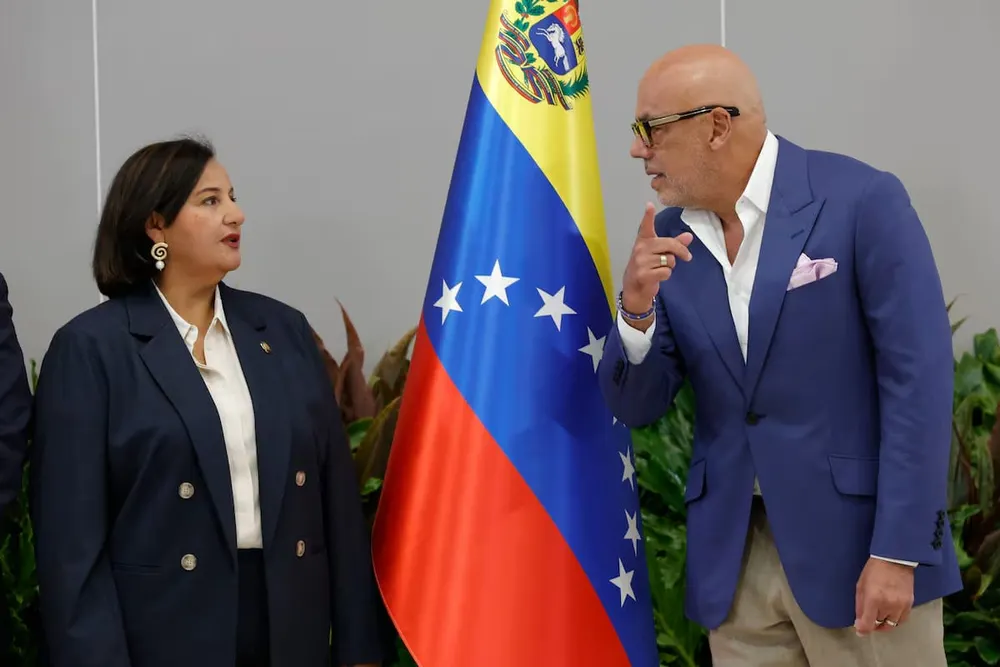
The dialogue formally began on August 1 with a phone call between Jorge Rodríguez, president of Venezuela’s Chavista-controlled National Assembly, and Dinorah Figuera, the exiled former legislator who leads the opposition bloc that won Venezuela’s last internationally recognized election in 2015.
In-person talks followed starting August 6 at Caraca’s La Carlota air base, where both sides agreed on a methodology, a shared agenda, and a firm deadline: August 12 for the conclusion of this first cycle. Subsequent sessions were held behind closed doors at the Gran Meliá Caracas hotel.
Acting President Delcy Rodríguez publicly celebrated the cycle’s progress upon its conclusion.
Agreements
The two delegations reached several concrete commitments. Most notably, they agreed the process will lead to a renewal of Venezuela’s Supreme Tribunal of Justice (TSJ).
On the earthquake response — the first item on the agenda both sides had agreed to in advance — the delegations committed to working toward releasing Venezuela’s international assets held at the Bank of England, funds the Maduro government had previously and unsuccessfully attempted to recover.
Both sides also requested the establishment of “transparency, traceability, and audit mechanisms” to ensure reconstruction funds are used properly. Beyond those specific outcomes, the parties agreed to broader procedural principles: political equality at the negotiating table, verifiable compliance with whatever commitments are reached, and protection of human and political rights “for all forces” involved.
Who’s at the Table
The opposition delegation, led by Figuera, includes former legislators Marco Aurelio Quiñones, Ramón López, Jorge Millán, Juan Miguel Matheus, Sergio Vergara, and Desirée Barboza.
On the government side, Jorge Rodríguez coordinates a team that includes Education Minister Ana María Sanjuán, National Assembly First Vice President Pedro Infante, and deputies América Pérez and Génesis Garvett, among others.
Figuera formally thanked the United States and Secretary of State Marco Rubio for their support of the process, writing that the dialogue’s start “marks a new chapter in the fight to build a dignified future for all Venezuelans.”
Beyond the formal table, Figuera used her time in Caracas to hold parallel meetings with groups the dialogue’s outcome will directly affect: former political prisoners and their families, retirees, and media workers, pledging to carry their specific demands into the negotiations.
“We held a meeting with former prisoners and family members of political prisoners, who gave me a communication that we will bring to the table,” she wrote on X. “We are in this process to achieve a democratic and free Venezuela.”
Dozens of opposition supporters gathered outside the negotiating hotel throughout the week to show support for the process.
Who’s Still Not in the Room
The dialogue continues to proceed without Venezuela’s two most internationally prominent opposition figures: María Corina Machado, the Nobel Peace Prize-winning opposition leader, and President-elect Edmundo González Urrutia, both of whom have said they will not obstruct the process but have declined to participate in a framework they say was designed without them — a position Sociedad Media has covered as it developed since the talks were first announced last month.
The tensions surrounding that absence escalated this week when Diosdado Cabello, one of Chavismo’s most powerful figures, launched a fresh attack accusing Machado of orchestrating a “plan against the transition,” without offering public evidence for the claim.
A separate signal of unmet public expectations surfaced the same morning the first cycle closed: labor union members staged a protest outside the negotiating venue specifically demanding that Venezuela hold presidential elections before the end of this year — a demand that, notably, does not appear among the concrete commitments the two delegations actually reached in this first cycle.
What This Adds to the Broader Picture
The conclusion of this first cycle lands amid a broader pattern of direct U.S.-Venezuela engagement we’ve tracked closely in recent weeks, including a high-level meeting between Delcy Rodríguez and senior U.S. Treasury and State Department officials in Caracas on economic cooperation and earthquake recovery.
Taken together, the dialogue’s outcomes and the parallel economic engagement track suggest Washington continues pursuing a two-pronged approach to Venezuela: direct financial and economic contact with Rodríguez’s government on one hand, and support for a political dialogue process on the other — one that, as of this first cycle’s conclusion, has produced concrete institutional commitments (TSJ renewal, frozen asset recovery) but nothing resembling the electoral timeline that protesting union members, and Venezuela’s broader public, have continued to demand.
Working Ahead
Neither delegation announced a specific date for a second dialogue cycle, nor did either side address what happens to the process’s legitimacy given the continued absence of Machado and González.
With the TSJ renewal and asset-recovery commitments now on record but unimplemented, and no electoral calendar yet in view, the coming weeks will likely determine whether this first cycle’s agreements translate into visible action, or join the list of prior Venezuelan dialogue attempts that produced commitments without follow-through.