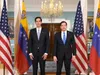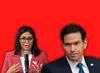

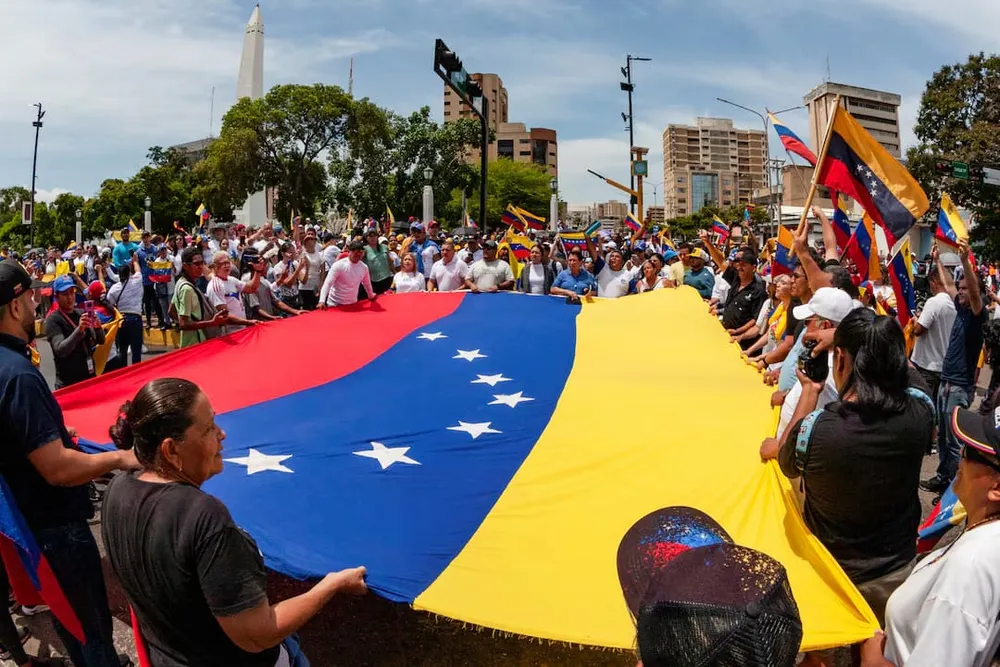
Venezuela’s new foreign minister, Oliver Blanco, said on Monday that all political forces will be able to take part in the country’s next elections and that every sector must respect the outcome. He declined to say when those elections will be held.
The remarks came in his first interview since taking the post, with the Spanish daily El Mundo, conducted in Madrid on the sidelines of the XXX Ibero-American Summit. When asked about Secretary of State Marco Rubio’s suggestion that elections could come in 2027, Blanco said, “It’s not for me to set a date.”
Blanco described the process as one with “an electoral horizon where all forces will be able to participate, where the result must be respected by all sectors, where a trustworthy CNE will be constituted,” referring to the National Electoral Council.
Blanco’s statement is a commitment to principles, not a schedule. Radio América VE noted that the message “establishes an aspiration” without fixing an electoral date. Blanco tied the vote to a wider institutional overhaul.
Blanco also reportedly pointed to a new Supreme Court (TSJ) by the end of this year as a key step in the political dialogue that is meant to lead to a reliable electoral authority. The CNE itself, along with guarantees of political participation and internal party democracy, is to be reviewed afterward.
He also argued that the transformation is already underway. “The process of democratic transformation began in Venezuela in January,” Blanco told El Mundo, citing an amnesty law he said has benefited more than 9,000 people. He added that no new political detentions have been registered and that the press and NGOs can operate.
Blanco was appointed on October 29 by acting President Delcy Rodríguez. He rose through the youth ranks of the opposition party Acción Democrática and worked alongside veteran opposition leader Henry Ramos Allup before stepping back from party politics. He joined Rodríguez’s government after the U.S. operation in January that removed Nicolás Maduro from power, serving as deputy minister for Europe and North America from February and first deputy foreign minister from July.
In that time he has been involved in restoring relations with countries including the United States, the United Kingdom, Chile and Israel.
He told El Mundo he does not belong to any party and said he is focused on his diplomatic role, not on personal political ambitions, according to El Informador.
Washington’s Role
Blanco’s comments follow his November 2 meeting with Rubio in Washington, the first between the two countries’ top diplomats since relations were restored after Maduro’s capture. The encounter was unusually brief, reporting that it lasted about five minutes, and said Blanco declined to answer a reporter’s question about possible elections, replying, “In another meeting, but I have to go.”
A day before Blanco’s appointment, Rodríguez promised elections under a “renewed” electoral authority, also without a date.
Skepticism Remains
Not all coverage accepts the government’s framing. Hispanidad, which ran the quote under a headline calling the transition “extremely slow,” says more than 400 political prisoners remain in Venezuelan jails and notes that opposition leader María Corina Machado recently visited the El Rodeo I prison to accompany detainees’ families.
What happens next hinges on the sequence Blanco outlined: a new Supreme Court by year’s end, a review of the electoral council, guarantees for all parties, and then a date.
Until a date is announced, and until the composition of the new bodies is known, the pledge that all forces can compete and all must accept the result remains a promise to be tested.