

ASUNCIÓN — In the space of one week, Paraguay watched its largest digital bank collapse, its president announce his resignation, Congress decline to accept it and remove him instead, and a judge order him held in pretrial detention.
Vice President Pedro Alliana, a longtime ally of Colorado Party leader Horacio Cartes, now governs the country. Whether the episode strengthens Paraguayan democracy or simply reshuffles the party that has dominated it for decades will depend on what happens in the courts, in Congress and at the ballot box over the next two years.
How the Government Fell
The crisis began when Paraguay’s central bank put Ueno Bank into resolution after its solvency ratio fell below half the legal minimum. Ueno has about 3 million customers, roughly 60% of the country’s adult population, and managed between $800 million and $850 million in public money.
Peña had been a business partner of Ueno’s parent company, Grupo Vázquez, until March 2025, though the bank says he was never a shareholder or investor.
The Senate removed Peña on Friday, November 6, by a unanimous vote of the 44 senators present. He is only the second Paraguayan president removed through impeachment, after Fernando Lugo in 2012.
Peña had submitted his resignation a day earlier, saying he wanted “to avoid more harm to the country,” but Congress did not accept it and proceeded with removal instead.
Peña’s lawyer, Ricardo Preda, has argued the process violated basic due process, and La Nación reports the Senate rejected Peña’s request for a 72-hour extension to prepare his defense.
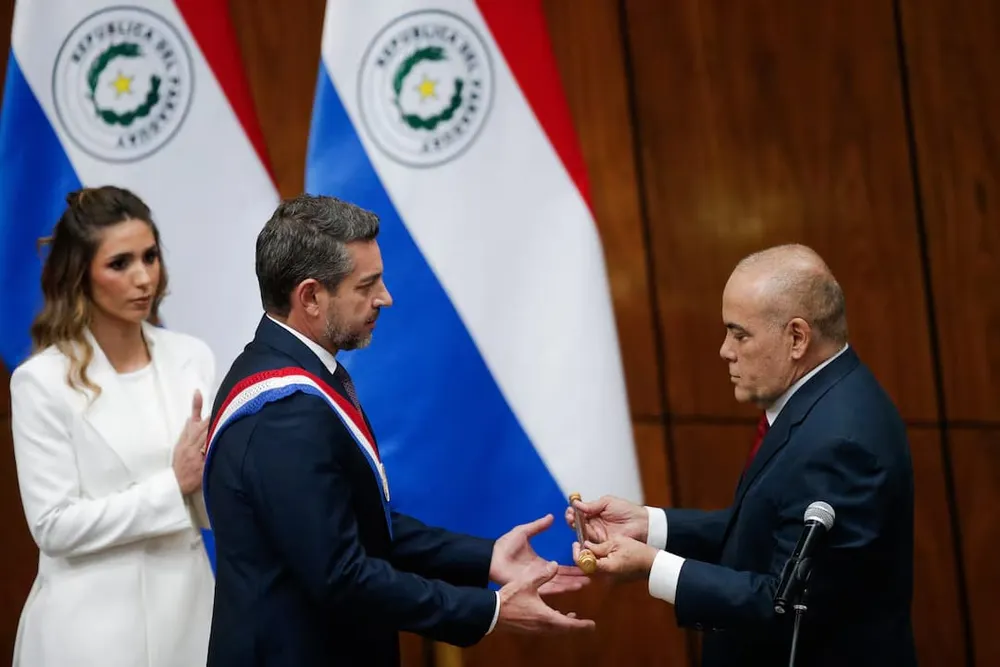
Prosecutors moved within hours. Peña was detained at his Asunción home Friday night, at about the same time Alliana took the oath of office in Congress.
On Saturday, prosecutors charged the former president with “lesión de confianza,” a breach-of-trust offense, and “administración en provecho propio,” or self-interested administration. Judge Humberto Otazú ordered pretrial detention at the Presidential Escort Regiment, a military installation in Asunción.
Peña declined to testify at the hearing.
Former central bank president Carlos Carvallo was charged with the same offenses, and producing false documents.
Prosecutors allege that between 2023 and 2026 Ueno received large deposits from public and pension entities while extending loans to companies tied to its own corporate group. EFE reports that Ueno’s owner and six executives were also sent to prisons for defendants awaiting trial. Pretrial detention is a precautionary measure, not a verdict, and no court has ruled on the substance of the allegations.
Shape Of The New Government
Alliana was sworn in Friday night to complete the term, which runs to August 15, 2028. No new election is required. Under Paraguay’s constitutional rules, the vice president succeeds a president who is removed, and Congress fills the vacated vice presidency by absolute majority.
In a legislature of 45 senators and 80 deputies, that threshold is 63 votes.
Alliana’s first decrees signal continuity with a handful of changes. He named Ariel Martínez, who held the post under Cartes, as interior minister, and made Rolando de Barros, previously the environment minister, his chief of staff. Juan Carlos Baruja moves from housing to public works. Defense Minister Óscar González and Justice Minister Rodrigo Nicora said Sunday they will stay on.
Alliana has also said he intends to maintain Peña’s foreign policy and cooperation with the United States.
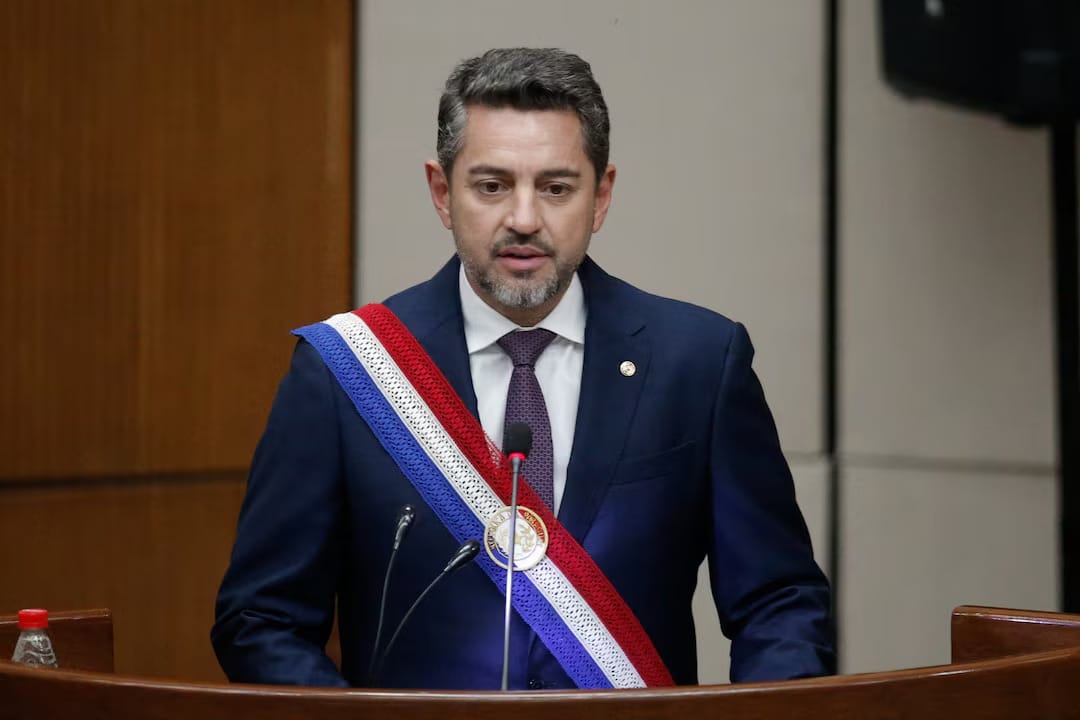
Alliana’s early public messaging stressed order and equality before the law. He told the justice minister to enforce the law “without privileges” in prisons and deployed the armed forces’ logistics command to help flood-affected families in the south.
Nicora said the prison system can receive anyone “regardless of their surname, background or political power,” per RCC. Government officials said Saturday the administration had come out “strengthened from this specific crisis.”
The new president is no stranger to friction with the man he replaced. In July, Última Hora and La Política Online reported that Alliana had pressed Peña to replace ministers, and that Peña, who had also publicly praised him as a probable 2028 successor, resisted.
Alliana had been positioning himself as the ruling movement’s presidential hopeful for 2028, and the AP reported that he put that bid on hold the Monday before the bank was seized, citing the “financial crisis.”
Supporters of the process can point to a sequence in which each branch did its job to maintain order and stability throughout the institutions of government. Congress used its impeachment power. Prosecutors charged a former head of state and a former central bank chief within a day of the removal. A judge ordered a former president held, and Ueno’s owner and executives went to prison alongside him. Citizens gathered outside the prosecutor’s office to demand accountability, and the government has committed to repaying savers.
By the central bank’s preliminary estimates cited by the AP, about 97% of Ueno depositors have balances within the roughly $38,000 guarantee.
The Colorado Party has essentially ruled Paraguay uninterrupted since 1947, and its long history includes the 1954-1989 dictatorship of Alfredo Stroessner.
Peña was hand-picked by Cartes, and the government that replaced him comes from the same movement. A unanimous Senate vote can read as a sign of national consensus or as evidence that the party managed the outcome. The coverage reviewed here does not settle which.
Speed raises its own questions. The Senate rejected the defense’s request for more time, and prosecutors and the judiciary acted within hours of the vote. How the case holds up under appeal, and whether Peña’s due-process arguments gain traction, will help determine whether the episode is remembered as accountability or as a rushed political reckoning.
Alliana’s own position is unsettled. Deputies rejected an opposition impeachment request against him by 48 votes to 30, and that prosecutors opened investigations on November 5 that reach him.
The scope and status of those inquiries are unclear, but a president whose government runs the prosecution’s counterparts in the executive branch is a test of institutional independence in itself.
There is also the matter of how the vice president is chosen. Congress, not voters, picks the replacement, and the legislature is dominated by the same party. And there is the money. State funds, including about $380 million from the IPS pension and health fund, and more than $163 million belonging to the Itaipú hydroelectric entity, remain frozen at Ueno. How quickly and transparently public institutions and ordinary savers are repaid will shape public trust in the new government.
The next steps are procedural and political. The Ueno case now moves through the investigative stage, with prosecutors expected to pursue evidence on how public money reached the bank and who approved it. Whether the inquiry stays limited to Peña, Carvallo and Ueno’s owners or extends to other officials will be one of the clearest signals of its independence.
Alliana’s relationship with Cartes, who heads the Colorado Party through 2028, will shape his freedom to act. And the party primaries expected in 2027, followed by the 2028 general election, will show whether a historically fragmented opposition can turn public anger into votes, or whether the ruling movement can absorb the crisis the way it has absorbed others.
For now, Paraguay has shown that its constitutional machinery for removing a president functions. Whether the same machinery can hold the next president, and the party behind him, to the same standard is the question the country will spend the next two years answering.