
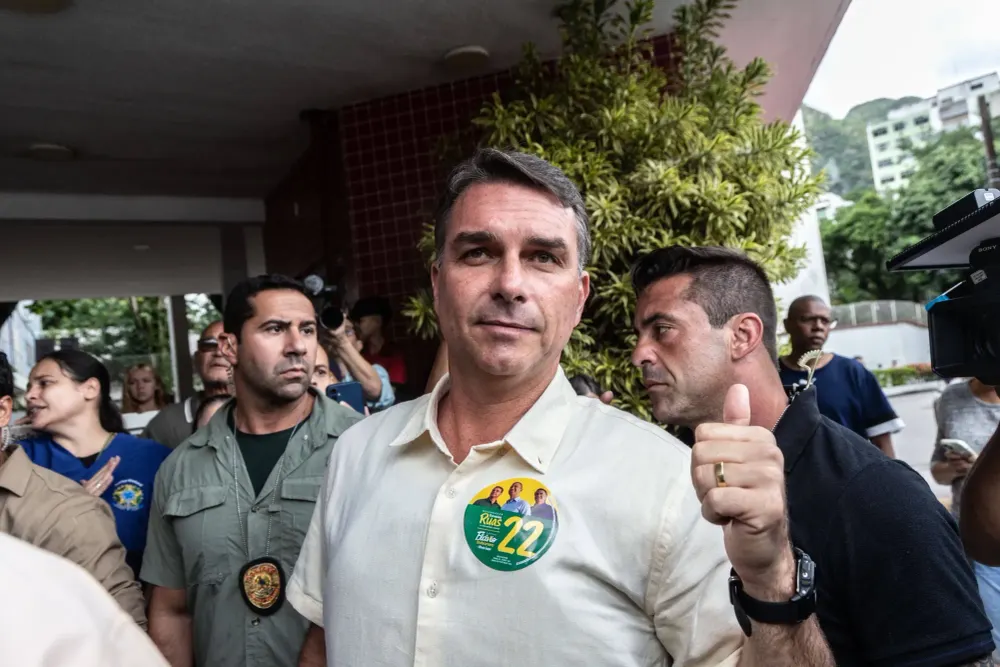
BRASÍLIA — Brazil’s presidential runoff is now two weeks away, and Flávio Bolsonaro enters the final stretch with a narrow lead over President Luiz Inácio Lula da Silva. Lula took to São Paulo’s Avenida Paulista on Sunday to mobilize supporters, while Bolsonaro spent the weekend building a coalition with local officials.
The vote is on October 25.
The First Round
Bolsonaro, the Liberal Party (PL) candidate and son of former President Jair Bolsonaro, finished first on October 4 with 47.03% of valid votes, ahead of Lula’s 45.15%. Neither reached the 50% needed to win outright.
Most polls had Lula leading, and Lula called the result “unexpected.” The right also performed strongly in Congress. The PL is on track to be the largest force in the Chamber of Deputies, Michelle Bolsonaro won a Senate seat in the Federal District, and Carlos Bolsonaro won one in Santa Catarina. Tarcísio de Freitas was re-elected governor of São Paulo.
Where the polls stand
Two post-election surveys show Bolsonaro ahead.
Datafolha (Oct. 6–8, 2,520 voters, margin of error 2 points): Bolsonaro 49%, Lula 45%, or 52% to 48% among valid votes.
That is at the edge of the margin of error. Forty-six percent say they would never vote for Lula and 43% never for Bolsonaro. Forty percent rate the Lula government negative and 35% positive.
A quarter of Bolsonaro’s voters say they are choosing him mainly to defeat Lula.
AtlasIntel/Bloomberg (Oct. 3–8, 5,026 voters, margin of error 1 point): Bolsonaro 51.1%, Lula 45.7%, or 52.8% to 47.2% among valid votes. An AtlasIntel poll on October 3 had Lula at 47.6% and Bolsonaro at 47.4%, and this survey’s fieldwork straddled the first round.
Analysts have suggested that protest votes against Lula helped Bolsonaro in the first round, which could limit his room to grow.
Lula’s Strategy: Bring Out Absent Voters
Lula’s campaign sees abstention as its main way to close the gap. At the Avenida Paulista rally on Sunday, he told supporters that almost 30 million people did not vote in the first round, counting abstentions and those for whom voting is optional.
“We have an obligation to talk to people who feel they no longer have the right to vote,” he said.
Campaign aides say he will concentrate on Rio de Janeiro, São Paulo and Minas Gerais, the three largest electorates, where abstention ran above average.
The São Paulo event, organized by education and science groups, drew a crowd that filled the avenue, though no estimate was given.
Vice President Geraldo Alckmin and governors Elmano de Freitas, Jerônimo Rodrigues and Rafael Fonteles were among those on stage. Lula named four priorities for a new term: technological revolution, digital industry, energy transition and public security reform. Rallies were also held in Campinas and Belo Horizonte.
Lula also criticized Electoral Court decisions as biased against his candidacy and said his lawyers would challenge them. The court’s president, Nunes Marques, provisionally ordered the removal of a video of a September 9 Lula speech in which he said the electoral court should not “want trickery,” a remark Nunes Marques read as implying fraud.
In August, another judge suspended a Lula campaign ad on Bolsonaro, finding it misleading.
Bolsonaro’s Strategy: Coalitions and the Northeast
Bolsonaro spent the weekend in São Paulo, holding closed-door meetings with mayors and councilors from the metropolitan region. His campaign says it is prioritizing the Northeast, a Lula stronghold, bringing first-round winners into the campaign and appealing to voters who backed other candidates. He is stressing cost of living, household debt and public security.
Endorsements are coming in unevenly. Ronaldo Caiado, who finished fifth with about 2.2% of the vote, endorsed Bolsonaro on October 6 at an event with Tarcísio.
Romeu Zema, with 0.27%, said he will oppose the PT. Republicanos and Podemos have met with Bolsonaro, while União Brasil and Progressistas were still deciding. Renan Santos (2.24%) said he has “disgust” for Bolsonaro but will not endorse Lula either.
Third-place candidate Augusto Cury (2.89%) has moved to endorse Flávio Bolsonaro.
Debates
Four debates were scheduled. Record cancelled its October 11 debate, citing the candidates’ schedules. Three remain:
Thursday, October 15: a pool of 11 outlets including SBT, CNN Brasil and Metrópoles.
Sunday, October 18: Band
Friday, October 23: TV Globo, after Jornal Nacional.
Bolsonaro’s campaign says he wants to debate, but it has not said which ones he will attend.
The race will likely turn on turnout and on who wins the roughly 30 million absent voters, and the smaller bloc of voters who rejected both candidates in the first round. Nearly all the polling shows a margin close to the margin of error, so debate performance and the endorsement count could decide the outcome.