



BRASÍLIA — Brazil’s presidential election progresses to a final second round showdown in October 25. Senator Flávio Bolsonaro of the Liberal Party (PL) finished first on Sunday with 47.03% of valid votes. President Luiz Inácio Lula da Silva of the Workers’ Party (PT) was second with 45.16%. Neither cleared the 50%-plus-one threshold needed to win outright.
With 100% of ballots counted, the Superior Electoral Court (TSE) reported that Flávio fell 3,545,892 votes short of a first-round victory and Lula fell 5,770,857 short.
The right-wing PL also did very well in the down-ballot races. It won governorships in several states and took 19 of the 54 Senate seats up for election.
Flávio Bolsonaro received 56,104,503 votes to Lula’s 53,879,538. Of the 119,300,788 valid votes cast, the two men together took more than 92%, so the other candidates shared less than 8%.
A candidate needed 59,650,395 votes to win in the first round.
The gap between the two finalists is about 1.9 percentage points, or roughly 2.2 million votes. It marks the smallest first-round margin between the top two presidential candidates in Brazil's history.

The count swung widely as returns came in. Votes cast abroad were reported first and favored Lula, 53.1% to 37.2%. Overseas voters have historically leaned more toward Lula than the domestic electorate. When about 12% of domestic ballot boxes had been counted, Flávio led 51.09% to 40.71%. That lead narrowed as more regions reported, and the final first-round gap is much smaller than the early numbers suggested.
Pre-election polling from Datafolha, Quaest and AtlasIntel had shown Lula ahead or tied. Flávio finished first anyway.
Under Brazil’s two-round system, the top two finishers meet three weeks later if no one wins an outright majority. Every presidential election since 2002 has gone to a second round, including 2022, when Lula edged Jair Bolsonaro, Flávio’s father.
The campaign was dominated by crime, corruption and the role of the United States. President Donald Trump, a Bolsonaro ally, and Washington’s “close watch” on the vote were recurring themes.
The runoff will test whether Flávio can turn a narrow first-round lead into a majority, and whether Lula can rebuild his coalition in the three weeks left.
Governors: 20 Races Settled, Seven Headed to a Second Round
Voters chose governors in all 26 states and the Federal District. According to O Tempo’s tally, 20 states elected a governor in the first round, and six states plus the Federal District go to runoffs on October 25.
Nexo Jornal also counted 20 states and reported that the PL elected more governors in the first round than any other party. Gazeta do Povo’s headline counted 19, tied to the unresolved Rio de Janeiro race described below.
First-round governors, by party:
PL (5):
- Sergio Moro in Paraná (50.10%, a razor-thin clearing of the threshold),
- Luciano Zucco in Rio Grande do Sul (58.05%),
- Marcos Rogério in Rondônia (56.86%),
- Arthur Henrique in Roraima (69.13%) and
- Jorginho Mello in Santa Catarina (68.98%).
Republicanos (3):
- Tarcísio de Freitas in São Paulo (62.65%),
- Cleitinho Azevedo in Minas Gerais (55.40%) and
- Otaviano Pivetta in Mato Grosso (60.77%).
PSD (4):
- Dr. Furlan in Amapá (62.75%),
- Eduardo Braide in Maranhão (54.05%),
- Raquel Lyra in Pernambuco (53.27%) and
- Fábio Mitidieri in Sergipe (59.27%).
PT (3): Jerônimo Rodrigues in Bahia (55.75%), - Elmano de Freitas in Ceará (53.18%) and
- Rafael Fonteles in Piauí (70.91%, the largest PT margin).
PP (2):
- Eduardo Riedel in Mato Grosso do Sul (67.07%) and
- Lucas Ribeiro in Paraíba (64.30%).
Others (3):
- Daniel Vilela (MDB) in Goiás, 59.17%;
- JHC (PSDB) in Alagoas, 52.19%; and
- Dr. Daniel (Podemos) in Pará, 51.37%.
The PT held its three northeastern strongholds. The right, split among the PL, Republicanos, PP and PSD, won the biggest prize in São Paulo and swept the South.
Seven Governor Runoffs on October 25
- Rio de Janeiro: Douglas Ruas (PL), 49.27%, against Eduardo Paes (PSD), 42.76%. Ruas finished well ahead of Datafolha and Quaest polling, which had Paes leading.
Gazeta do Povo reported that Ruas could still be declared the first-round winner if the Electoral Court nullifies the votes for candidate Anthony Garotinho, who took 3.18%. That would put Ruas above 50% of valid votes.
- Distrito Federal: Celina Leão (PP), 49.93%, against Leandro Grass (PT), 34.47%.
- Acre: Mailza Assis (PP), 49.76%, against Alan Rick (Republicanos), 32.27%.
- Espírito Santo: Lorenzo Pazolini (Republicanos), 49.65%, against Ricardo Ferraço (MDB), 34.06%.
- Amazonas: Omar Aziz (PSD), 40.57%, against Maria do Carmo (PL), 24.53%.
- Tocantins: Professora Dorinha (União), 45.52%, against Vicentinho Júnior (PSDB), 43.94%.
- Rio Grande do Norte: Allyson (União), 36.94%, against Cadu de Lula (PT), 36.16%, the closest governor’s race in the country.
Four of the seven leaders finished within about 0.4 points of an outright win, so a few thousand votes separated them from avoiding a runoff.
The Senate: A Historic Right-Wing Wave
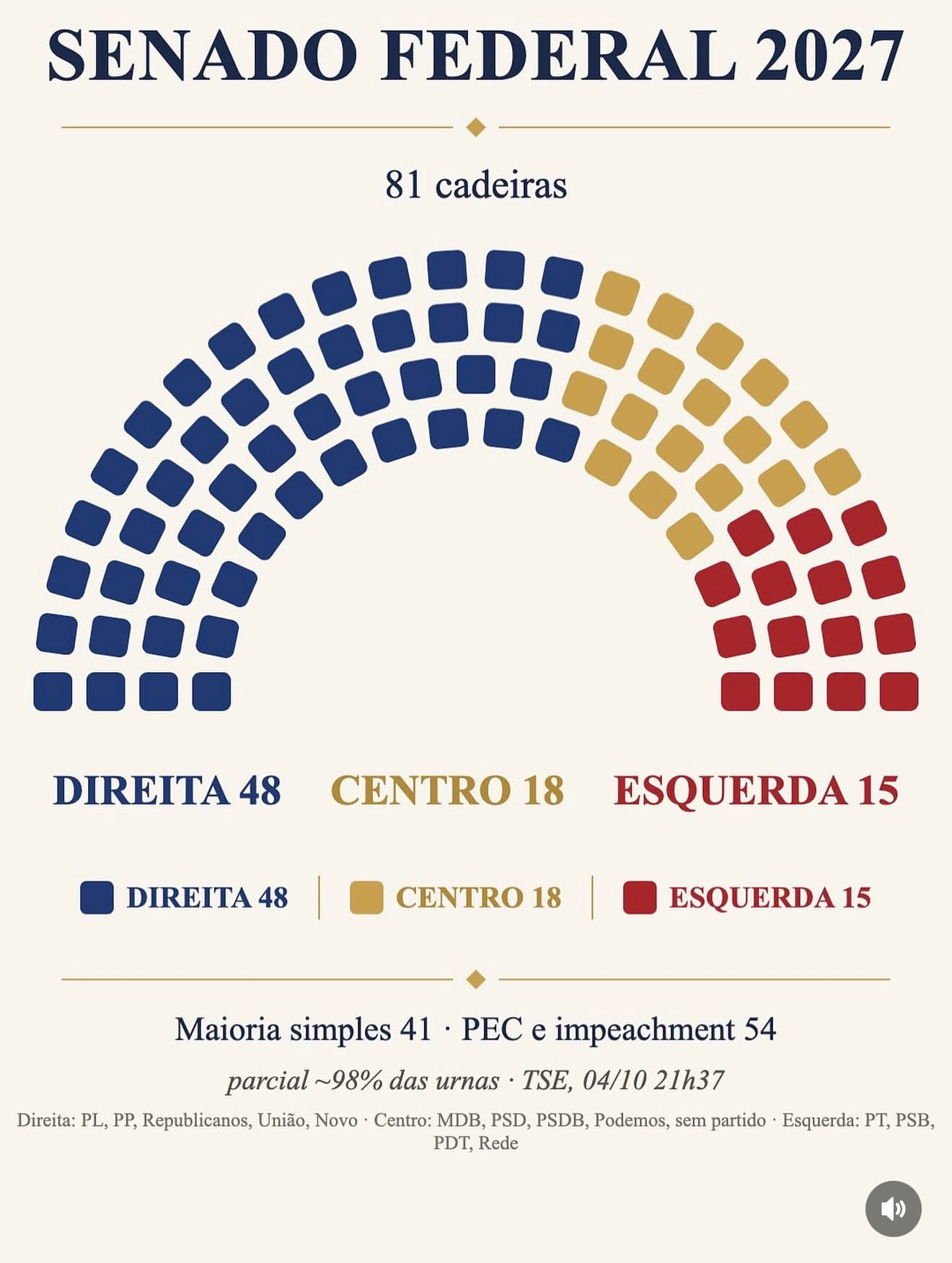
Two seats per state and the Federal District were up, so 54 of the Senate’s 81 seats were contested. The new senators take office in February 2027.
The PL won 19 of the 54 seats, according to GCMais. The outlet said that is the most any single party has won in one election since the 1988 Constitution.
Gazeta do Povo described a “historic right-wing wave” and wrote that the right will hold more than 45 seats in the upper house starting in 2027. GCMais’s projected 2027 composition puts the PL at about 28 seats, followed by the PT with 9, the MDB with 8, and the PP and Republicanos with 6 each.
Notable winners:
- Federal District: Michelle Bolsonaro and Bia Kicis, both PL. Michelle is the former president’s wife.
- Santa Catarina: Carol de Toni and Carlos Bolsonaro, both PL. Carlos is the former president’s son.
- São Paulo: Guilherme Derrite (PP) and André do Prado (PL).
- Rio de Janeiro: Carlos Portinho and Carlos Jordy, both PL.
- Paraná: Filipe Barros (PL) and Deltan Dallagnol (Novo), the former anti-corruption prosecutor.
- Rio Grande do Sul: Sanderson (PL) and Marcel van Hattem (Novo).
- Minas Gerais: Domingos Sávio (PL), the top vote-getter, and Marília Campos (PT).
- Goiás: Gustavo Gayer (PL), 24.73%, and Gracinha Caiado (União Brasil), 21.61%.
The left-wing PT won six of the 54 seats, according to Exame’s list: Rui Costa and Jaques Wagner in Bahia, Humberto Costa in Pernambuco, Marília Campos in Minas Gerais, Samanda de Lula in Rio Grande do Norte and Rogério Carvalho in Sergipe.
What Comes Next
Whoever wins on October 25 will take office on January 1, 2027. A Flávio Bolsonaro presidency would arrive with a friendly Senate and several allied governors. A Lula victory would mean governing against a Senate in which the right holds a large majority, the toughest legislative position of his career.
Lula’s main advantages are the PT’s grip on the Northeast and the incumbent’s campaign machine.
For Flávio, the question is whether the PL’s down-ballot momentum carries over to his own race.
🚨🇧🇷 | AGORA/BRASIL: Brazil’s right-wing achieves a majority sweep of the Federal Senate — to take control of the chamber for 2027. pic.twitter.com/eLje5oi3NB
— Sociedad Media (@sociedadmedia) October 5, 2026