

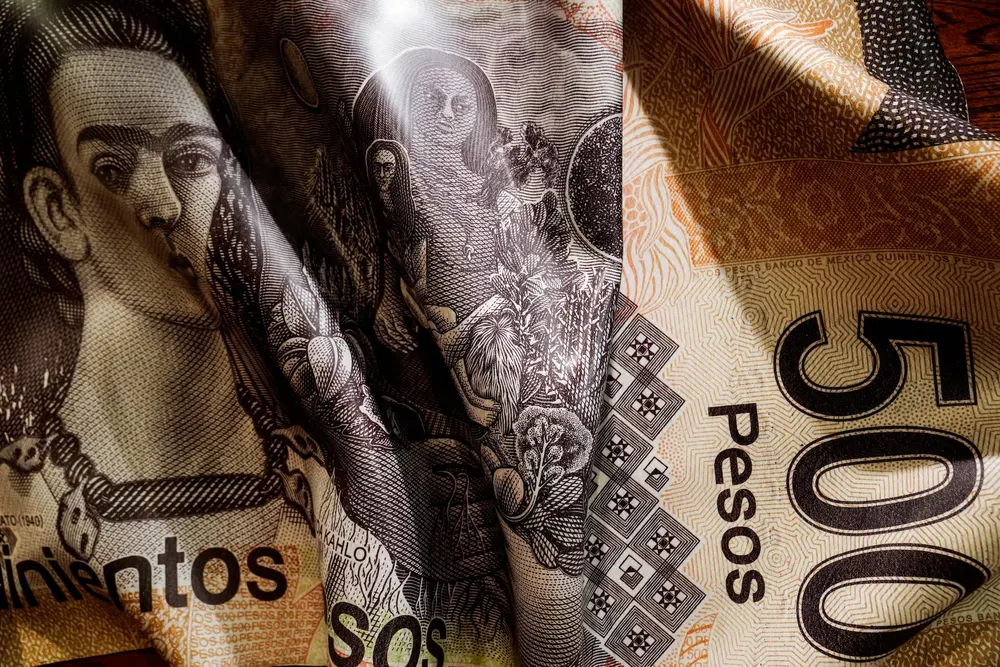
MEXICO — The Mexican peso fell 2.26% against the dollar on Wednesday, its sharpest daily decline since April of the previous year, closing at 18.8456 per dollar in the interbank market. That is the largest drop since a 2.62% fall on April 4, 2025. The move was driven by a stronger dollar worldwide as narrowing interest-rate gap with the United States left the peso more exposed than most currencies.
The dollar strengthened after the minutes of the Federal Reserve’s October meeting, and comments from Fed officials, reinforced expectations of tighter U.S. monetary policy.
According to Forbes México, almost all Fed officials said further rate hikes would be needed if the U.S. economy develops as expected, and a couple warned that persistent inflation could call for an even firmer stance.
The Fed has held its reference range at 3.75% to 4%. CME Group’s FedWatch tool gave a 93% probability of a 25-basis-point hike in December and 7% for a 50-basis-point hike.
Banco Base said the dollar rose 0.43% on its weighted index to its highest level since May 12, and the peso was the most depreciated currency of the session.
Why The Peso Was More Exposed
Higher U.S. rates erode the appeal of what traders call the carry trade, in which investors borrow in low-yield currencies to hold higher-yielding ones such as the peso. Banxico’s surprise 25-basis-point cut on November 5, to 6.25%, had already narrowed that advantage.
Banco Base calculates that the gap between Banxico and the Fed is 225 basis points, its lowest on record.
The central bank signaled it would hold at 6.25% for an extended period, and its meeting minutes are due Thursday. The peso was already under pressure before Wednesday.
Banamex estimated the currency had depreciated about 10% from early September through November 5.
Stocks Fell Too
The pressure extended to local equities. Mexico’s IPC stock index fell 1.75% to 69,154.17 points, its fourth consecutive session of losses after record levels on November 10.
Among individual stocks, Grupo México fell 6.36%, Peñoles 8.37%, Banorte 1.72% and the Bolsa Mexicana de Valores 2.60%. The reports reviewed do not say what drove the sharper declines in the mining stocks.
A weaker peso raises the peso cost of imported goods and of dollar-denominated debt, and it can help exporters that earn in dollars. The overall effect depends on how long the move lasts and how much passes through to prices.
Banco Base sees a path to weakness: if the Fed raises rates by 25 basis points in December and Banxico holds, the gap narrows to 200 basis points.
Under a 50-basis-point hike, the gap falls to 175 and the bank expects the exchange rate to reach 19 pesos per dollar, rising to 19.50 in 2027. That is one firm’s scenario, not a consensus forecast.
Investors are expected to monitor Banxico’s minutes, U.S. data and the Fed’s upcoming meeting in December.