

SOUTH AMERICA — South America is headed for a year of modest growth, with a wide gap between the leaders and the laggards. The International Monetary Fund’s October 2026 World Economic Outlook projects the region to expand about 2.1% in 2026, and Latin America and the Caribbean as a whole by 2.3%, a slight cut from the 2.4% it forecast in July.
Regional Layout
The IMF expects Latin America and the Caribbean to grow 2.3% this year and 2.5% in 2027, down from 2.5% in 2025.
South America alone is projected at 2.1% in 2026 and 2.4% in 2027. The fund’s message is that the region is growing steadily but slowly, with little help from the forces lifting other economies.
Two global factors weigh on the outlook. The war in the Middle East has turned energy into an inflation shock for countries that rely heavily on the commodity like Colombia, with oil about 45% above prewar levels, raising fuel and power costs for households and businesses, and global borrowing costs remain at multi-decade highs.
The IMF also says most of the region is getting little benefit from the artificial intelligence boom: “there is little offset from the technology upturn in most countries.” Although several governments across the region are betting big with investment and development in the new space, i.e. data centers.
Country-By-Country Projections
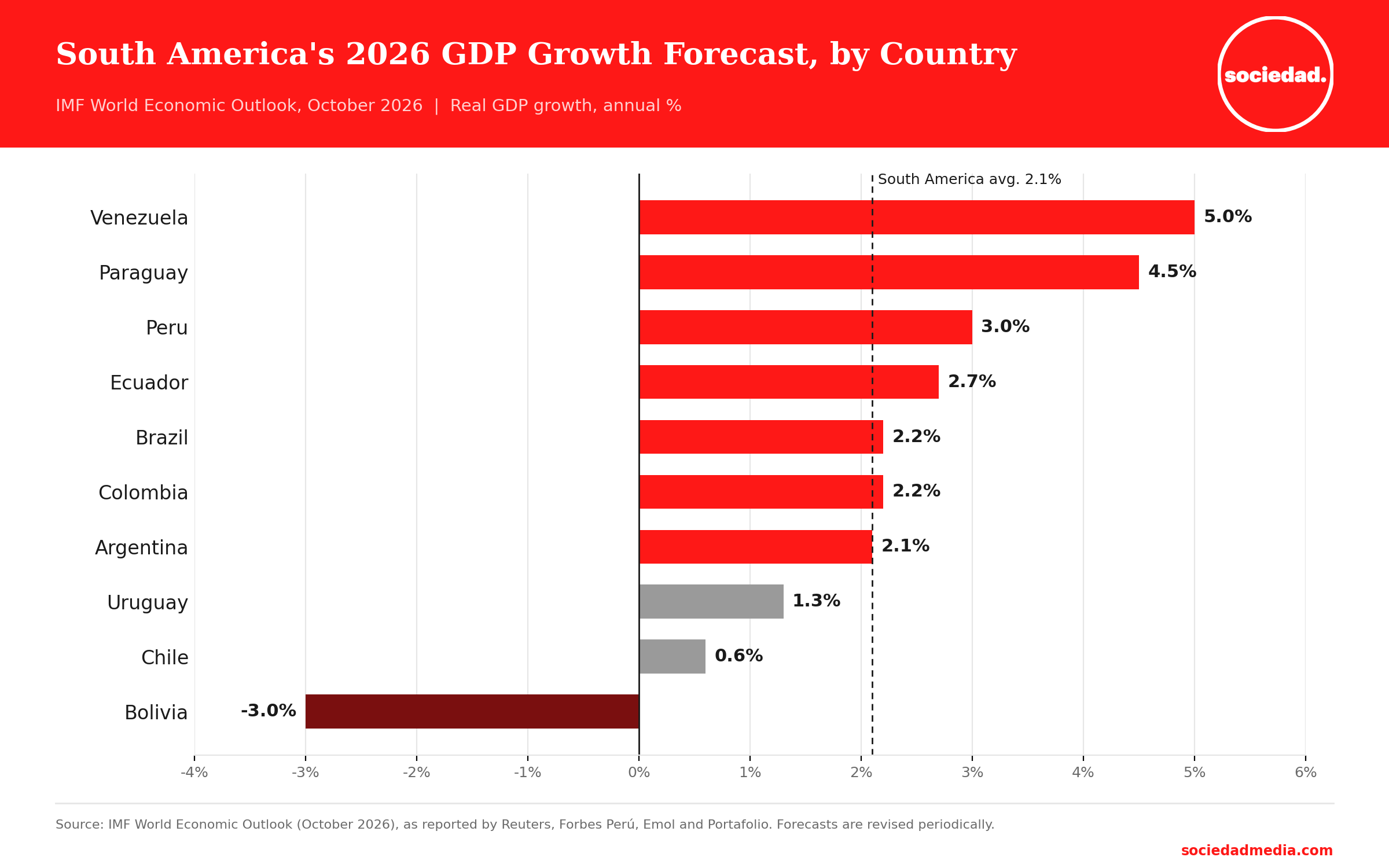
Leaders. Venezuela and Paraguay top the list, and Peru’s forecast was raised to 3.0% from 2.8% in July, the third-highest in South America. Ecuador is projected at 2.7%.
Venezuela’s big boost is undoubtedly increased oil production and significantly more “liquid gold” coming online with U.S. investments.
The middle. Brazil is projected at 2.2% this year, trimmed from 2.4%, and the IMF expects it to slow to 1.9% in 2027 as monetary policy stays restrictive, fiscal support is withdrawn and global uncertainty weighs.
Colombia is also at 2.2%, below the regional average, with a small rebound to 2.3% in 2027. Argentina’s 2026 forecast was cut sharply to 2.1% from 3.5% in July after growing 4.5% in 2025, though the fund expects a recovery to 3.5% in 2027 and inflation falling to 32.5% this year.
Laggards. Chile’s forecast fell to 0.6% from 1.8% in July, reflecting weak mining output and the energy shock, before recovering to 2.6% in 2027. Uruguay is at 1.3%. Bolivia is the outlier, projected to shrink 3.0% after a 1.6% contraction in 2025.
What Separates Winners From Losers
The IMF says the energy shock’s net effect on the region depends on two things: whether commodity exporters’ gains outweigh energy importers’ losses, and how credible central banks’ inflation targets are.
Economies that export energy or raw materials, or that have kept inflation expectations anchored, are better placed. Countries that import fuel, depend on declining mining output or carry heavy fiscal and external pressures fare worse.
Inflation and jobs remain pressure points. The IMF projects Colombia’s inflation at 6.0% this year, up from 5.1% in 2025, with unemployment rising to 9%. Chile’s unemployment is forecast at 9.5%, and Venezuela’s inflation is projected to jump to 467.9% from 252.0%.
Risks... There Are Always Risks
The IMF says risks remain tilted to the downside. A prolonged or escalating Middle East conflict could keep energy and food prices high, and market turmoil could raise government borrowing costs, pressure currencies and tighten financial conditions in emerging economies.
Fiscal vulnerabilities and renewed trade tensions add to the list.
The upside depends on a faster return to stability in energy markets and continued AI investment spilling over to commodity and manufacturing exporters.
IMF projections are snapshots, and the fund revises them several times a year, so figures could be updated. What lasts is the pattern: South America’s growth is moderate, uneven and sensitive to commodity prices, energy costs, inflation and domestic policy.
Country forecasts matter most for what they say about relative strength, which economies are pulling ahead and which are falling behind.