
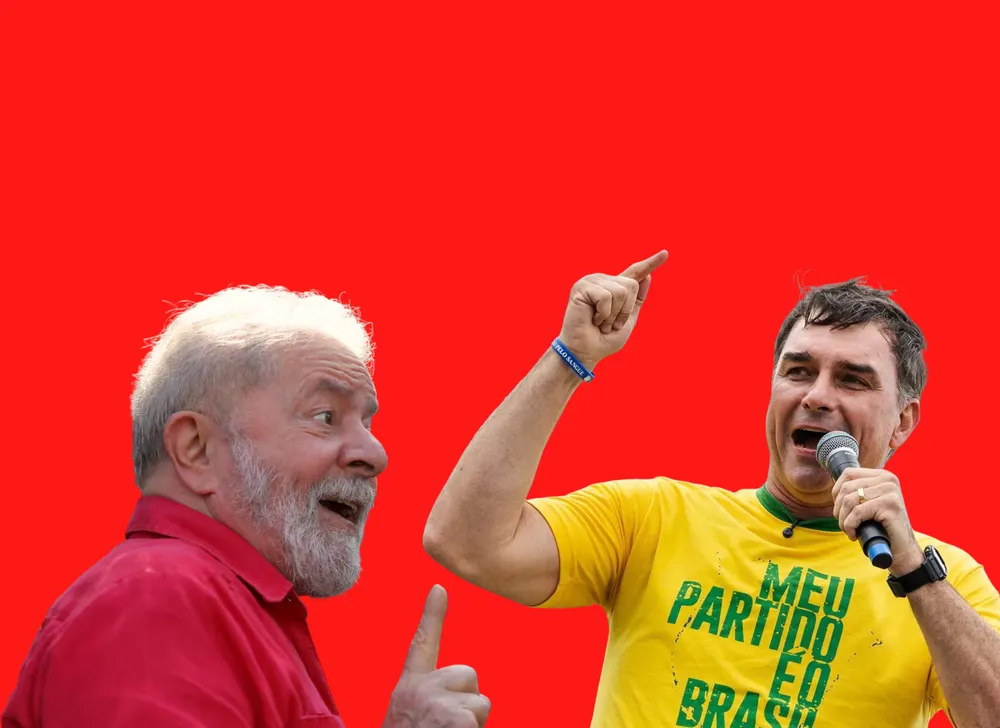
SÃO PAULO — Within hours of the TSE confirming a runoff, the two finalists in Brazil’s presidential race had set the terms of the next three weeks.
Senator Flávio Bolsonaro (PL), who finished first with 47.03% of valid votes, declared “the end of the PT era.” President Luiz Inácio Lula da Silva (PT), second with 45.16%, admitted he had expected to win outright and promised “a new campaign” starting Monday.
The two will meet in the runoff on October 25. Flávio finished about a 1.9 point lead over Lula, with roughly 2.2 million votes ahead in the first round.
Flávio: “The End of the PT Era is Decreed”
Flávio Bolsonaro framed the result as a mandate for change, even though he fell short of a majority. “It was by very little, but I was very happy with the number of Brazilians who went out to the streets, or rather to the ballot boxes, to express themselves,” he said, according to Metrópoles.
“They did not stay home, because they wanted this change.”
His headline line was blunt: “It is the end of the PT era. The end of the PT era is decreed, the change in our country.”
He then drew a personal contrast with the president: “He is concerned with power. I am concerned with the future of Brazil. I am running for Brazil.”
Important themes from Flávio’s remarks also include cutting the number of ministries, a say over Supreme Court appointments, opposition to presidential reelection and criticism of campaign spending.
It is also reported that his campaign would seek endorsements from the defeated center-right candidates for the second round.
Lula: “I Was Convinced I Would Win in the First Round”
Lula spoke in São Paulo alongside Vice President Geraldo Alckmin and allies following the results. He did not hide his disappointment. “I confess I was convinced that we would win in the first round,” he said. Lula added: “The result is often unexpected. You never get everything you wanted.”
He then moved quickly to the runoff. “The runoff is the hour of the ‘proof of nine’,” he said, using a Brazilian phrase for the decisive check of a result. “It is time to show the true picture of Brazil today and the Brazil we want. From tomorrow, we start a new campaign.”
He used sports language to rally supporters. “The game is about to begin, we are in overtime,” Lula said. He said Brazilians like a runoff, adding: “And I am very good at knockouts.”
The president closed with a warning to his opponents: “Bolsonaristas, get ready, because we are going to defeat you... We will win this election.”
Lula also went on the attack. Of Flávio, he said: “On the other side we have only uncertainty, with a dark past.” He called it “a dark biography, with dark connections, with very serious suspicions,” and referred to alleged links to Rio militias, organized crime and the Banco Master fraud scandal. Lula assured that “all of this will become clear.”
On policy, Lula pointed to education, public health, domestic pharmaceutical production, the Petrobras oil discoveries and critical minerals. “We already beat hunger once, we need to repeat it, but it will be through education that we change this country,” he said.
No Comeback Since 1989
Lula’s challenge is historic. Brazil has not seen a presidential runoff comeback since redemocratization. The first-round leader has won every runoff since the first direct presidential election after the dictatorship in 1989:
1989: Fernando Collor led with 30.48% and won the runoff 53.03% to 46.97% over Lula.
2002: Lula led with 46.44% and won the runoff 61.27% to 38.73% over José Serra.
2006: Lula led with 48.61% and won 60.83% to 39.17% over Geraldo Alckmin.
2010: Dilma Rousseff led with 46.91% and won 56.05% to 43.95% over Serra.
2014: Rousseff led with 41.59% and won 51.64% to 48.36% over Aécio Neves.
2018: Jair Bolsonaro led and won the runoff over Fernando Haddad.
2022: Lula led with 48.43% to Jair Bolsonaro’s 43.20% and won the runoff.
Each of those candidates was ahead after the first round. Lula, who finished second in 1989 and lost, led the first round in 2002, 2006 and 2022 and won each time.
This time he is the one chasing.
The pattern is not a law. The 2014 runoff was decided by about 3.3 points, and the 2022 first-round gap was five points, nearly triple the current one. A 1.9-point deficit is the smallest first-round margin on record. The runoff will turn on where the roughly 8% of first-round votes cast for other candidates go, and on turnout among voters who stayed home.