

MIAMI — The split within Venezuela’s opposition over how to handle a political transition became explicit and on-record this weekend.
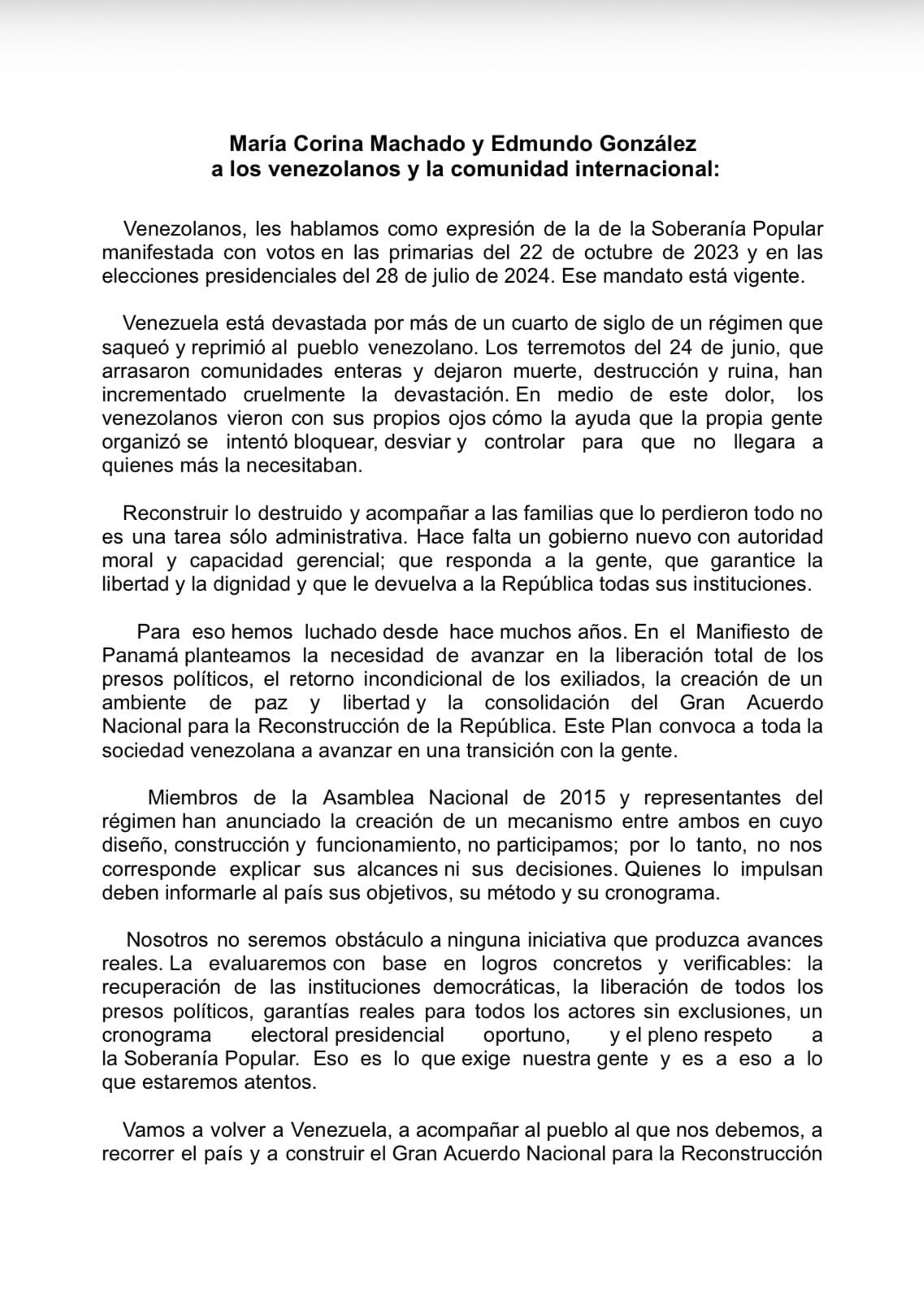
María Corina Machado and President-elect Edmundo González Urrutia announced Sunday, July 26, that they will not take part in the U.S.-backed dialogue process set to begin August 1 between a faction of the opposition and Delcy Rodríguez’s interim government — a process they say was designed entirely without them.
Issued Statement
In a joint statement posted to social media, Venezuelan opposition leaders Machado and González said plainly that the new dialogue mechanism, announced July 14 by Dinorah Figuera, president of the opposition-aligned 2015 National Assembly, and Jorge Rodríguez, president of the Chavista-controlled assembly elected in 2025, was built without their involvement: “Members of the 2015 National Assembly and representatives of the regime have announced the creation of a mechanism between the two of them, in whose design, construction, and functioning we did not participate,” they wrote. “Therefore, it is not up to us to explain its scope or its decisions.”
Crucially, the two leaders stopped short of trying to block the process. They said they would not become an obstacle to any initiative capable of producing verifiable progress toward a genuine political transition, and announced their own intention to return to Venezuela to “accompany the people we owe ourselves to.”
The pair tied their eventual return to a parallel effort they’re calling the “Gran Acuerdo Nacional para la Reconstrucción de la República” — a Great National Agreement for the Reconstruction of the Republic — which they describe as encompassing the release of political prisoners, the return of exiles, and the creation of real conditions for political transition.
Machado also used the statement to reaffirm González’s claim to victory in Venezuela’s disputed 2024 presidential election, which Maduro’s government declared won amid widespread fraud allegations.
A Process Washington Helped Design
The dialogue Machado is rejecting is the same one we’ve covered as it developed: the Figuera-Rodríguez talks that the U.S. Embassy in Caracas publicly welcomed as “an important next step in the political reconciliation process,” part of Secretary of State Marco Rubio’s broader, increasingly hands-on role in shaping Venezuela’s post-Maduro transition.
A report published on July 16 by Venezuelan outlet El Independiente quoted former opposition deputy Américo De Grazia offering a blunt read on why Machado was left out: Machado, he said, had her chance to establish a three-way negotiating channel between Trump, Rodríguez, and herself, and it didn’t happen — so the process is now moving forward through the 2015 Assembly instead.
De Grazia added that “the 2015 Assembly has a mission according to a script established by Washington,” tasked with building an administrative link to the 2025 Assembly to clear away institutional obstacles — a characterization that, if accurate, underscores just how directly the U.S. has been shaping the process’s structure, with or without Machado’s participation.
A Leader Still Negotiating From Exile
Machado’s rejection of this specific process is notable given she had previously expressed her own “determination” to negotiate a transition directly with Rodríguez’s government. That makes this less a rejection of dialogue itself than a rejection of being cut out of designing it.
Machado has been in exile since December, when she left Venezuela clandestinely to collect her Nobel Peace Prize in Oslo, and has since accused Venezuelan authorities of closing the country’s airspace to prevent her return during the earthquake crisis that has killed thousands.
Machado’s renewed pledge to physically return to Venezuela — “we are going back to Venezuela,” she said, echoing previous promises — now carries the added complication of a political process moving forward on terms she has explicitly said she had no part in shaping.
This development sharpens a question that has been building since the Figuera-Rodríguez talks were first announced: whether Venezuela’s transition, as Washington is currently structuring it, produces a genuine democratic opening or a negotiated arrangement between elites — the interim Chavista government and a faction of the pre-existing opposition — that sidelines the political leadership with the clearest electoral mandate against Chavismo.
Machado and González’s decision to stand aside rather than obstruct leaves the August 1 talks free to proceed, but it also means whatever progress those talks produce will need to eventually reconcile with a Machado-González camp that has explicitly declined to be bound by, or take responsibility for, an outcome designed without them.
How Washington, Rodríguez’s government, and the Figuera-led opposition faction respond to that gap — and whether Machado’s own parallel reconstruction agreement gains traction as a competing framework — is likely to be one of the more consequential storylines shaping Venezuela’s transition through the rest of the year.
Sociedad Media is a Miami-based digital news publication covering the latest news & developments across Latin America & their impact on Miami’s Latino community.
For questions, corrections, or tips, contact info@sociedadmedia.com


