

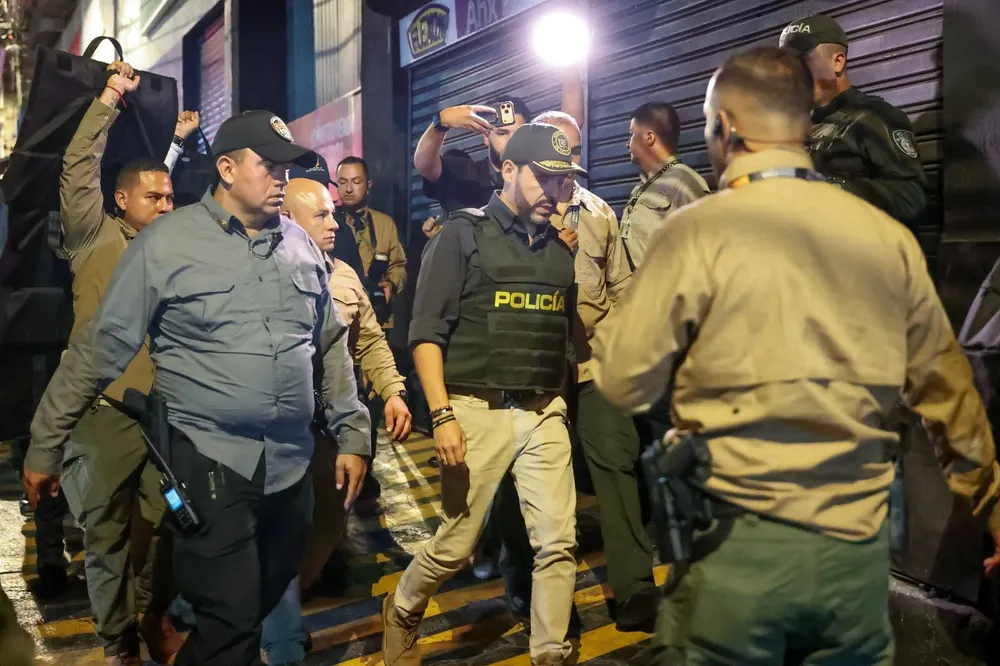
BOGOTÁ — Colombian President Abelardo de la Espriella personally led a large overnight security operation in Bogotá on Wednesday, with authorities reporting 172 arrests and 114 raids. The operation, named “Bosur-Kratos,” focused on crime-ridden areas of the capital, including the central San Bernardo and Santa Fe districts.
Officials say it dismantled 10 criminal gangs.
The operation began in the early hours of October 28, after planning at the Metropolitan Police command the night before. Units left from the police headquarters in El Salitre around 1:30 a.m., with drones and body cameras monitored live from the command center.
President De la Espriella followed the operation from the headquarters and announced the results on X, calling it a success. He said the offensive would continue against criminal leaders, networks and their finances.
Police, the Army and prosecutors took part, and Bogotá Mayor Carlos Fernando Galán credited coordination between the national government and the city after “several months of investigation.”
Preliminary counts were first reported as more than 170 arrests, and the figure was later put at 172.
Results
Authorities seized 11 firearms, three grenades, 72 cartridges and 34 cell phones. They also seized about 2.3 kilograms of marijuana, 130 grams of cocaine, 2.25 kilograms of bazuco (cocaine base), 250 tusi wraps and roughly 10 million pesos in cash.
Of the 172 detainees, 92 face conspiracy charges, 29 drug trafficking, 22 theft and 15 illegal weapons possession. Smaller numbers face charges including personal injury, homicide, feminicide and sexual abuse of a minor.
Suspects will be handed to the Attorney General’s Office for judicial processing.
Officials said the suspects included alleged hitmen, extortionists, robbers and gang leaders, and linked them to about 350 homicides in Bogotá. Brig. Gen. Giovanni Cristancho said one targeted group coordinated homicides, extortion, kidnappings and forced displacement in southern Bogotá. De la Espriella also singled out an alleged gang member known as “Mailo,” accused of a January grenade attack on the Troya Night Club in Santa Fe that killed one person and wounded nine.
These are allegations, and no one has been convicted.
The Neighborhoods
In San Bernardo, specialized police units patrolled streets around a known drug-sale site, the “Olla del San Bernardo,” which has long been associated with micro-trafficking, robberies and fights.
In Santa Fe, officers carried out frisks and business inspections and used drones to watch rooftops. The operation followed community complaints, including reports of a possible hitman office, businesses used for money laundering and a house where torture was alleged. Those claims still require judicial verification.
City councilor Andrés Barrios had requested a joint national and district intervention in the area. He praised the response and asked for investigations into the networks behind the activity and into money laundering, and for protection for informants.
Hours before the operation, De la Espriella said he had authorized “a very important and strategic bombing.” The president said he would give details later. He did not link it to the Bogotá operation, and no details had been released as of this writing.
“Bosur-Kratos” was a law-enforcement operation, not a military one. The targets were urban crime networks and the measure of success is arrests and charges before a judge, and the seizures were mostly small arms, grenades and street-level drugs.
The campaigns against the ELN and FARC dissident Frente 33 require a separate approach — these are in some cases air strikes ordered by President Abelardo de la Espriella and carried out by the military’s special operations command with air force support, aimed at rural camps in Catatumbo, Guaviare and Nariño.
These operations may produce arrests, but in most instances result in combatant camps destroyed and killed, with tolls often preliminary or unclear.
The government has reported five strikes since August, including at least eight ELN dead in Nariño on October 22, and the president announced a sixth on Wednesday, hours before the Bogotá raids, with no target or toll confirmed.
The two strategies share a hands-on presidential style and announcements on X ahead of official figures, but one aims to put suspects before a court and the other to degrade armed groups by force.
¡172 CAPTURADOS EN BOGOTÁ! ¡GOLPE CONTUNDENTE CONTRA LA CRIMINALIDAD! 🇨🇴
— Abelardo De La Espriella (@ABDELAESPRIELLA) October 28, 2026
¡A LOS CRIMINALES NO LOS VAMOS A DEJAR DORMIR TRANQUILOS!
Esta madrugada estuve en Bogotá, acompañando personalmente a nuestra Fuerza Pública en la Operación KRATOS, una ofensiva contra las estructuras… pic.twitter.com/ur2UB16caH