


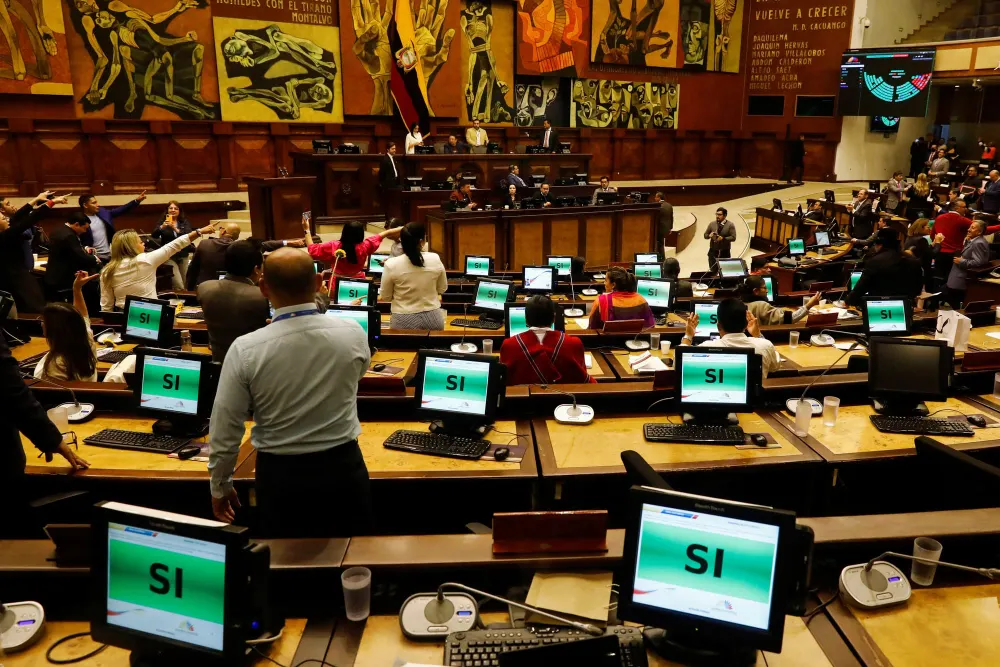
QUITO — Ecuador’s National Assembly approved sweeping legislation on Tuesday that dramatically increases prison sentences for anyone who recruits, uses, or exploits minors on behalf of criminal organizations, gangs, or armed groups.
The measure passed with 88 votes from the ruling ADN (Acción Democrática Nacional) party and its allies, while the country’s largest opposition bloc, Rafael Correa’s Revolución Ciudadana (correísmo), abstained.
The legislation raises criminal penalties for child recruitment from a previous range of 10 to 13 years to a new range of 22 to 26 years in prison. It applies broadly, covering recruitment into organized crime groups, irregular armed groups, and armed forces alike.
The law specifically defines child recruitment as “captación o vinculación a estructuras criminales con fines de instrumentalización” — the capture or linkage of minors into criminal structures for exploitation.
Beyond sentencing, the law gives the state new tools to fight recruitment online, allowing authorities to temporarily block IP addresses, domains, and URLs hosting content that promotes criminal recruitment of children.
The bill was comprehensive by design: it reforms 15 existing laws across 62 articles, touching the penal code, the juvenile justice code, drug-control statutes, and regulations governing health, education, culture, and sports.
It was championed by Vice President María José Pinto and Interior Minister John Reimberg.
Why the Opposition Abstained
Correísmo lawmakers stopped short of voting the bill down, but made clear they see it as insufficient. Legislator Mireya Pazmiño said the party would “exigir que la seguridad empiece por la educación, el arte y el deporte” — demand that security start with education, art, and sports — framing tougher sentencing alone as an incomplete response.
The opposition’s sharpest objection centered on a separate provision shifting oversight at juvenile detention centers away from educational staff toward prison-guard-style security personnel. Legislator Paola Cabezas argued those guards “aren’t prepared” to work with youth populations, warning the change could leave detained minors “easy prey for violence” inside the facilities meant to protect them.
Youth Crisis
The law lands amid a documented surge in child involvement in Ecuador’s organized-crime networks.
According to the National Observatory for Childhood, Adolescence and Youth, more than 2,000 children were detained in 2026 alone for gang-related activity, and the country recorded 305 child homicides in just the first half of the year.
Those figures have made child recruitment one of the most urgent fronts in President Daniel Noboa’s broader security crackdown, alongside the government’s separate efforts targeting gang leadership and prison escapes.
The abstention by correísmo signals a familiar political dynamic in Ecuador: opposition lawmakers are wary of appearing soft on gang violence in a country where public anger over crime runs high, even as the more progressive elements of the nation’s political system prefer social funding in addressing urgent security concerns.