



COLOMBIA — Three days after a 7.4-magnitude earthquake tore through western and central Colombia, the country’s disaster management agency has produced its clearest picture yet of the damage — and the numbers, still climbing, already mark this as one of the deadliest natural disasters in Colombia's modern history.
The Human Toll
According to Colombia’s National Unit for Disaster Risk Management (UNGRD), whose most recent tally was updated on Wednesday, August 12 at 3:00 p.m., the earthquake has killed 241 people, injured 3,771, and left 287 people still missing.
The toll has climbed steadily and somewhat inconsistently since the quake struck Monday morning — moving from an initial count near 20, to 111 by Monday evening, to 132 and then 181 by Tuesday, before crossing 240 by Wednesday, with different official sources (the presidency, UNGRD, and the Association of Colombian Capital Cities) reporting figures that have not always matched precisely as the disaster response continues.
The damage spans 14 departments and 403 municipalities, affecting a total of 24,324 families and 49,214 people, according to UNGRD’s latest figures.
Five cities remain under red alert given the severity of damage: Pereira, Cali, Quibdó, Manizales, and Armenia.
City by City
Pereira, capital of Risaralda department, has emerged as the single hardest-hit city, with a preliminary count of 66 deaths, 37 people still missing, 15 people confirmed trapped, 66 buildings completely destroyed, and 26 more partially collapsed, according to Asocapitales’ tally.
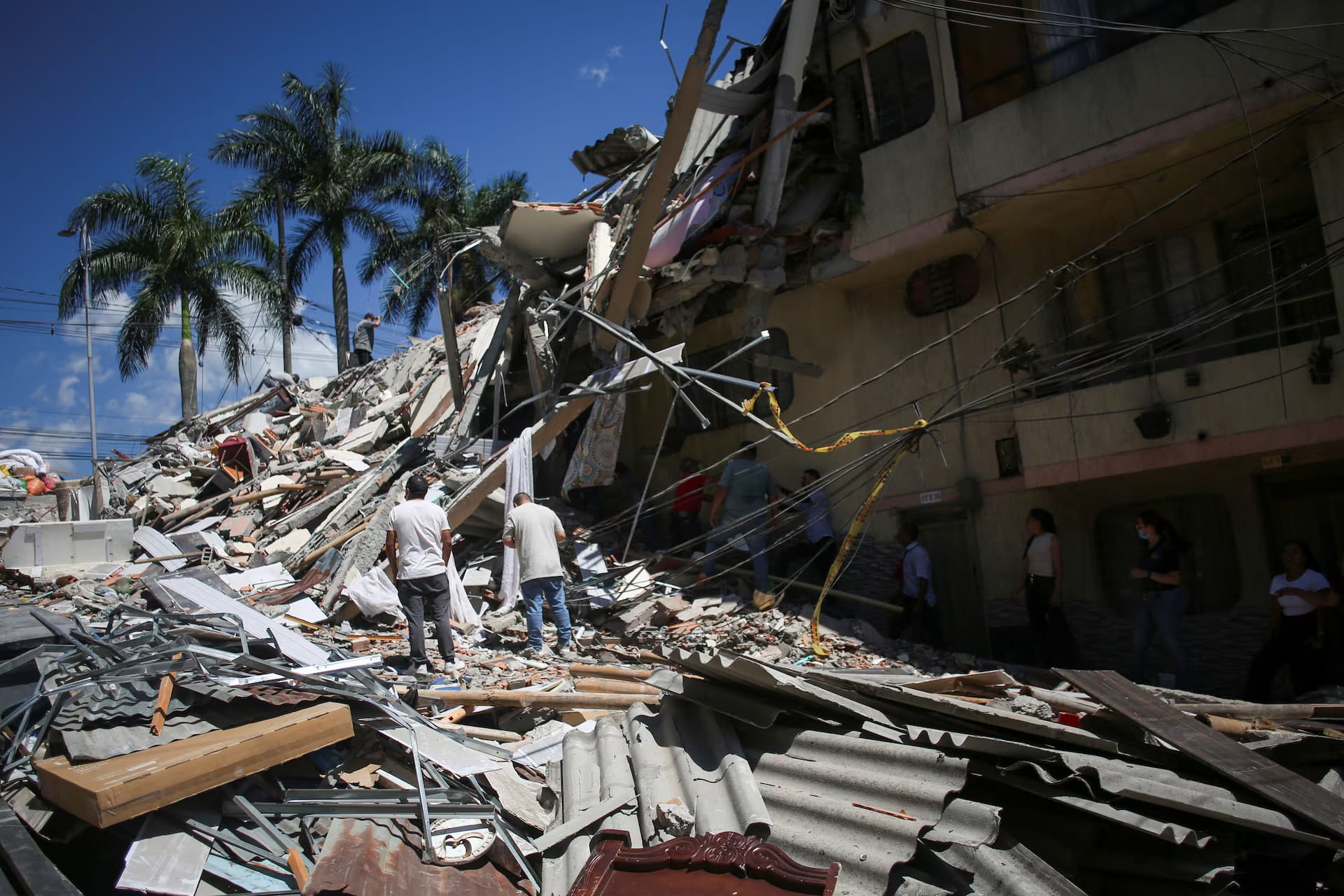
In Cali, capital of Valle del Cauca, authorities have reported 95 deaths, 949 injuries, 239 people trapped, and 180 missing, with entire residential buildings collapsing in the Capri and Limonar neighborhoods.
Manizales reported 4 deaths and 17 total building collapses, along with more than 20 collapsed homes; the city’s landmark cathedral lost its right dome, which collapsed onto the central dome structure. Quibdó, closest to the earthquake’s epicenter in Chocó, reported 9 deaths and more than 80 injuries in the disaster’s earliest hours, with its main airport, El Caraño, remaining out of operation.
Infrastructure Damage
UNGRD’s latest infrastructure count shows 9,215 homes completely destroyed and 45,457 more damaged, alongside 140 collapsed buildings, 1,667 affected educational centers, 530 community centers, and 188 health facilities.
A separate, slightly earlier government figure — cited directly by President Abelardo de la Espriella — put the toll at 1,136 homes destroyed, 8,357 damaged, and 48 collapsed buildings, illustrating how rapidly the assessed damage has grown as more remote areas complete their reporting.
Six airports suffered infrastructure damage and remain closed to commercial flights: Pereira, Manizales, Armenia, Cartago, Buenaventura, and Quibdó’s El Caraño, the last of which also sustained runway damage. Eighteen roads were affected, along with at least 16 water supply systems (acueductos).
Cali’s healthcare network was particularly strained: seven medical care institutions (IPS) remained closed and evacuated as of the most recent health department report, while 25 more were being evaluated for possible structural damage, prompting an orange alert across the city’s entire health network and triggering patient transfers coordinated through the Regional Center for Urgencies and Emergencies (CRUE).
Costs
Early economic estimates vary considerably depending on methodology, but all point toward a multibillion-dollar recovery effort. BTG Pactual, Latin America’s largest investment bank, calculated that Colombia would need approximately 20 trillion pesos (roughly $6.35 billion) just to fund the initial emergency response and first phase of reconstruction — equivalent to about 1% of the country’s GDP.
BTG’s chief Andean economist, Munir Jalil, was blunt about the fiscal reality facing a government whose budget deficit closed 2025 at 6.4% of GDP:
“There’s no question there’s no money," he said, adding that the incoming administration would need to insert previously unplanned reconstruction line items into its 2027 budget proposal.
The U.S. Geological Survey has offered a wider range: with 34% probability, the agency estimates losses could fall between $1 billion and $10 billion, while a separate USGS model places potential damage anywhere from 0% to 7% of Colombian GDP, with a maximum scenario near $40 billion.
For historical context, Colombia’s 1999 Armenia earthquake — its last comparable disaster — cost an estimated 2.2% of national GDP and 35% of the affected region’s GDP, according to XP Investments.
Where the Money Is Coming From So Far
International support has begun arriving alongside the domestic response. The World Bank is set to disburse $450 million through its Catastrophe Deferred Drawdown Option (Cat DDO), a contingent credit line designed for exactly this kind of disaster. The Inter-American Development Bank has made available a contingency credit line of up to $400 million. The Development Bank of Latin America and the Caribbean (CAF) pledged an additional $500,000 for humanitarian needs. The United States announced $15.5 million directed toward emergency shelter, food, protection services, and damage assessment.
Colombia’s government has also indicated it may pursue tax benefits of up to 37% for companies making earthquake-related donations, an incentive aimed at mobilizing private-sector contributions to the response.
Reconstruction Efforts
UNGRD and departmental authorities continue conducting census work across the five most affected departments, meaning both the human toll and the infrastructure damage figures are expected to keep rising as rescue teams reach more remote areas and complete building-by-building assessments.
On the fiscal side, de la Espriella’s government — barely a week into office — now faces the task of incorporating reconstruction spending that was never part of its original budget planning, a challenge complicated by Colombia’s already strained public finances.
Whether the final cost lands closer to BTG’s initial $6.35 billion estimate or approaches the more severe scenarios modeled by the USGS will likely become clearer only as damage assessments continue over the coming weeks.