


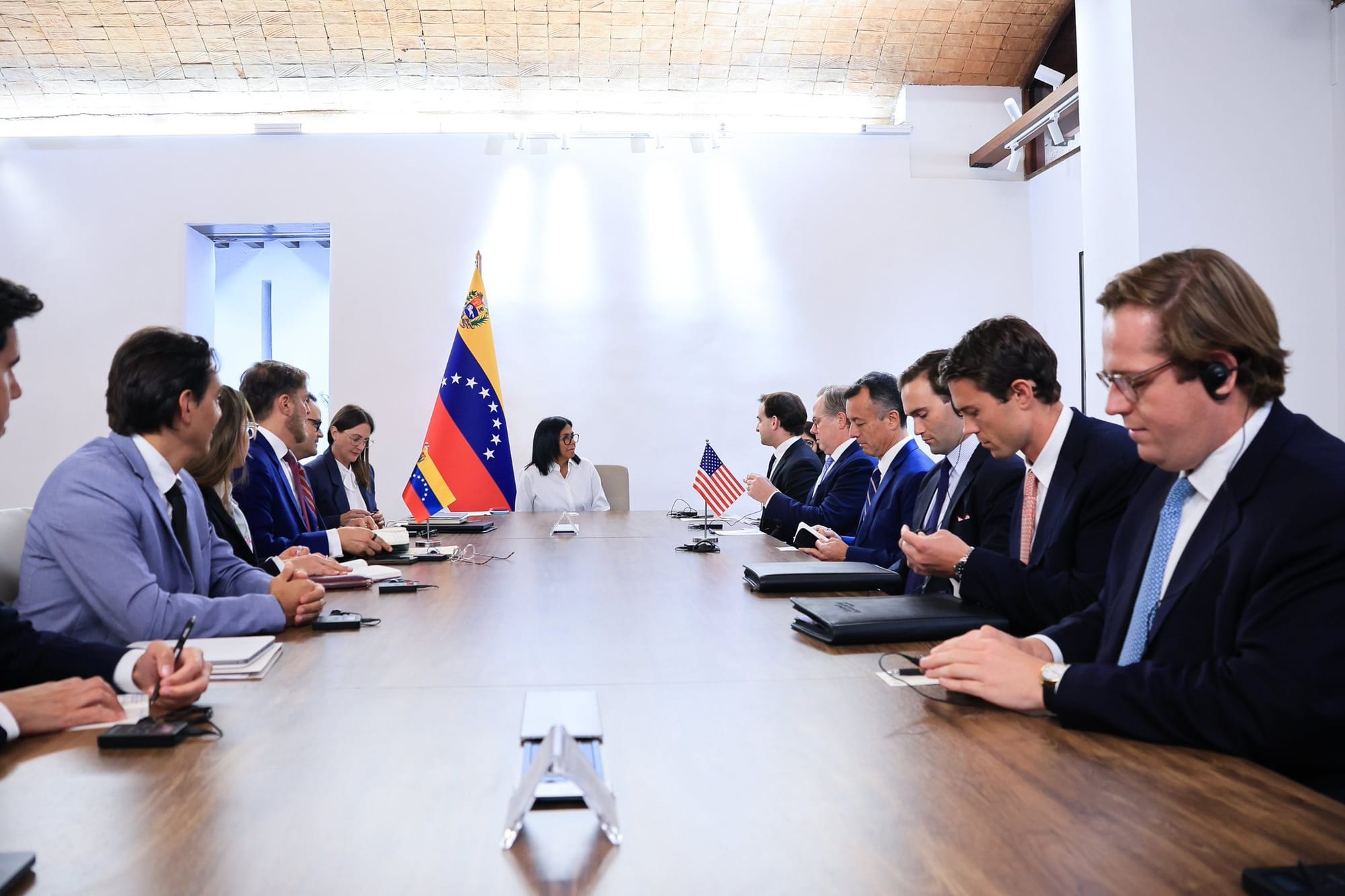
CARACAS — Venezuela’s acting president, Delcy Rodríguez, held a high-level working meeting Monday, August 10, in Caracas with a delegation of senior U.S. Treasury and State Department officials — one of the most direct, visible instances yet of Washington engaging Rodríguez’s government face-to-face since Nicolás Maduro’s capture seven months ago.
Who Was There
The U.S. delegation was led by Jonathan Greenstein, Treasury’s Deputy Assistant Secretary for International Financial Affairs, and Jonathan Burke, Deputy Assistant Secretary for Terrorist Financing.
Venezuela’s presidential press office confirmed the meeting and released photos, but did not name the specific Venezuelan ministers or officials who joined Rodríguez.
What Was Discussed
According to Venezuela’s presidential press office, the meeting focused on evaluating a shared “economic development” agenda and strengthening bilateral relations, with both sides working to “robustecer” — reinforce or strengthen — existing agreements across commercial, energy, and financial sectors.
The two delegations also discussed reactivating financial mechanisms intended to benefit Venezuela’s socioeconomic development and pursuing stabilization of the country’s energy market, though officials offered no further specifics on either point.
TeleSUR’s coverage of the meeting described it as taking place under the framework of what it called “Diplomacia de Paz,” or peace diplomacy.
The Backdrop: An Earthquake & an Eased Sanctions Window
The meeting builds directly on a policy shift the U.S. Treasury announced in July: a temporary easing of certain financial oversight measures, in effect from July 27, 2026, through January 29, 2027, under which the Financial Crimes Enforcement Network will not pursue compliance actions against financial institutions providing authorized services in sanctioned Venezuela.
The measure is explicitly designed to reduce obstacles for U.S. banks and other institutions processing transactions tied to humanitarian assistance, reconstruction, and economic recovery following the devastating double earthquake that struck Venezuela on June 24.
A World Bank assessment has estimated the physical damage from that earthquake at $19.6 billion.
Part of a Broader Pattern of Engagement
Monday’s meeting is not an isolated gesture. It came in the same window as a separate, notable development: Washington publicly welcomed the arrival in Venezuela of opposition figure Dinorah Figuera to begin dialogue with Chavista officials toward a political transition, continuing the negotiating track between Rodríguez’s government and a Washington-aligned opposition faction that we’ve covered as it developed — the same process María Corina Machado and President-elect Edmundo González Urrutia have publicly declined to join.
Taken together, the economic delegation’s visit and the ongoing Figuera dialogue reflect the dual track Washington has pursued with Venezuela since Maduro’s January 3 capture: active, direct economic and financial engagement with Rodríguez’s government on one hand, paired with a separate, parallel push toward political dialogue and an eventual democratic transition on the other — even as no concrete timeline for actual elections has yet been set.
Neither government detailed specific next steps or a timeline for the “reactivated” financial mechanisms discussed Monday.
The meeting adds to a steadily accumulating record of direct U.S.-Venezuela economic contact this year, even as the broader question of the country’s political future, including when Venezuelans will next have the opportunity to vote, remains unresolved.