

BRASÍLIA — President Lula skipped this week’s BRICS summit in New Delhi to campaign at home in southern Brazil, leaving one of the bloc’s five founding members without a head of state present at what analysts are calling one of the group’s most consequential gatherings in years.
Days later, that campaign choice crystallized into its sharpest message: a direct warning to Brazilian voters that their own oil and mineral wealth could suffer the same fate Venezuela’s just did under a new U.S. agreement, unless they keep those resources “in the hands of the Brazilian people.”
According to CNN Brasil, Lula made the decision to skip the September 12-13 summit specifically to prioritize his reelection campaign, opting instead to hold rallies in Brazil’s southern region during the same dates.
Brazil was represented at the summit by Foreign Minister Mauro Vieira rather than the president himself. This marks a deliberate scheduling choice rather than a medical or logistical constraint — a distinction worth noting given that Lula has previously missed a BRICS summit for health reasons, cancelling a 2024 trip to Russia on doctors’ advice after a head injury and participating by videoconference instead.
This time, no such explanation applies: the choice to stay home was about the campaign calendar, full stop.
Why the Empty Seat Stood Out
Lula’s absence drew immediate, pointed commentary from foreign policy analysts. Geopolitical strategist Brahma Chellaney noted that Lula is now the sole sitting head of state remaining from the original 2009 BRIC founding quartet — Brazil, Russia, India, and China — still in office, making his absence from a summit of his own founding bloc unusually conspicuous.
Two newer BRICS members, Saudi Arabia and the UAE, also sent only their foreign ministers rather than heads of state, but neither carries Brazil’s symbolic weight as one of the group’s original architects.
Russian President Vladimir Putin’s attendance, by contrast, reinforced the summit’s geopolitical significance, and India is expected to hand the bloc’s rotating presidency to China at this gathering.
The gap was made more visible by China’s own posture toward Brazil this year: Chinese President Xi Jinping notably skipped July’s BRICS summit hosted in Rio de Janeiro, sending Premier Li Qiang instead, in what regional analysts read as a signal of Beijing’s frustration with Brazil’s reluctance to formally join China’s Belt and Road Initiative.
Warning To Capitalize On Fears Of U.S.
The full political logic behind Lula’s choice became explicit on Sunday, September 13, when he closed out a nationwide day of campaign mobilization with a direct appeal built entirely around Venezuela’s recent experience.
Speaking live on social media, Lula asked Brazilians to consider what the October election actually means for the country’s future:
“What’s at stake is what you want for your country. What future do you want? Do you want a country where the oil is ours, or a country where what happened in Venezuela happens?”
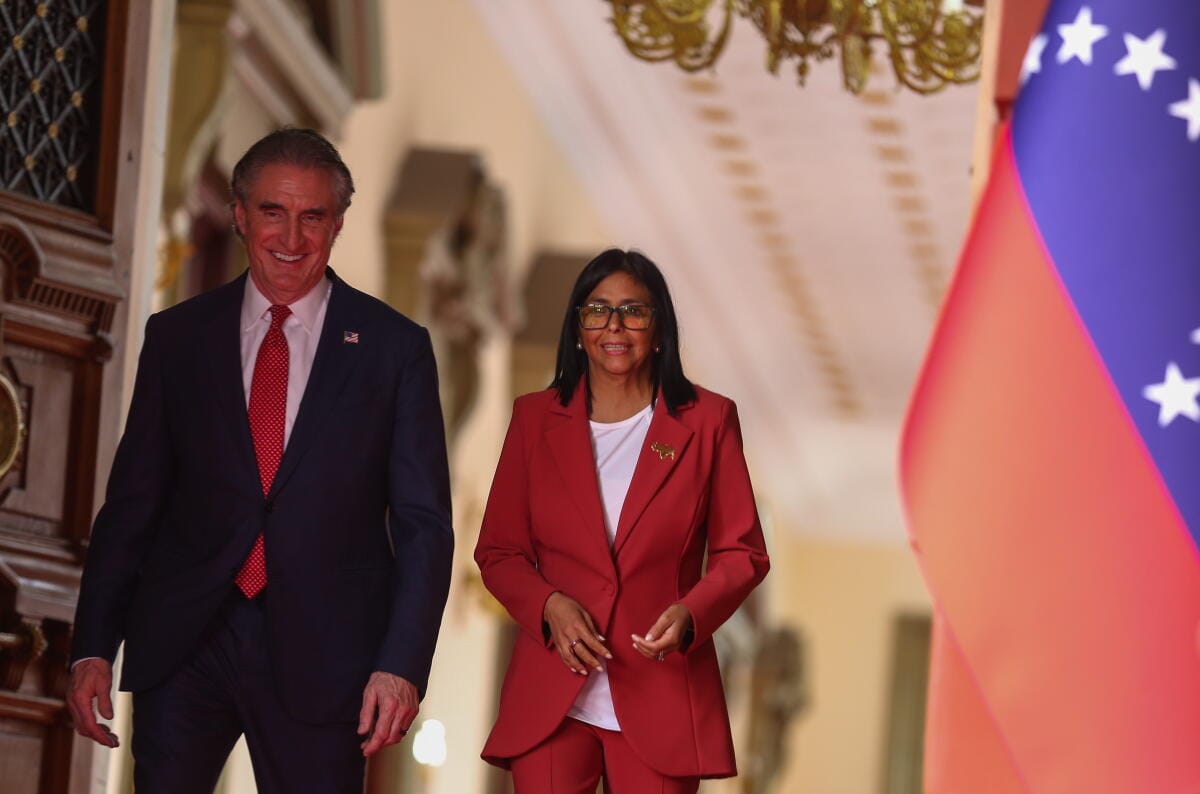
Lula was referring directly to the agreement between Venezuela’s acting president, Delcy Rodríguez, and the Trump administration, under which private companies gained access to roughly one-fifth of Venezuela’s crude reserves through a venture in which the Pentagon holds a 35% equity stake — a deal Sociedad Media has covered in detail as it developed.
Lula extended the warning beyond oil specifically, asking voters to consider Brazil’s critical minerals as well, and closed with his central pitch: that Brazil must remain “a sovereign country, with only one owner: the Brazilian people.”
The message capped a coordinated day of action: the Workers’ Party (PT) organized 1,120 separate campaign activities across cities in 26 of Brazil’s 27 states, according to PT president Edinho Silva, who joined Lula for the livestream.
The scale and coordination of the mobilization suggest the Venezuela comparison was not an offhand remark, but a deliberately planned centerpiece of the campaign’s closing message heading into October.
Taken together, Lula’s BRICS absence and his Venezuela warning form a single, coherent campaign strategy rather than two unrelated events. By staying home from New Delhi to hold rallies in Brazil’s south — a region where conservative and Bolsonaro-aligned support has historically run strong — and then using the following days to frame October’s vote as a referendum on whether Brazil’s own resources stay in Brazilian hands, Lula’s campaign has signaled it sees more electoral value in domestic economic nationalism than in international summitry, even one involving his own country’s founding role in a major global bloc.
The approach also lets Lula sidestep a genuine awkwardness: appearing alongside Russia, China, and other BRICS leaders in the campaign’s final stretch would have offered his opponents an easy opening to question his alignment, precisely as he’s trying to cast himself as the candidate best positioned to protect Brazilian sovereignty from outside interference.
Brazil’s Tightening Race
The Venezuela warning also lands against the broader economic and political backdrop we’ve covered extensively: an economy showing genuine growth and low unemployment, undercut by persistent inflation, a benchmark interest rate near 14%, and a fiscal deficit that breached 7% of GDP in 2025. Just 32% of Brazilians rate the economy as good, and food prices — particularly the cost of picanha, the beef cut that has become informal shorthand for whether Lula delivered on his 2022 promises — remain the emotional center of voter frustration.
Late-August polling showed Lula leading every first-round survey by two to eight points over Flávio Bolsonaro, but runoff simulations between the two men were essentially tied within the margin of error, and AtlasIntel data showed Flávio actually ahead in Minas Gerais, a critical battleground state Lula won by just 0.4 points in 2022.
What’s New Since Our Last Update
The race has continued tightening in the weeks since. Self-help author Augusto Cury has emerged as a genuine third-place surprise, climbing from just 1% support to as high as 11% during August — a development that complicates runoff math for both leading campaigns, since Cury’s late surge could pull first-round votes from either side in unpredictable ways. Flávio Bolsonaro has continued sharpening his own economic message with direct, visceral supermarket comparisons, contrasting current prices with those under his father’s presidency, while facing his own scrutiny over his embrace of El Salvador’s mass-incarceration “Bukele model” as a security platform.
Notably, Lula’s Venezuela-oil framing also arrives against a backdrop of his own government’s more cautious posture on the underlying U.S.-Venezuela standoff: in a December phone call with Trump, Lula reportedly voiced unease about the prospect of U.S. military involvement in Venezuela and pushed for a diplomatic resolution, with officials inside his own government privately attributing Washington’s posture largely to strategic interest in Venezuela’s oil reserves — the same dynamic he’s now invoking as a cautionary tale for Brazilian voters.
With Brazil’s October 4 first round now around the corner and a runoff considered highly likely given the historical pattern of every Brazilian presidential election since 2002 going to a second round, Lula’s decision to skip BRICS and instead spend the final week building a sovereignty-and-resources message appears to have been a deliberate bet: that warning Brazilians about U.S. dominance and hegemony, and fending off Venezuela’s fate resonates more powerfully with undecided voters than a diplomatic appearance in New Delhi ever could.
Whether that bet pays off, or whether the empty seat at BRICS and the Venezuela comparison both fade into background noise against inflation and higher food prices as the dominant issues of the campaign’s final stretch, will become clear over the next several weeks as both campaigns enter their closing arguments.


