

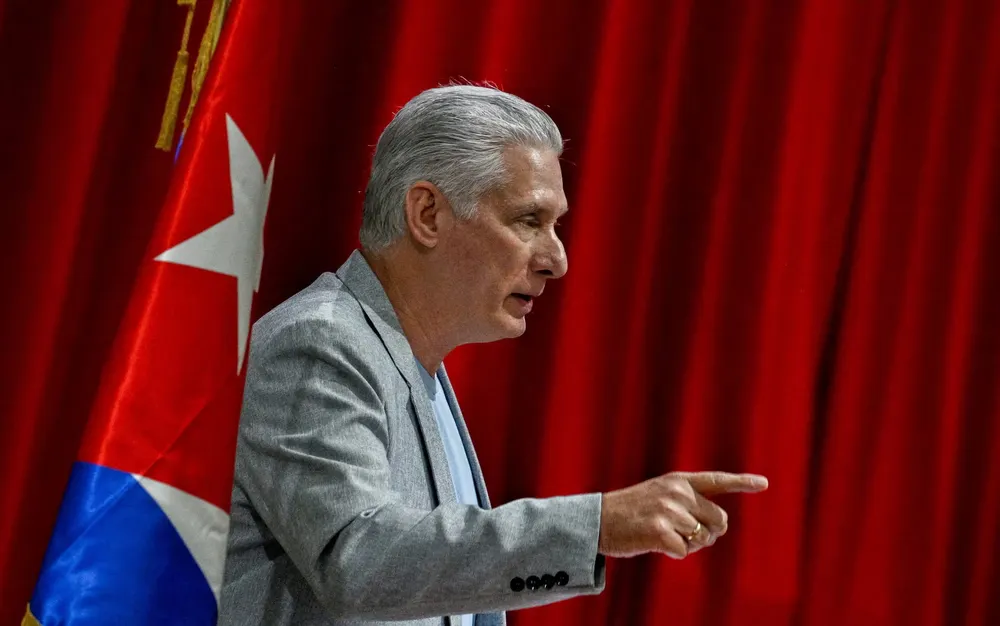
MIAMI — Cuban President Miguel Díaz-Canel used the 25th anniversary of the September 11, 2001 attacks to accuse the United States of practicing “state terrorism” against Cuba, and carrying out a policy of genocide against the island, invoking a quote by the long-time dictator Fidel Castro from the day of the attacks.
In a statement marking the anniversary, Díaz-Canel wrote:
“A quarter of a century after the September 11 attacks, the words of Fidel from that day take on renewed relevance,” before quoting: “I believe that this such unusual event should serve to create the international struggle against terrorism, but... the international struggle against terrorism is not resolved by eliminating one terrorist here and another there; by killing here and there, using similar methods and sacrificing innocent lives. It is resolved by putting an end, among other things, to state terrorism and other repulsive forms of killing, putting an end to genocides, and loyally following a policy of peace and respect for moral and legal norms that are ineludible.”
Díaz-Canel then applied that framework directly to Cuba’s present situation:
“Cuba, which has suffered for over 60 years various types of terrorist attacks with a toll of more than 3,400 dead and 2,099 injured, today faces a genocidal plan to subdue the people through hunger. That too is terrorism, state terrorism.”
The statement made to symbolize a reference to the U.S. economic embargo and sanctions regime, which Havana has long characterized in similar terms.
Un cuarto de siglo después de los ataques del 11 de septiembre, cobran renovada actualidad las palabras de #Fidel aquel día: "Creo que este hecho tan insólito debiera servir para crear la lucha internacional contra el terrorismo, pero..."
— Miguel Díaz-Canel Bermúdez (@DiazCanelB) September 11, 2026
1/4 pic.twitter.com/k8E6qfq585
Hours after the attacks, Castro addressed the nation from Havana’s Ciudad Deportiva, expressing condolences for the victims and offering Cuban medical assistance to help treat the wounded, also using the tragedy to further the Cuban government’s foreign policy agenda of Latin American resistance against “U.S. hegemony,” and to shaping public opinion following the 9/11 attacks.
Díaz-Canel’s statement is not a departure from the long-held sentiments of the former Cuban dictator, but a continuation of it by asserting prolonged victimization of U.S. imperialism even as the Cuban people remain among the most oppressed populations in the world.
Rubio Condemns Latin American Left
During a three-country Latin America tour, U.S. Secretary of State Marco Rubio remarked while in Quito, Ecuador that left-wing governments have devastated the countries they’ve controlled across the hemisphere. Asked whether he was concerned that U.S. policy in the region might fuel a resurgence of left-wing movements, Rubio responded:
“Left-wing groups have already been here. And they have destroyed the hemisphere. The left destroyed Venezuela. The left destroyed Cuba. The left destroyed Nicaragua. The left has basically destroyed every country they’ve gotten hold of in the hemisphere.”
Rubio went further, tying left-wing governments in the region directly to organized crime: “These left-wing groups are, in fact, allied with these drug trafficking criminal organizations. They are aligned with them. They are their allies.”
Shortly after those remarks, Cuban Foreign Minister Bruno Rodríguez accused the United States of attempting to “rewrite the history of the hemisphere” — writing on social media that “the destructive trajectory of American imperialism and its alliance with the region’s most reactionary governments is well written and documented.”
Cuba’s government separately accused Washington more broadly of “imperialism” in the wake of Rubio’s comments.
U.S. officials, on the other hand, including Rubio, have instead pointed to decades of internal governance, administrative “incompetence,” public corruption and economic policy under Cuba’s single-party socialist rule as the root cause of the perpetuation of internal crises and destitution on the island of Cuba — a framing Rubio has repeated on multiple occasions this year, as the administration in Washington continues to push the regime in Havana to adopt more extensive democratic reforms.