
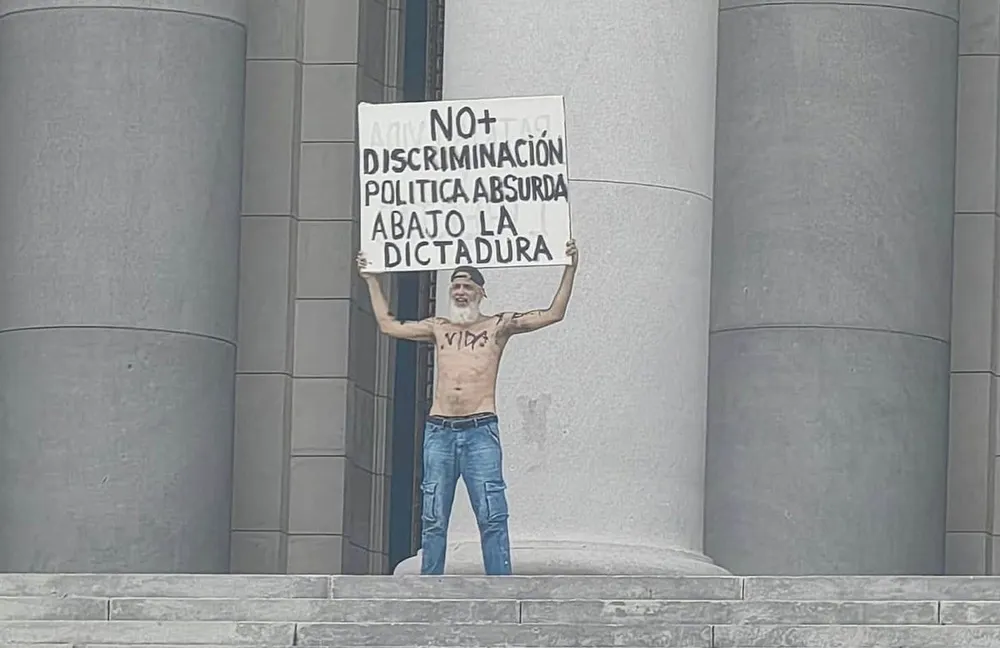
HAVANA, CUBA — Cuban-born Ariel Limias Leyva, a 52-year-old former Assembly of God pastor and painter at Havana’s San José fair, climbed the steps of the Capitolio in Old Havana shirtless on Friday, October 2, holding a hand-painted, double-sided sign. One side read “No + discriminación, política absurda, abajo la dictadura” (“No more discrimination, absurd politics, down with the dictatorship”); the other read “patria y vida y libertad” (homeland, life, and freedom), a direct rebuttal to Cuba’s national state motto created by Fidel Castro in 1960, “Patria o Muerte” (Homeland or Death) (later changed to “¡Patria o Muerte, Venceremos!” (Homeland or Death, We Shall Overcome!)/
Limias Leyva was swiftly approached by state authorities, detained and held overnight for interrogation at a police station on Dragones Street in Old Havana.
On Saturday morning, he was transferred to Villa Marista, the State Security facility in Havana long used to detain and interrogate government critics.
His wife, Yulia Morales, said he remains incommunicado while under interrogation by political police.
The protest came one day after a Cuban court sentenced content creator Anna Bensi and her mother to two years of restricted freedom, a ruling widely seen as the immediate trigger for his demonstration.
Morales told reporters the two had discussed the risks beforehand: “Lo hablamos, sabíamos las consecuencias, pero su sentido de justicia es mucho mayor que el riesgo” — “We talked about it, we knew the consequences, but his sense of justice outweighs the risk.”
This is not Limias Leyva’s first act of protest; he previously demonstrated in April and July of 2021 and was fined on both occasions. Observers have drawn comparisons to Luis Robles, another Cuban who was imprisoned for more than four years after a similar solo sign protest and was ultimately forced into exile — a precedent that underscores the potential consequences Limias Leyva now faces.
Crackdowns Continue Despite Diplomatic Contacts
Limias Leyva’s detention comes as the United States and Cuba remain locked in an uneasy standoff that has included intermittent diplomatic contact but no resolution.
Secretary of State Marco Rubio said in late September that Washington remains open to engaging with Cuban officials willing to pursue “an irreversible path towards a better future” and whose “hands are not stained with blood” — language widely read as linking any opening to human rights conditions.
Cuba’s government has publicly denied any active negotiations, with Foreign Minister Bruno Rodríguez stating flatly that “Havana and Washington are not negotiating,” even as President Trump has floated the idea of a dramatic change in the island’s political and economic trajectory.
The diplomatic freeze has coincided with intensifying U.S. economic pressure, including an oil blockade, energy supply restrictions, and new rounds of secondary sanctions imposed throughout 2026.
Cuban officials say the embargo cost the island’s economy a record $8 billion between March 2025 and February 2026, contributing to severe blackouts and fuel shortages across the country.
Yet even amid that economic strain — and whatever diplomatic signals pass between Washington and Havana — cases like Limias Leyva’s demonstrate that the Cuban government’s tolerance for public dissent at home has not softened, with ordinary citizens who speak out still facing swift detention and transfer to State Security facilities like Villa Marista.
🚨🇨🇺 | AHORA/CUBA: Ariel Limias Leyva, de 52 años y expastor, subió descamisado las escaleras del Capitolio en La Habana este viernes con un cartel que decía “No + discriminación, política absurda, abajo la dictadura” / “patria y vida y libertad.”
— Sociedad Media (@sociedadmedia) October 3, 2026
Fue detenido, interrogado… pic.twitter.com/e016sePjo8