



Two Pacific-facing Latin American governments are on the Asian stage this week with different problems to solve and a shared goal: keeping their Asian partners close. Peru’s Keiko Fujimori is looking for investment, new markets and help against a coming El Niño, while Mexico’s Claudia Sheinbaum is selling a $432 billion investment plan to Asia-Pacific businesses while managing a tense trade relationship with China and pressure from Washington.
Both leaders are in Shenzhen for the APEC leaders’ summit, and both met Chinese President Xi Jinping on Tuesday.
Peru: Investment, Markets & El Niño Relief
Fujimori framed her trip in three parts. She said she would pursue a high-level agenda “to strengthen our relations, promote investment, open new markets, and secure support and cooperation in the face of the El Niño phenomenon.” She considers the last item urgent enough that she is skipping events tied to Pope Leo XIV’s visit to Peru:
“I would never think of snubbing Pope Leo XIV... but given the circumstances the country is going through, and with the El Niño phenomenon, it is also essential to participate in APEC meetings.”
China has been Peru’s top trading partner since 2014, when it displaced the United States. A protocol updating the bilateral free trade agreement took effect on November 1.
In her meeting with Xi, Fujimori said Peru would offer Chinese companies an “open and stable” business environment and invited them to increase investment, while Xi proposed using the updated free trade agreement to consolidate cooperation in infrastructure, energy and natural resources, and to explore renewable energy and artificial intelligence.
She also cited the Chancay port’s “significant role” in Peru’s economic development, and Xi said the port helps boost economic exchange between Asia and Latin America.
The tangible result was El Niño aid: she thanked Xi for “valuable support of 22.5 million dollars, between resources and machinery,” that will contribute to Peru’s efforts against the phenomenon.
Fujimori’s Shenzhen schedule also includes a working lunch with Chinese businesspeople and a visit to a technology center.
Japan
Fujimori is due in Tokyo on the night of November 19, with her main meeting being with Prime Minister Sanae Takaichi, followed by the planned signing of cooperation documents on disaster risk management, information and communication technologies, agriculture, education and critical minerals.
The visit marks the tenth anniversary of the strategic partnership between the two countries. Peru is also trying not to be forced into a choice between Washington and Beijing: Fujimori has said Peru “will not get into the fight” between the two superpowers.
Mexico: Plan México & Careful Balance
Sheinbaum’s trip is her first official visit to China as president, and the agenda is centered on investment. On Tuesday she presented a $432 billion portfolio of investments for 2024–2030 to more than 1,000 business leaders from APEC’s 21 economies, covering energy, transport, housing and industrial development.
Economy Minister Marcelo Ebrard said she was one of the main speakers at the APEC Business Advisory Council. Before leaving, the Presidency said one goal was to learn from Chinese experience with smart hospitals, the circular economy, waste transformation and new energy sources.
Beyond the Chinese partnership, the trip is part of a push to diversify Mexico’s economic relations, and Mexico is due to host APEC in 2028.
The China relationship is the delicate part. Mexico approved tariff increases of up to 50% in 2025 on products from countries without free trade agreements, including China, a move meant to boost domestic production but one that affects trade with Beijing, one of Mexico’s main suppliers.
Before the trip, Sheinbaum said trade would not be the central topic and that closer ties with China would not hurt Mexico’s negotiations with Washington. She also ruled out negotiating a free trade agreement with China.
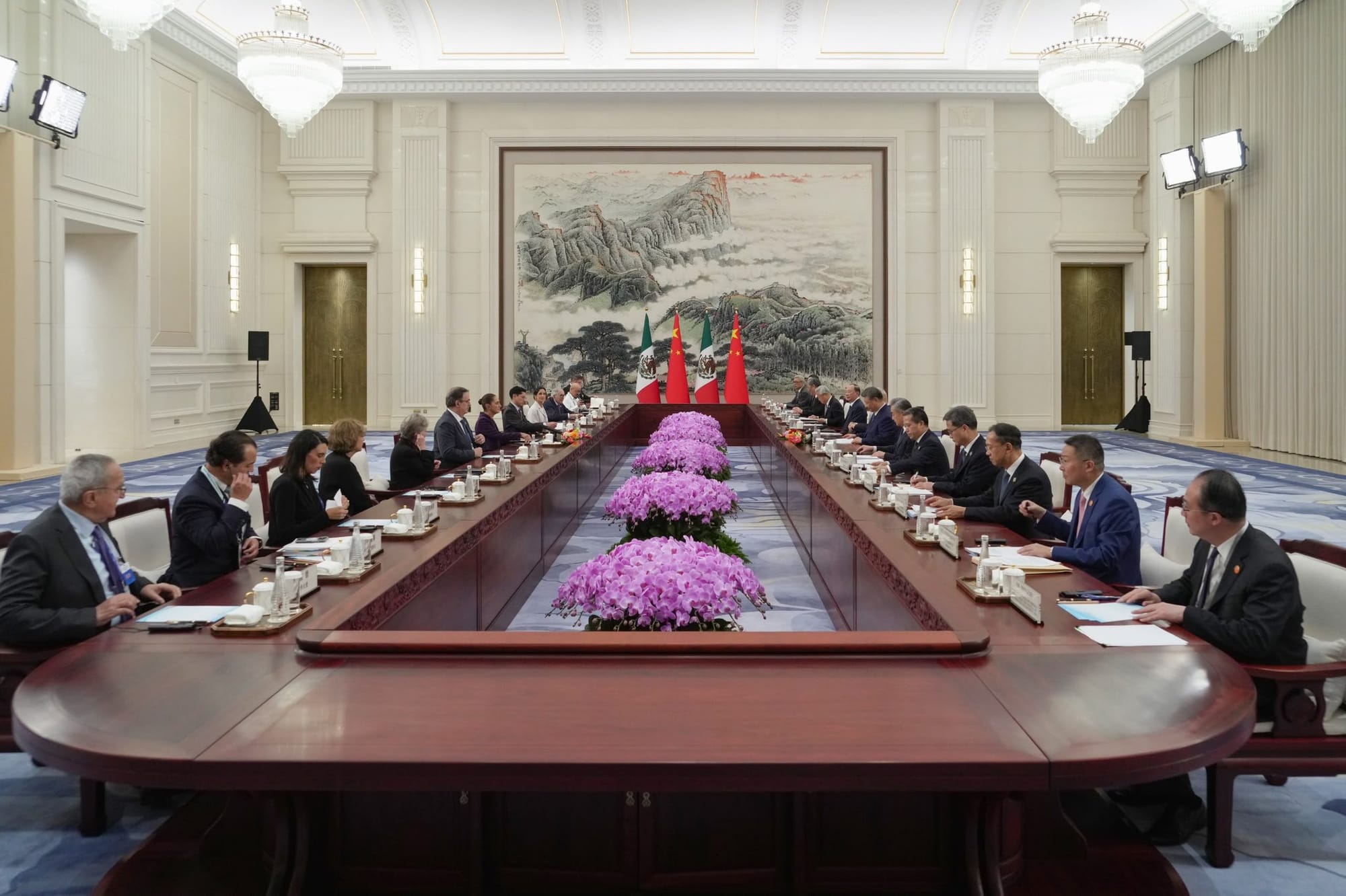
In the Xi meeting, Mexico proposed strengthening cooperation in trade, investment, manufacturing, artificial intelligence, agriculture, water resources, health and tourism, and Xi proposed raising relations “to a higher level,” with deeper cooperation on infrastructure, technology and clean energy.
Both governments will give institutional continuity to previous agreements, but no specific new agreements were detailed. Sheinbaum also covered her North American flank, meeting Canada’s Mark Carney, with both reaffirming their commitment to renewing the USMCA.
The leaders’ side meetings add to the picture. Sheinbaum and Fujimori are scheduled to meet on Wednesday, after a diplomatic rupture that suspended Peru–Mexico relations for a year. That meeting is less about Asia than about a shared Pacific agenda, including the Pacific Alliance and disaster cooperation.
Sheinbaum has also said she will have a brief meeting with Donald Trump, after earlier ruling out a meeting in China. She described it as a “very brief, bilateral meeting” with Mexican government sources estimating 10 to 15 minutes. Her topics were not specified, but tariffs, the USMCA review and border pressure are in the background.
For Peru, the question is whether the Shenzhen and Tokyo visits turn into concrete El Niño aid and investment before the weather hits. For Mexico, it is whether the investment pitch produces commitments from Asian firms without straining its relationship with Washington.
Neither government has said it is choosing between partners, but both are testing how far they can broaden ties with Asia while the United States presses its own agenda.
Reunión con el presidente Xi Jinping y su gabinete. Hablamos de una nueva era de cooperación para el desarrollo en las relaciones México-China. pic.twitter.com/ucrYYb7BSe
— Claudia Sheinbaum Pardo (@Claudiashein) November 17, 2026