
MIAMI — Cuba’s longest-serving foreign minister made an unusually candid admission about his own tenure this month, even as his government presented a record accounting of economic damage from the U.S. embargo and continued rejecting any suggestion that its economic reforms might extend into genuine political change — a combination that offers a useful snapshot of where Cuba’s prospects for democratic transition actually stand heading into the fall.
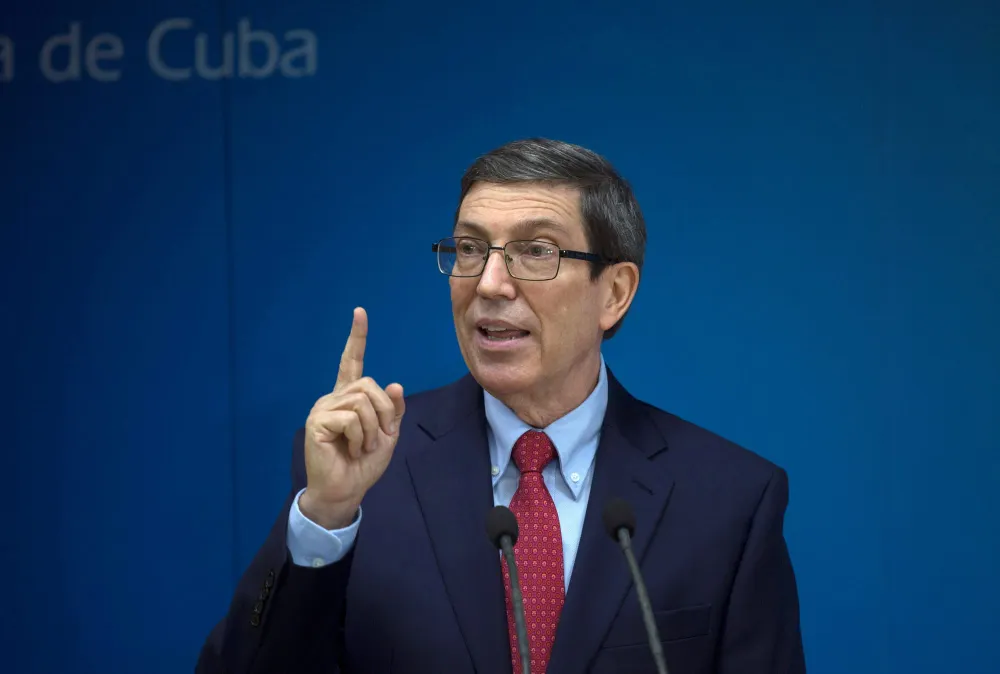
Foreign Minister Bruno Rodríguez Parrilla, in a September 3 interview, acknowledged that he has held his post for too long — and said capable younger officials exist within Cuba’s diplomatic corps who could perform the role even better than he has.
Rodríguez, 68, has led Cuba’s Foreign Ministry (MINREX) since March 2, 2009, when Raúl Castro appointed him following the ouster of his predecessor, Felipe Pérez Roque.
Over nearly two decades, Rodríguez has served under both Raúl Castro and Miguel Díaz-Canel, and personally participated in the negotiations that restored U.S.-Cuba diplomatic relations under Barack Obama and Raúl Castro, hosting Obama in Havana in March 2016 — the first visit by a sitting U.S. president to Cuba in nearly 90 years.
Notably, Rodríguez stopped short of announcing any actual resignation or transition timeline. The remark reads less as a concrete political signal and more as a rare personal reflection from a government not otherwise known for public introspection about its own leadership continuity — a distinction worth keeping in mind for anyone reading it as evidence of imminent change at the top of Cuba’s diplomatic apparatus.
Denying a Crisis While Describing One
In separate remarks this month, Rodríguez explicitly denied that Cuba faces a humanitarian crisis, arguing that Cuba’s population is deeply supportive of one another — even as he went on to describe deteriorating conditions across electricity, water supply, food preservation, transportation, and healthcare.
Most strikingly, he cited Cuba’s own infant mortality data: a rate of 4 deaths per 1,000 live births in 2018 that climbed to 9.9 per 1,000 by 2025 — more than double in seven years.
“They are children, not numbers. Deaths that shouldn’t have happened,” Rodríguez said. The juxtaposition — denying a humanitarian crisis while citing a doubled infant mortality rate without acknowledging evidence of the island’s deterioration of public services — captures a broader pattern in how Cuba’s government discusses its own conditions: acknowledging genuine hardship in specific, data-driven terms, while resisting the broader “crisis” framing that might invite questions about internal governance rather than external blockade.
A Record Damage Report
On Monday, September 7, Rodríguez presented Cuba’s annual report on embargo damages to the diplomatic corps accredited in Havana, along with national and international press.
The report calculates $8.0833 billion in damages at current prices between March 1, 2025 and February 28, 2026 — a figure Cuban officials describe as a record, representing more than a 7% increase over the previous year’s report.
Rodríguez tied the increase directly to developments specific to 2026: two executive orders Trump signed in January and May designating Cuba a threat to U.S. national security, and what Rodríguez described as a “cerco petrolero” — an oil blockade comparable to a naval blockade — aimed at preventing petroleum shipments from reaching the island.
He cited more than 7,000 shipping containers of food, medicine, and hospital supplies seized abroad as a direct consequence of that policy, and said the embargo’s daily impact on Cuba now exceeds $900,000. Rodríguez characterized the policy in the starkest terms available to him, calling it a “coldly calculated plan of collective punishment” and, in a separate public statement the same day — a silent genocide.
What’s Changing Economically — and What Isn’t Politically
The embargo report and Rodríguez’s remarks arrive alongside continued implementation of the 176-measure economic reform package Cuba’s National Assembly approved in June, which has expanded private banking, currency exchange, and small and medium-sized private enterprise on the island.
But that economic liberalization has consistently stopped at Cuba’s political system’s edge. President Díaz-Canel has repeatedly and explicitly rejected any characterization of these changes as capitalist reforms, telling Brazilian outlet Folha de S.Paulo in an August interview that “no hay reformas capitalistas” — there are no capitalist reforms — and describing the changes instead as “necessary concessions” within an ongoing process of socialist construction that the Communist Party guarantees will not produce what he called “capitalist restoration.”
Rodríguez’s own framing throughout his recent public statements has followed the same pattern: extensive, specific acknowledgment of Cuba’s economic and infrastructure hardships, paired with no indication whatsoever that political liberalization forms any part of the government's response.
Reading the Signals Together
Taken as a whole, September’s developments suggest a government managing a genuinely difficult moment through candor about hardship rather than through any opening toward political pluralism. Rodríguez’s admission about his own tenure, whatever its ultimate significance, occurred alongside — not instead of — a doubling down on the government’s core positions: that the embargo, not internal governance, remains the primary driver of Cuba’s crisis, and that economic adjustment, however extensive, will not extend into the political domain.
That combination leaves Cuba’s prospects for any near-term democratic transition essentially unchanged from where they stood earlier this year, even as the specific severity of the country’s economic and demographic crisis — documented in the same period by record embargo-damage figures, a doubled infant mortality rate, and a historic decline in births we've covered separately — continues to deepen.
With no transition timeline attached to Rodríguez’s comments, no political reforms attached to the ongoing economic liberalization, and Washington’s sanctions pressure continuing to escalate rather than ease, the coming months are unlikely to produce a meaningful shift in Cuba’s governing structure.
What they are likely to produce, based on the pattern established this month, is continued detailed public accounting from Cuban officials of the human and economic costs of the current standoff — an accounting that increasingly serves as evidence for both sides of the underlying dispute: proof, for Havana, of an externally imposed humanitarian toll; and proof, for Washington and Cuba’s diaspora communities, of a governing model whose internal management remains entirely off the table for genuine reform.