

MIAMI — El Salvador has sent 100 special forces personnel to Haiti to help find four Salvadoran aviation technicians who disappeared after a gang attack on their armored vehicle, and a second group of about 100 soldiers was expected to follow Thursday night, according to Salvadoran officials.
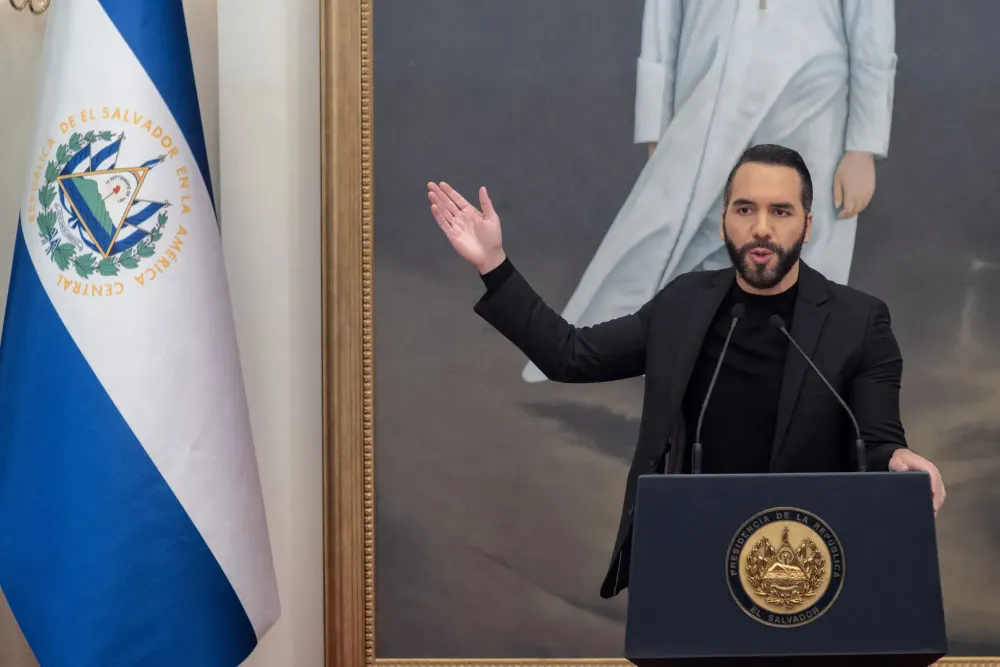
President Nayib Bukele announced on Wednesday that El Salvador had launched a military operation to rescue the four men, without giving details, and warned that his government would respond with greater force if they were not released alive and unharmed.
Addressing the gangs directly on X, he said they should not take his words for empty threats and that El Salvador, having dealt with gangs at home, “can finish with you too.”
Two Salvadoran officials said the first 100 special forces arrived Thursday to lead the search and intensify operations in the area, and one official said another 100 soldiers were due that night. Sources close to the operation described the deployment as “only the beginning.”
Salvadoran authorities are operating on the assumption that the four are alive.
The four men are aviation technicians serving with the U.N.-backed Gang Suppression Force, whose Salvadoran contingent focuses mainly on medical evacuations.
On Sunday, October 19, gunmen attacked their armored vehicle with gunfire and explosives in the Santo area of Croix-des-Bouquets, on the outskirts of Port-au-Prince. The men escaped the burning vehicle and have not been seen since.
It was the first major attack on the international force since it began operating in Haiti last year. Haiti’s government said Wednesday night that the four had been kidnapped, called their release an “absolute priority” and held a meeting at the prime minister’s office to review operations in coordination with the force.
Who is Responsible?
No group has claimed responsibility, and no ransom demand or proof of life has been made public. The area is controlled by gangs including Chèn Méchan, Kraze Barye, led by Vitel’homme Innocent, and 400 Mawozo, led by Lanmo Sanjou.
Both leaders face U.N. and U.S. sanctions.
Unconfirmed reports point to Chèn Méchan with support from 400 Mawozo, but that has not been verified.
Police and the international force have been clashing with armed men in the area, and residents have been told to stay indoors. Residents of the Cul-de-Sac plain describe intense air patrols and a wartime atmosphere.
The attack tests a force that replaced a Kenya-led mission that struggled with limited resources. The Gang Suppression Force has more than 2,000 troops on the ground, with contributions from El Salvador, Chad, Jamaica and Guatemala.
The U.N. authorized up to 5,550 security personnel in 2025, and the Security Council has extended the mission through at least March 2027.
El Salvador’s role was recently widened. In early October, its legislature extended the country’s participation for a year and broadened the mandate beyond medical evacuations to allow civilian and military deployments.
Bukele has said the Salvadoran mission is strictly non-combat and that its contingent includes only pilots and technical staff.
The mission operates in a country where gangs are estimated to control about 70% of Port-au-Prince. The U.N. says more than 5,700 people were killed or injured and more than 230 kidnapped from January to mid-September, and nearly 1.5 million people have been displaced in recent years. Haiti is preparing for its first general election in more than a decade.