


PORT-AU-PRINCE, HAITI — Four Salvadoran soldiers deployed with the international Gang Suppression Force (GSF) are missing after an ambush near Port-au-Prince on Sunday a setback that could test how far President Nayib Bukele is willing to take El Salvador’s role in Haiti’s gang violence epidemic.
What We Know
The attack took place over the weekend, October 18 in Croix-des-Bouquets, a commune about 12 kilometers from the capital, according to EFE, citing Haitian local media. Haiti24.net placed it in an area called Santo. Local reports, relayed by witnesses, say a military and police operation involving military aircraft was deployed as part of search and rescue efforts.
The GSF X account issued a statement late Sunday evening:
“A vehicle carrying personnel from the Gang Suppression Force (GSF) was attacked by suspected gang members today... According to preliminary reports, armed individuals opened fire on the vehicle, prompting an exchange of fire.”
No reports name the gang involved or mention other casualties.
In an official statement, El Salvador’s Armed Forces corroborated the GSF’s account of the incident, stating four Salvadoran aerotécnicos, airmen, with Task Force Libertad II were ambushed by heavily armed criminal groups as they returned to camp in an armored vehicle.
— FUERZA ARMADA (@FUERZARMADASV) October 19, 2026
The attackers used firearms and explosives, the statement said, and the vehicle caught fire, though the four soldiers escaped it. Salvadoran helicopters sent to help forced the attackers back but were hit by gunfire, according to the Armed Forces.
Repeated attempts by land and air to reach the soldiers, coordinated with other countries’ contingents, were blocked by the intensity of the fighting. The task force is working with the Gang Suppression Force command and international forces to establish contact and determine the soldiers’ location, the statement said, adding that the situation is still developing.
The element’s whereabouts are unknown.
A #GSF vehicle came under attack by suspected gang members today in Santo, Croix-des-Bouquets. Personnel responded in accordance with Rules of Engagement, with helicopter support. Security operations are ongoing. Full statement: pic.twitter.com/kb0otTyrtE
— Gang Suppression Force - Haiti (@GSForceHaiti) October 19, 2026
El Día, a Dominican newspaper, initially reported, citing unnamed sources, that five troops may have been kidnapped, that two may be injured, and that support units found the area empty when they arrived.
La República, which republished the report, cautioned that it is preliminary and unverified.
Until officials confirm what happened, “missing” is the safest description.
How Extensive is El Salvador’s Role in Haiti’s Civil War?
By the numbers, El Salvador is a minor contributor, but its role has grown over time.
President Bukele first put El Salvador forward in March 2024, when he posted on X, “We can fix it,” on Haiti’s gang violence. He attached three conditions: a U.N. Security Council resolution, the consent of Haiti’s government, and coverage of all mission costs.
When the Legislative Assembly authorized troops in October 2024, the commitment was narrow. Officials said it was limited to medical evacuations for the UN-backed, Kenyan-led Multinational Security Support Mission, which they described as El Salvador’s area of experience.
Lawmakers did not appear to know how many troops would go.
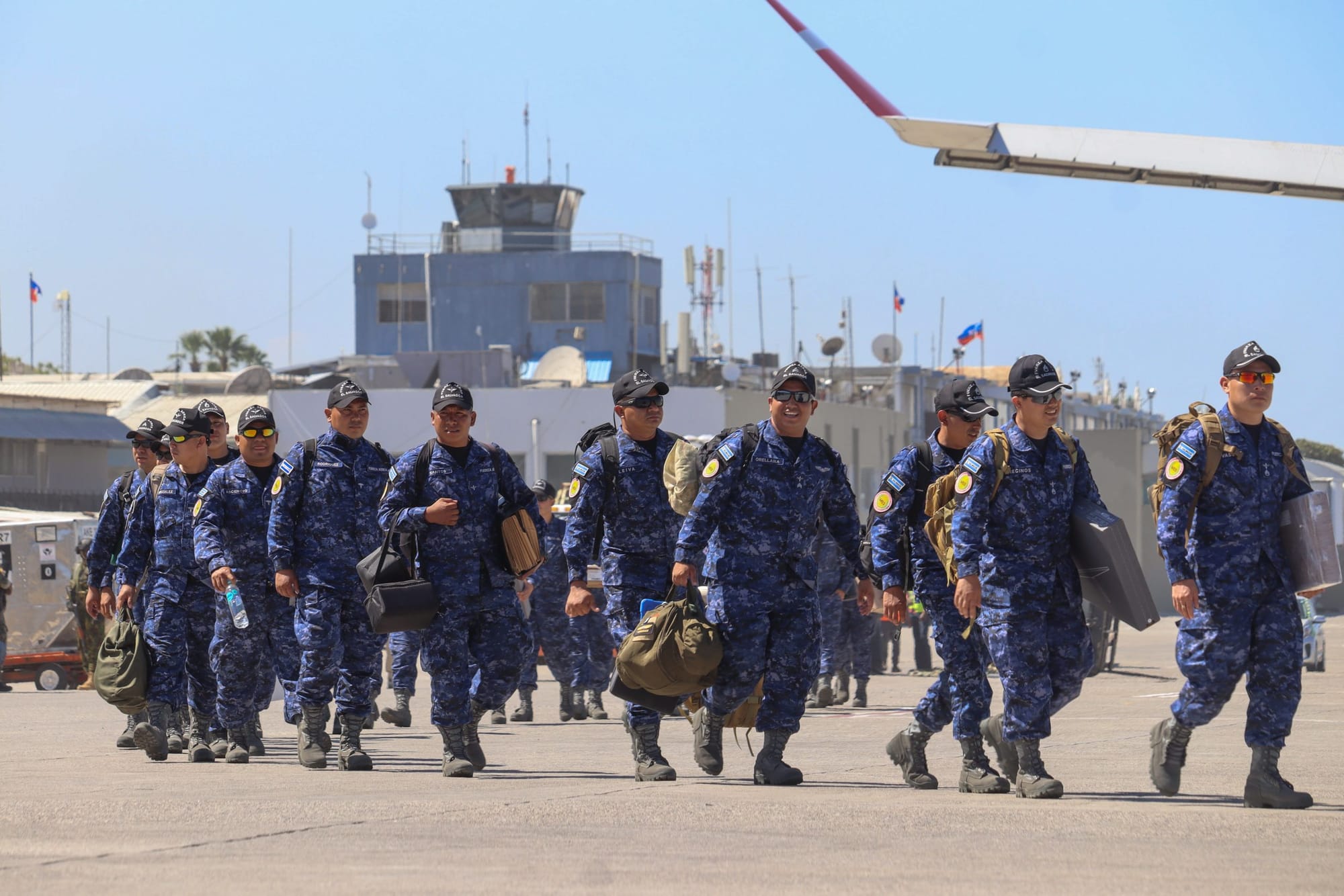
Salvadoran soldiers began arriving in January 2025. A published tally of the mission as of June 2025 listed 78 Salvadoran air force personnel. That is far fewer than Kenya’s 732 police officers and fewer than Guatemala’s 150 military police, though I could not confirm the figure with official data.
The Security Council replaced the Kenyan-led mission with the Gang Suppression Force on September 30, 2025. The GSF is planned to reach more than 5,500 personnel, but U.S. figures cited by Salvadoran media put it at roughly 1,500 today, with plans to reach 4,000.
On September 29, 2026, the Assembly approved a transitional law that broadens El Salvador’s role. It took effect October 2 and runs through October 2027, with possible extensions while the mission continues.
The earlier decree covered only medical evacuations. The new law authorizes aircraft “equipped for specific missions,” protected by other aircraft, and civilian and military personnel “according to the needs of the mission.”
It allows the mission to carry out activities deemed necessary under the Geneva Conventions. It also says Salvadoran personnel cannot be handed over to any international tribunal, entity or state for trial, subject to treaties the country has ratified, and that El Salvador told the United States its armed forces can offer military aid and defense equipment.
The law does not state how many personnel will deploy. It also does not explain what the four missing soldiers were doing in Croix-des-Bouquets, which is a question the government will have to answer.
Their presence on an apparent ground mission outside Port-au-Prince suggests a role beyond medical evacuation.
What it Says About Bukele’s International Ambitions
The commitment is small, but it fits a pattern. Bukele has built his political brand on crushing gangs, and he has sought to present that approach as a model for other countries. His March 2024 offer to “fix” Haiti was an early example. Haiti gives him a stage where he can claim that experience, with limited exposure. His conditions in 2024 would have kept the cost low.
The tight 2024 mandate kept the risk low, and the 2026 expansion is a step up.
The timing also matters. In July 2025, the Assembly, dominated by Bukele’s Nuevas Ideas party, lifted the limit on consecutive presidential terms. In July 2026, the party proclaimed him its candidate for a third consecutive term in the February 2027 election. Contributing to a U.S.-backed mission supports the close security partnership he has built with Washington, which also includes the deportee detention arrangement at the CECOT prison.
That arrangement has been criticized by human rights groups who allege abuses at Salvadoran security facilities. Haiti offers Bukele a strategically favorable image of the Central America nation as a reliable security partner.
The Risk
The missing soldiers raise the stakes, however. Bukele’s pitch relies on an image of control and success. A prolonged hostage situation, or increased deaths among Salvadoran troops, could put that image at risk and would test domestic public support for a mission that Salvadorans may not be familiar with. It would also test the law’s clause protecting personnel from international prosecution.
The first thing to watch is whether the government confirms the soldiers’ status and what they were doing. The second is whether El Salvador expands its Haiti presence or draws back. In either case, Bukele’s response will say more about his international ambitions than the size of the original contingent did.
Social media posts may reflect older information, and could be subject to revisions in later published articles.
🚨🇸🇻🇭🇹 | NEW/SECURITY: Five Salvadoran soldiers from the Gang Suppression Force (GSF) are missing after an ambush on Sunday, October 18.
— Sociedad Media (@sociedadmedia) October 19, 2026
EFE says it happened in Croix-des-Bouquets, a commune about 12 km from Port-au-Prince, citing local Haitian media.
📸 AP pic.twitter.com/Y1GCnBbMCC