

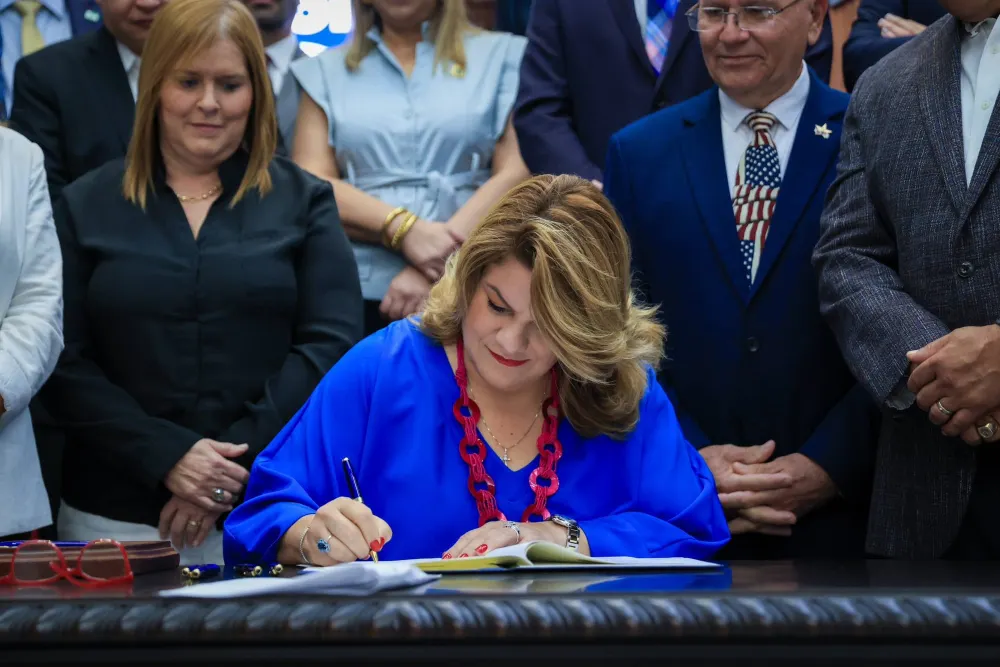
SAN JUAN, P.R. — Puerto Rico Governor Jenniffer González-Colón has put the island’s statehood demand in writing on Friday, signing a joint resolution formally asking President Donald Trump and the U.S. Congress to admit Puerto Rico as a state on equal footing with the other 50 of the union.
The resolution had already passed the island’s Legislative Assembly. Copies, in English and Spanish, go to the president, the Senate president, the House speaker and every member of Congress.
Senate President Thomas Rivera Schatz and House Speaker Carlos “Johnny” Méndez signed it earlier but did not attend the press conference in San Juan alongside the island’s governor.
Petition, Not a Poll
González-Colón, a member of the pro-statehood New Progressive Party, presents the resolution as a step beyond the island’s past status votes. In previous referendums, the results were sent to Washington as an expression of the island’s wishes. This time, she said, the Puerto Rican government is submitting an official petition. Her administration, studying how Alaska and Hawaii reached statehood status in January and August of 1959, respectively.
“It is now up to Congress to heed that will,” González-Colón said.
The petition rests on the island’s referendums in 2012, 2017, 2020 and 2024.
In the 2024 vote, held alongside the November general election, statehood received 620,782 votes, or 58.61% of valid votes among the three options, according to results the State Elections Commission certified. Sovereign free association received 29.57% and independence received a small minority of 11.82%.
The current territorial status was not on the ballot, and the result does not bind the federal government.
The resolution does not change Puerto Rico’s status, and it does not require Congress to act. Under Article IV, Section 3 of the Constitution, only Congress can admit new states. Puerto Ricans are U.S. citizens, but those living on the island cannot vote for president and have no voting representation in Congress.
Local outlet El Nuevo Día reported that the governor does not plan to pursue a new congressional status bill until after the midterm elections. She did not rule out another plebiscite before her term ends. Her next step is to lobby members of Congress.
“I’m not afraid of any national party,” she said, as quoted by El Vocero.
The Obstacle in Washington
The politics of any admission are difficult. President Trump has said he opposes statehood for both Puerto Rico and Washington, D.C. On May 21, he told reporters in the Oval Office that making both states “would be a disaster.” In his remarks, he linked the idea to Democrats gaining control of Congress. He also suggested that scrapping the Senate filibuster could open the way for Democratic proposals such as Puerto Rican statehood, according to EFE.
El Nuevo Día noted that recent status bills have had little Republican support. I found no response from Trump or the White House to the resolution itself.
Washington’s Democrats on the other have floated the idea with a new seriousness recently, with former presidential hopeful Kamala Harris pledging to pack the Supreme Court and admit both Puerto Rico and Washington D.C. as new states once the Democrats take back control of Congress.
Opposition at Home
The island’s other parties were quick to push back on the governor’s measure. Resident Commissioner Pablo José Hernández, who leads the Popular Democratic Party, said, “the status will not change; what has to change are the government’s priorities.” He argues the government should focus on fixing electricity and water service.
Hernández has his own bill in Congress for a four-option plebiscite that would include the current commonwealth status, which the governor criticized as inconsistent.
Juan Dalmau of the Puerto Rican Independence Party called the resolution a “desperate” move to divert attention from scandals in the administration, El Nuevo Día reported.
Several tests lie ahead. The first is the November 3 midterm elections, which will decide the Congress that receives the request. The second is whether any member of Congress files a statehood bill that the resolution can support. The third is whether the governor can rally enough Republicans in Washington, whose votes would be essential, for any statehood possibilities for the island of Puerto Rico.
For now, the petition makes the request official, but it does not guarantee anyone in Washington will act on it.
Hoy, acompañada de legisladores de las delegaciones de mayoría de la Cámara de Representantes y del Senado, secretarios del Gabinete y representantes de la sociedad civil, firmé la Resolución Conjunta 66-2026, una medida de administración que conmemora el 250 aniversario de la… pic.twitter.com/blCLo4S4TS
— Jenniffer González (@Jenniffer) October 16, 2026