

CARIBBEAN — Dominican counter-narcotics authorities, working with the U.S. Drug Enforcement Administration, intercepted a speedboat carrying 595 packages of suspected cocaine off the country’s southern coast on Sunday, September 13, arresting three foreign nationals following an hours-long pursuit at sea.
The Dominican Republic’s National Directorate for Drug Control (DNCD) said it received intelligence about a vessel approaching Dominican shores near Baní, in Peravia province, suspiciously enough to trigger an air, sea, and land tracking response.
After several hours of pursuit, agents intercepted the roughly 32-foot speedboat, equipped with two 115-horsepower outboard motors, several nautical miles south of Punta Salinas beach.
Authorities arrested the three foreign nationals aboard: two Colombian citizens and one Venezuelan.
Stash
Inside the vessel, agents located 24 bales containing the 595 packages of suspected cocaine, wrapped in adhesive tape and marked with a variety of different logos.
Beyond the drugs themselves, authorities seized five fuel tanks and one fuel canister, a GPS device, five cell phones, a Colombian passport, a backpack containing clothing, and other evidence.
The seized packages were sent under standard chain-of-custody protocol to the National Institute of Forensic Sciences (Inacif) for analysis to confirm the exact type and weight of the substance.
Partnership
The interdiction was led by the DNCD, alongside the Dominican Republic’s Navy (ARD) and Air Force (FARD), under the coordination of the Attorney General’s Office (Ministerio Público) and with support from national intelligence agencies.
Air Force communications director Colonel Manuel Gómez said his institution provided aerial support to the DNCD throughout the operation, while Navy communications director Captain Isaac Rodríguez said surface units intercepted the vessel as it attempted to enter Dominican jurisdictional waters.
The operation also drew support from two allied agencies: the Southern Command Joint Interagency Task Force (JIATFS) and the DEA.
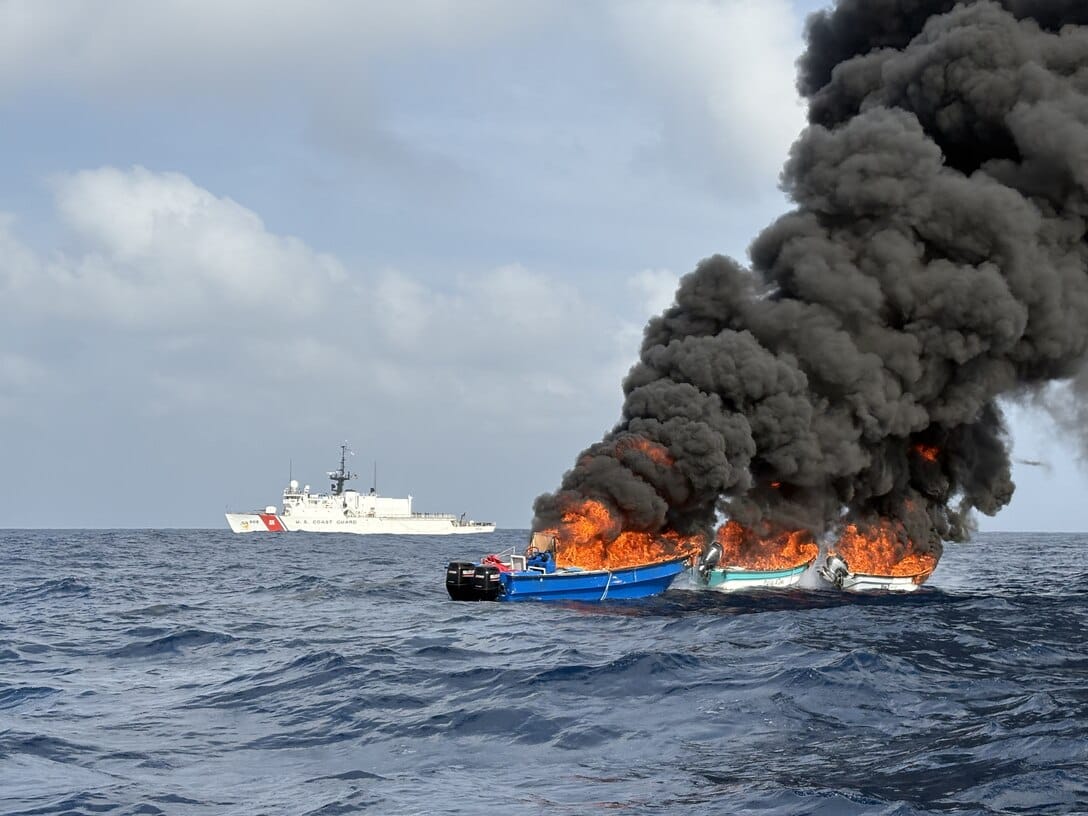
According to the DNCD, the Ministerio Público and drug control authorities are continuing their investigation to determine the shipment’s point of origin and to identify and locate any additional individuals connected to the criminal structure allegedly behind it.
Officials described the group’s typical method of operation as introducing illicit substances into Dominican territory from South America via speedboats — the same pattern reflected in Sunday's interception.
The DNCD noted that Dominican authorities have seized more than 29 metric tons of various illicit substances so far in 2026, through operations conducted at ports, airports, border areas, coastlines, and other points across national territory.
Officials attributed that broader total to sustained interdiction operations and continued cooperation with national and international partner agencies.
The three foreign nationals arrested in the operation remain in custody, at the disposal of the Ministerio Público, for an alleged violation of Law 50-88 on drugs and controlled substances — the Dominican Republic’s principal narcotics statute.
A Corridor Under Sustained Pressure
Punta Salinas and the broader Peravia coastline sit along a well-established maritime trafficking corridor connecting South American cocaine production to onward markets, making this stretch of the Dominican Republic’s southern coast a recurring focal point for interdiction operations throughout the year.
The combined air, sea, and land response deployed Sunday — spanning the DNCD, Navy, Air Force, and coordination with both the Attorney General’s Office and U.S. counterparts — reflects the kind of multi-agency posture Dominican authorities have increasingly relied on to intercept vessels before they reach the coastline itself, rather than attempting to seize shipments only after they’ve already made landfall.
With the seized packages now undergoing formal forensic analysis at Inacif and the broader investigation into the shipment’s origin still open, Dominican authorities say they continue working to identify any additional members of the trafficking network believed to be behind the shipment.
The case adds to the country’s already substantial 2026 enforcement total, and reflects the Dominican Republic’s ongoing, U.S.-supported effort to intercept drug trafficking routes moving through its waters from South America — an effort officials indicate will continue as investigators work to trace this particular shipment back to its point of origin and identify who was meant to receive it.


