


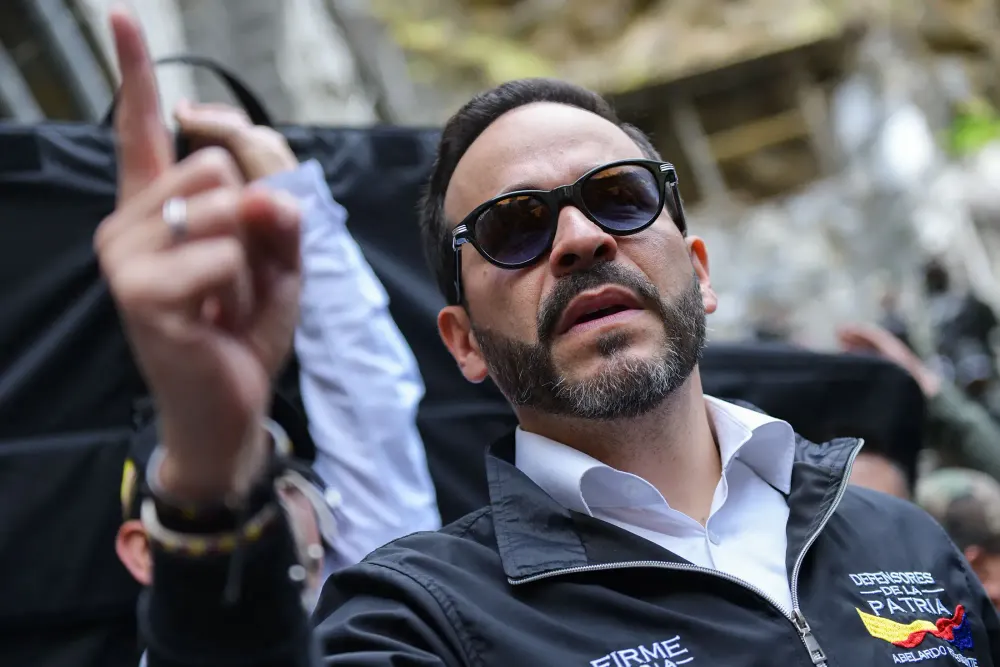
BOGOTÁ — President Abelardo de la Espriella marked his first 36 days in office with a televised address to the nation on Sunday, September 13, laying out nine central points covering Colombia’s fiscal crisis, his security offensive, relations with the United States, and earthquake recovery — a speech that doubled as both a governing report card and an unusually direct set of warnings aimed at his political predecessors.
The Fiscal Crisis
De la Espriella opened by confirming what his own economic team had already flagged earlier in the month: Colombia’s fiscal deficit stands at 7.8% of GDP, with projections showing it could widen to 9.4% as the country’s borrowing capacity nears exhaustion.
The president was explicit about attributing responsibility for that gap to the outgoing Petro administration, saying that in his very first week in office, “Petrismo committed 10 trillion pesos” in spending he characterized as “a massive theft from the public treasury.”
De la Espriella vowed direct consequences:
“I will not leave you in peace, I am coming for every one of you.”
To address the deficit, his government has structured an austerity plan totaling 17.4 trillion pesos in cuts, including nearly 13 trillion in reduced transfers, 3 trillion in cuts to goods and services purchases, and 2.5 trillion in reductions to non-priority investment projects.
Security: The Administration’s Defining Break From Petro
Security emerged as the clearest area of differentiation from the prior government, according to analysis published alongside the address. Where Petro’s “Paz Total” (“Total Peace”) framework pursued negotiations with armed rebel groups, De la Espriella restructured Colombia’s intelligence leadership from his first days in office, dismantled ongoing dialogue tables, and reactivated direct military and police operations against criminal structures.
The government’s stated strategy aims to comprehensively dismantle the finances, infrastructure, and leadership of criminal organizations. De la Espriella backed his security claims with an extensive set of figures covering his first 36 days: more than 17,140 captures by Colombia’s security forces, 24 criminal leaders affected — 19 captured and five killed in operations, including alias “Max Max,” a FARC explosives specialist eliminated in Caquetá — and 73 signed extradition orders.
The biggest target among the killings featured in De la Espriella’s security accounting was that of Naín Andrés Pérez Toncel, alias “Bendito Menor” or “Naín,” the roughly 26-year-old top leader of the Autodefensas Conquistadoras de la Sierra Nevada (ACSN, formerly known as “Los Pachenca”).
Three named military operations anchored the results he presented: Operación Azarías, targeting the Carolina Ramírez front, left 24 fighters dead, six captured, one minor rescued, and 35 firearms seized; Operación Amón, in El Peñol, Nariño, killed seven structure members and captured five more; and a separate action against “Los Orión” resulted in six captures and the seizure of 17,000 detonators and roughly 100 kilograms of explosive material.
Beyond leadership targets, security forces seized 1,761 firearms and 75,613 kilograms of drugs over the same period, while eradicating 1,506 hectares of coca.
De la Espriella also cited a concrete disruption to fuel theft along the Pozos Colorados-Galán pipeline, saying illegally siphoned hydrocarbon volumes fell 24.94% when comparing the last ten days of August to the first ten days of September — a reduction he said kept roughly 652,554 gallons out of criminal hands.
“We’ve hit them where it hurts most” — before declaring: “The era in which the State retreated while criminals advanced is over.”
Washington’s Backing, and a Shift From Prior Tensions
De la Espriella also highlighted a marked change in tone with the United States compared to the diplomatic friction that characterized parts of the Petro era.
Missions to Washington led by Vice President José Manuel Restrepo and Colombia’s economic team have reopened financing channels with development banks and helped restore international private-sector confidence, according to the government’s own framing.
That shift has been reinforced by direct statements of support from President Trump for the Colombian government, emphasizing shared priorities on global security and counter-narcotics cooperation — support that has translated concretely into Colombia’s formal accession to the U.S.-led Shield of the Americas coalition and the $1 billion security assistance package we’ve reported on previously.
Earthquake Recovery: The Crisis That Defined His First Days
De la Espriella’s administration took office just three days before Colombia’s devastating August 10 earthquake, which official National Planning Department figures put at 331 dead, 4,519 injured, 122 missing, and 466,606 people affected across 498 municipalities in 16 departments.
Reconstruction is projected to cost approximately 40 trillion pesos and take five to six years to complete.
The president used part of his address to highlight a September 7 agreement reached in Quibdó between his government and private business leaders, mobilizing more than 2 trillion pesos toward mining, infrastructure, capital attraction, and seed capital for entrepreneurs in earthquake-affected Chocó — an effort his government has framed not simply as disaster relief, but as an opportunity to address structural problems in the region that predate the earthquake itself.
The crisis response, however, was complicated further by wildfires in Tolima department that burned through at least 50,000 hectares and affected 28,000 producers, with five active fire fronts still burning as of September 4.
Corruption: A Promise of “Ordinary Prison” for Offenders
Among the address’s nine points, El Tiempo highlighted a specific and pointed commitment on corruption: De la Espriella pledged that those convicted of corruption-related crimes — whom he referred to pointedly as “white-collar thieves” — would serve their sentences in ordinary prison facilities rather than receiving what he characterized as preferential treatment historically extended to that category of offender in Colombia’s justice system.
University Autonomy & Other Policy Notes
The address also touched on university autonomy as a distinct policy commitment, though De la Espriella offered fewer specifics on that front compared to the fiscal, security, and earthquake-related portions of his remarks — reflecting a broader pattern analysts have noted in his governing style so far, discussed below.
Political analysts consulted by Noticias RCN identified the budget rollout as one of the administration’s clearest early stumbles: despite campaigning on austerity, De la Espriella’s government presented a budget considerably larger than his predecessor’s.
Analysts argued the increase likely reflects a more honest accounting of obligations the state must actually assume, rather than a genuine expansion of spending — but acknowledged the concept was difficult to communicate clearly to the public, and that the government's messaging strategy around it could have been more effective.
The administration also appears to be using the fiscal situation strategically, warning Congress about the consequences of maintaining elevated public spending levels. Separately, Congressman Víctor Manuel Salcedo, whose party has formally aligned with the government, offered a memorable summary of the month: “There’s more president than government” — a generally favorable assessment of De la Espriella personally, paired with reservations about the depth and functioning of his broader governing team.
With Colombia’s fiscal debate now shaping up as a central political battleground between the presidency and Congress, the security offensive continuing at the pace we’ve documented in recent weeks, and Chocó’s earthquake reconstruction just beginning its five-to-six-year timeline, De la Espriella’s second month in office will likely test whether his government can translate Sunday’s nine-point accounting into sustained governing capacity — or whether, as Congressman Salcedo’s assessment suggests, the gap between presidential visibility and functioning government becomes a more persistent theme of his term.