

COLOMBIA — Colombia’s monthlong offensive against its armed groups widened further this weekend, with security forces killing a prominent Caribbean coast criminal leader alongside his girlfriend in Riohacha and seven FARC dissidents in a separate operation in Nariño — even as Colombia’s top military commander revealed in a new interview that much of the ELN and FARC dissident leadership Bogotá is hunting has been hiding across the border in Venezuela for years.
“Bendito Menor” & “La Bebecita” Killed in Riohacha
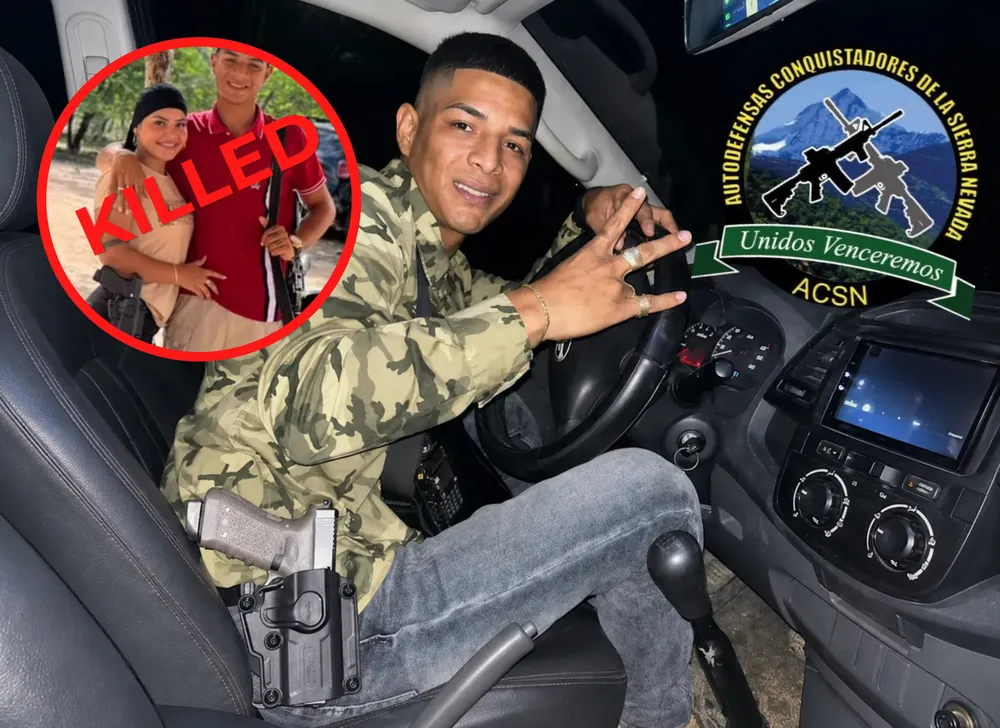
Naín Andrés Pérez Toncel, alias “Bendito Menor” or “Naín,” the top leader of the Autodefensas Conquistadoras de la Sierra Nevada (ACSN) — a structure formerly known as “Los Pachenca” — was killed early Friday, September 4, in a joint Army and National Police operation at a house in the Los Olivos neighborhood of Riohacha, La Guajira.
His girlfriend, Rosa Angélica Tarazona, alias “La Bebecita,” died alongside him, along with two of his associates, aliases “El Tío” and “Casiloco.”
The operation, code-named Centinela de la Patria, involved Colombia’s Sijín, its Special Operations Group (GOES), and a Dijín commission sent from Bogotá, and received technological and intelligence support from the United States, according to reporting by Infobae.
Pérez Toncel, 26 years old, led the Javier Cáceres front and was linked by authorities to the 2025 Maicao massacre, which killed five people, along with selective killings, extortion, arms trafficking, and drug trafficking across Magdalena, Cesar, and La Guajira.
Toncel gained notoriety online for showcasing a lifestyle of luxury vehicles, firearms, and private parties on TikTok and Instagram alongside Tarazona, presenting the couple as “crime influencers.”
Notably, Colombia’s previous government under Gustavo Petro had suspended his arrest warrant after naming him a negotiator for the ACSN — a decision President Abelardo de la Espriella referenced directly when he traveled to Riohacha to confirm the operation’s results.
“The peace this government believes in is peace imposed through arms. That is lasting peace,” De la Espriella said.
De la Espriella had personally ordered his newly designated defense minister, retired general Jorge Eduardo Mora López, to prepare the operation against Pérez Toncel during an earlier visit to La Guajira, after video circulated online showing the ACSN leader riding through Riohacha in a motorcycle caravan celebrating Colombia’s win over Ghana in the World Cup.
The ACSN itself issued a public statement following the deaths, calling on civilians in the Sierra Nevada de Santa Marta and across Magdalena, La Guajira, and Cesar to remain calm: “Although this is a blow to our organization, there will be no retaliation.”
Seven FARC Dissidents Killed in Nariño
Separately, De la Espriella announced on Saturday, September 6, that seven members of the Franco Benavides front of the Estado Mayor Central (EMC) — the formal name for the FARC dissident structure led by Néstor Gregorio Vera, alias “Iván Mordisco” — were killed in a military operation in El Peñol, Nariño, with five additional people captured.
The president said forces also located five cocaine base processing laboratories, seizing 1,007 gallons of liquid precursor chemicals and 175 kilograms of solid precursor materials, along with 6,000 milliliters of ketamine and 600 milliliters of fentanyl in a separate seizure in Barrancabermeja.
Against illegal mining, he said forces intervened at seven mining production units and seized seven dredging vessels.
Hoy es un gran día para Colombia. La Operación Centinela de la Patria dio un golpe contundente al narcoterrorismo: gracias a una acción impecable de nuestra Policía Nacional y de un comando especial de la DIJIN, fue dado de baja alias Naím o “Bendito Menor”, uno de los criminales… pic.twitter.com/q4cwdqLnGM
— Abelardo De La Espriella (@ABDELAESPRIELLA) September 4, 2026
De la Espriella used the announcement to provide a broader accounting of his young government’s security results: since taking office on August 7, his administration reports 14,914 captures and the seizure of 49,379 kilograms of narcotics.
“For every soldier or police officer they kill, I will bring down upon the criminals the full weight and full legitimate force of the State. They will not break us. We will pursue and fight the narco-terrorists until we end this cancer that has bled Colombia for decades,” he said.
Criminal Activity Operations — Venezuela
The operations unfolded against a striking new admission from Colombia’s own military leadership about where much of the remaining guerrilla and dissident command structure is actually based.
In an interview with Vicky Dávila for Semana, Major General Erik Rodríguez, commander of Colombia’s Military Forces, stated that senior ELN and Segunda Marquetalia leadership are located in Venezuela, naming aliases Iván Márquez, Silvana Guerrero, and Antonio García specifically.
Rodríguez described the ELN as “a transnational terrorist organization that is now a threat not only to Colombia and Venezuelans, but to the entire region.”
He also disclosed that the ELN has grown from 5,851 members in 2022 to 7,123 in 2026, while the Segunda Marquetalia now counts 584 members.
Iván Mordisco’s EMC structure grew from 3,576 fighters in 2022 to 4,480 in 2026, and the rival Estado Mayor de los Bloques y Frentes, led by alias “Calarcá,” has grown to 3,001 members. The Clan del Golfo saw the sharpest growth of any structure, expanding from 4,061 members in 2022 to 10,268 in 2026 — an increase of more than 6,000 people.
A Pattern Dating Back Decades, Disrupted by Maduro’s Capture
Venezuela’s role as a safe haven for Colombian armed groups is not new. The ELN has used Venezuelan territory irregularly as refuge since the 1980s, but the relationship deepened significantly after Hugo Chávez took power in 1999, according to analysts, who have documented senior ELN commanders — including members of the group’s Eastern War Front, Northeastern Front, and Central Command (Coce) — enjoying freedom of movement and security guarantees inside Venezuela for years, in some cases under direct Chavista protection.
Former Colombian Defense Minister Pedro Sánchez has said that during his tenure, intelligence indicated roughly 60% of ELN members operated in the border region, and that approximately 40% of that group were Venezuelan citizens.
That arrangement was thrown into disarray following Nicolás Maduro’s January 3, 2026 capture by U.S. forces. According to intelligence reporting cited by El País Colombia shortly after the capture, ELN and FARC dissident structures — having lost the guarantees they previously enjoyed under Maduro’s government — began reassessing whether to remain in Venezuela or retreat toward Colombia or other allied countries.
A previously exposed set of documents and videos further indicated political coordination between armed groups and sectors of Chavismo, naming Venezuelan general Iván Rafael Hernández Dala as a possible military coordinator of actions involving FARC dissidents.
A General’s Suggestion: Bombing Raids Across the Border
Rodríguez’s interview went further than simply confirming leadership locations. In the same Semana interview, Colombia’s top military commander suggested the possibility of bombing raids targeting these leaders inside Venezuelan territory — a notable escalation in rhetoric given the sensitivity of any Colombian military action crossing into a neighboring country.
A separate investigation by La FM identified 31 specific ELN and FARC dissident commanders believed to remain sheltered in Venezuela as of earlier this year.
With De la Espriella’s government continuing to report near-daily operational results against Colombia’s armed groups just one month into his term, and his own military’s top commander now publicly identifying senior enemy leadership as based across the Venezuelan border, the coming weeks are likely to test how far Bogotá is willing to go in pursuing that leadership beyond Colombia’s own territory — and how Venezuela’s post-Maduro government responds to any Colombian military activity aimed at commanders who spent years operating with impunity inside its borders.