

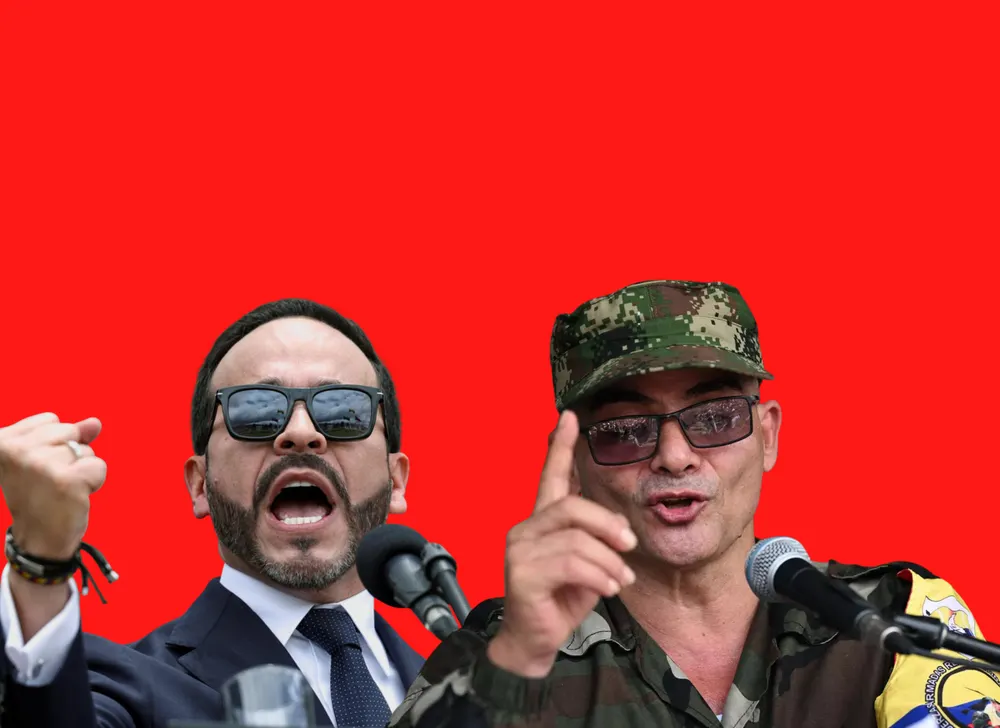
COLOMBIA — Three and a half weeks into his presidency, Abelardo de la Espriella has overseen the deaths of four senior guerrilla commanders in a rapidly intensifying military campaign against Colombia’s FARC dissident factions — even as an ELN car bombing near the Venezuelan border killed a civilian and wounded eleven, underscoring how far from resolved the country’s security crisis remains.
The Latest Killing: “Felipe” in Valle del Cauca
De la Espriella announced on X early Saturday, August 29, that Colombian Army forces had killed alias “Felipe,” also known as “Arcadio,” during an offensive operation in Valle del Cauca.
Felipe led the Rodrigo Arias company of the Ricardo Velásquez column, part of the Jaime Martínez structure within the FARC dissident faction commanded by Néstor Gregorio Vera, better known as “Iván Mordisco.”
De la Espriella identified Felipe as the structure’s regional chief and held him responsible for multiple attacks on police stations in Dagua and El Queremal using drone-dropped explosives.
Defense Minister Jorge Mora called Felipe’s death “a hard blow to a structure responsible for explosive attacks, drone use, extortion, and threats against the security forces and the population.”
De la Espriella said the encirclement around Iván Mordisco himself continues tightening, warning that the offensive would continue against anyone who attacks Colombia’s security forces or civilian population.
Bombing Campaign in the Amazon
Felipe’s death followed an even larger operation days earlier in Guaviare, an Amazonian department of just over 100,000 residents, where De la Espriella ordered what he described as the third bombing raid of his young administration and the largest such strike Colombia has carried out since the government of Juan Manuel Santos (2010-2018).
Colombian forces killed 20 fighters from the Estado Mayor Central (EMC) — the formal name of Iván Mordisco’s FARC dissident structure — captured five more, and recovered two minors during the early-Monday raid.
De la Espriella wrote on X: “We took down twenty narco-terrorists, captured five ... and recovered two minors.” Among those killed was alias “El Tigre” or “El Pintado,” identified as chief of the Carolina Ramírez front and one of Iván Mordisco’s most trusted lieutenants.
“This bandit was one of Mordisco’s trusted men,” De la Espriella said, adding a direct warning to the dissident leader himself: “We are getting closer and closer to Mordisco. We’re coming for you, Mordisco... A bomb is going to fall on you.”
Colombian officials later specified that the broader campaign against the Carolina Ramírez structure, dubbed Operación Militar Azarías, had by that point produced 27 total casualties to the structure: 20 killed, five captured, and two minors recovered.
A Third Commander Killed Days Earlier
The Guaviare bombing itself followed the August 27 death of Juan Antonio Agudelo Salazar, alias “Urías Perdomo,” leader of the Rodrigo Cadete front and one of the principal lieutenants of Alexánder Díaz Mendoza, “Calarcá” — commander of a rival FARC dissident structure, the Estado Mayor de los Bloques y Frentes (EMBF).
Perdomo was killed during Operación Amón, a pre-dawn bombing raid on a jungle camp complex in El Retorno, Nariño department. Colombian authorities had previously placed a 400 million peso reward on information leading to his capture.
President de la Espriella notifies the public of recent operations killing one alias “El Tigre” or “El Pintado,” chief of the Carolina Ramírez front. Credit: @ABDELAESPRIELLA/X
Notably, thirteen dissidents captured in a related 2024 operation under the same camp network had been released under an order from former President Gustavo Petro and a corresponding resolution from then-Attorney General Luz Camargo, on the premise that they were peace negotiators — a decision De la Espriella’s government has pointedly contrasted with its own approach.
Rival Guerrilla Factions Clashing Directly
Colombian military sources cited by El Espectador reported that Iván Mordisco’s EMC faction and Calarcá’s rival EMBF faction fought each other directly in Guaviare from August 24 to 26, an internal guerrilla clash that reportedly killed at least 30 people before Colombian forces’ own operations began in the same department days later.
ELN’s Car Bomb Near Venezuela
Even as the government’s offensive against FARC dissidents accelerated, a separate armed group struck directly at Colombian security forces. A car bomb attributed to the Ejército de Liberación Nacional (ELN) exploded at a police station in Los Patios, Norte de Santander — near Colombia’s border with Venezuela — killing one civilian, wounding eleven others, and partially destroying the building.
The attack occurred on the same day De la Espriella announced the 20 dead from the Guaviare bombing. He responded with a direct promise on X: “We will pursue with an iron hand those who attack Colombians until we capture them, dismantle their structures, and return peace of mind to our communities.”
Norte de Santander’s Catatumbo region, where the attack occurred, remains one of Colombia’s most contested territories, home to both ELN forces and the 33rd Front of FARC dissidents.
De la Espriella’s offensive posture began almost immediately after his August 7 inauguration. Just two days later, his government announced the killing of six members of armed groups in operations he described as sending “a clear and forceful message to all criminals in Colombia.”
At the time, he said explicitly: “There is nowhere for them to hide when the State is determined to act. I have given specific instructions to law enforcement agencies to carry out all necessary operations that were held back by the previous administration.” That framing — a direct contrast with Petro’s more negotiation-oriented approach to Colombia’s armed groups — has defined the government’s security messaging in each operation since.