


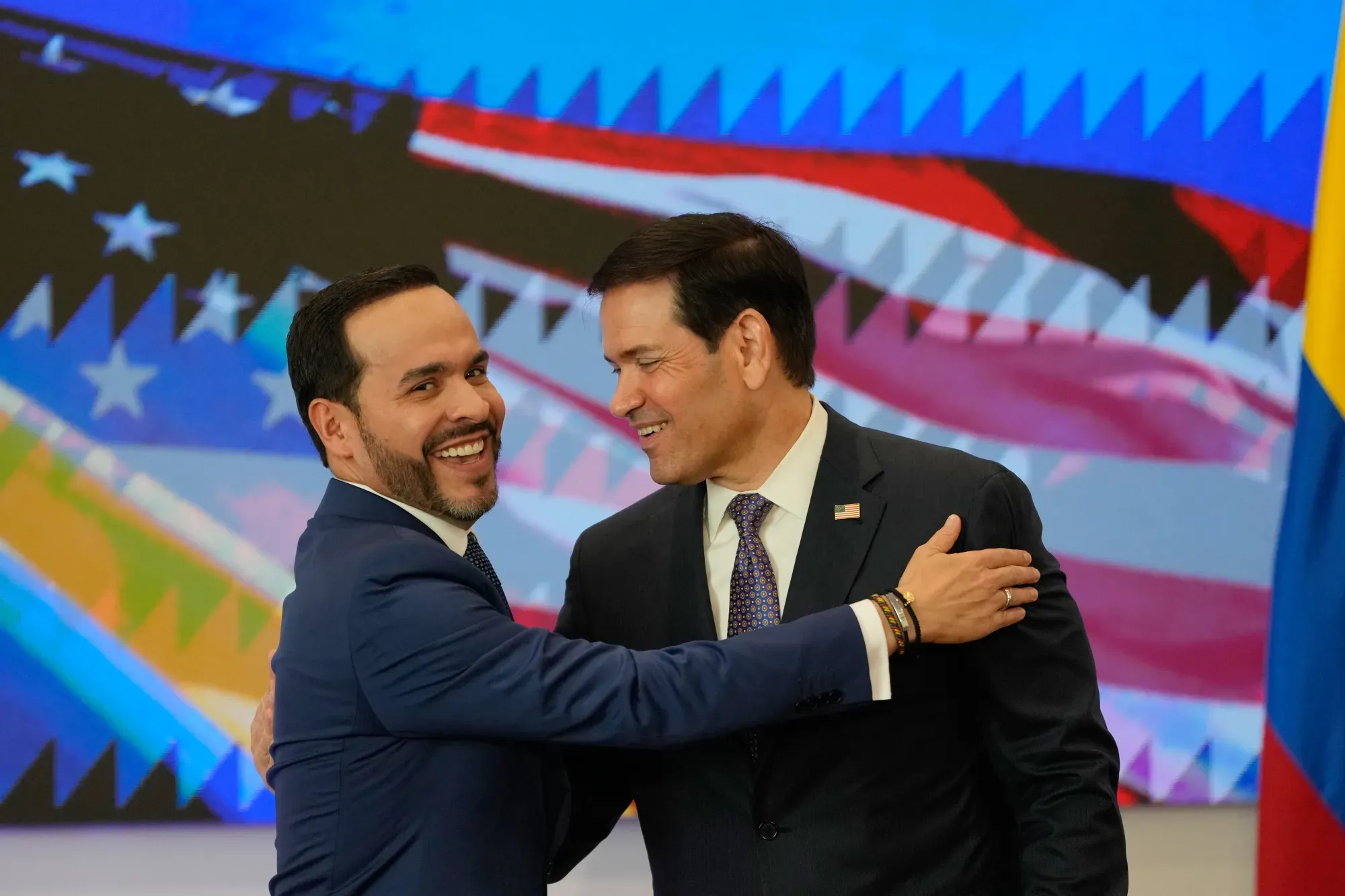
BARRANQUILLA — Secretary of State Marco Rubio’s first visit to Colombia since taking office produced a two-hour meeting with President Abelardo de la Espriella that touched nearly every major security question facing the country and the region — narco-terrorism, the ELN’s presence in Venezuela, migration, and the possibility of a permanent U.S. military presence — even as Rubio was careful to clarify that Colombia has not formally requested American troops on its soil.
Rubio landed in Barranquilla on Tuesday, September 8, arriving at Ernesto Cortissoz Airport in the municipality of Soledad, where he was received by Colombian Foreign Minister Omar Bula Escobar and Colombia’s ambassador to Washington, María Consuelo Araújo.
He proceeded to the Batallón Paraíso, a military complex that has served as an alternate seat of Colombia’s presidency alongside the Palacio de Nariño in Bogotá since De la Espriella took office August 7.
The meeting itself ran approximately 120 minutes and also included Colombia’s ambassador to the United Nations, Mauricio Gaona, along with Rubio’s wife, Jeanette Rubio, and Colombia’s First Lady, Ana Lucía Pineda.
Barranquilla’s district government activated a special security, mobility, and health-response operation for the visit, working with U.S. security agencies and national authorities, though many logistical and protective details remained undisclosed.
What the Two Governments Discussed
According to Colombian officials and multiple outlets covering the meeting, the agenda centered on security cooperation, the fight against narco-trafficking and narco-terrorism, migration, trade, and the regional relationship with Venezuela — specifically including the presence of ELN leadership across the Venezuelan border, a topic Colombia’s own top general had addressed directly in public remarks just days before Rubio's arrival.
Foreign Minister Bula characterized the visit on social media as marking the beginning of a bilateral alliance with the Trump administration “based on mutual respect, sovereignty, and the defense of national interests.”
Rubio’s Direct Answer on Troops
Asked specifically about the possibility of a permanent U.S. military presence in Colombia, Rubio was clear that no such arrangement is currently approved or underway.
“Whatever they ask of us, we are prepared to provide, if possible, given the importance Colombia holds,” Rubio said at a press conference following the meeting.
Rubio specified that Washington cannot unilaterally install a military base in Colombia — any such initiative would need to originate from a formal Colombian request and then be reviewed jointly by both countries’ authorities.
“We need to study whether that’s feasible. In many cases, these bases are shared bases,” he said. Rubio added that De la Espriella had presented alternatives during the meeting that Washington's authorities will now review, though he did not specify what those alternatives entailed.
The question of any future U.S. troop presence carries genuine legal and political sensitivity inside Colombia. According to reporting from La Jornada, Colombia’s Consejo de Estado (the country’s highest administrative court, which must be formally consulted by law on matters involving foreign military presence) confirmed that no such consultation had been requested regarding this visit or any troop-related proposal.
Colombia’s Congress — which the constitution empowers to authorize any foreign military presence in the country — was similarly not consulted, a gap opposition lawmakers aligned with former President Gustavo Petro’s Pacto Histórico coalition have already signaled will become a matter of political scrutiny.
The “Donroe Doctrine” in Barranquilla
La Jornada’s coverage framed the visit explicitly within the broader “Doctrina Donroe” — the Trump administration’s regional strategy combining hardline counter-narcotics cooperation with efforts to secure access to natural resources of strategic interest to Washington, including critical minerals.
Before boarding his flight to Colombia, Rubio previewed his priorities for the broader three-country tour, describing Washington’s central goal as working “to strengthen our presence in the Hemisphere,” alongside security, counter-narcotics cooperation, trade, and investment.
$1 Billion Commitment
Tuesday’s meeting built directly on a security assistance package the Trump administration, in coordination with Congress, had already pledged to Colombia following De la Espriella’s inauguration: up to $1 billion aimed at strengthening Colombian security forces against narco-terrorist organizations and transnational organized crime.
That package includes technology transfers, defense spending optimization, military interoperability, and — notably — authorization for coordinated operations between U.S. and Colombian troops on Colombian territory, a provision Colombia’s defense establishment confirmed in August, ahead of Tuesday’s visit.
Regional Partnership
The meeting’s substance points toward deepening, formalized security cooperation between Washington and Bogotá across nearly every front — counter-narcotics operations, intelligence sharing on ELN and FARC dissident structures operating from Venezuelan territory, and continued economic engagement tied to the earlier $1 billion pledge — while stopping short of any concrete commitment on the more politically sensitive question of a physical U.S. military installation.
That distinction matters: Rubio’s answer leaves the door open to a future base while placing the burden of initiating that request squarely on De la Espriella’s government, a dynamic that gives Bogotá formal control over the pace of any escalation even as the broader security relationship between the two countries continues to deepen rapidly just one month into De la Espriella’s presidency.
With Rubio continuing his tour to Ecuador and Peru in the days following the Barranquilla meeting, and Colombia’s Congress and Consejo de Estado not yet formally engaged on any troop-related question, the coming weeks are likely to reveal whether De la Espriella’s government moves to formally request the kind of expanded U.S. military cooperation Rubio signaled Washington remains open to providing — and whether that request, if it comes, triggers the domestic political and constitutional review that opposition lawmakers have already indicated they intend to demand.