



MIAMI-DADE — Early voting in Miami-Dade County shows Democrats have returned more ballots than Republicans, but the lead is dwindling as Republicans push large tides after first two days of early ballots. Republicans also hold the registration advantage in the county, but the question that will determine the race in South Florida, and spell what’s to come nationally is whether the administration’s hardline on immigration will have an impact on voter turnout.
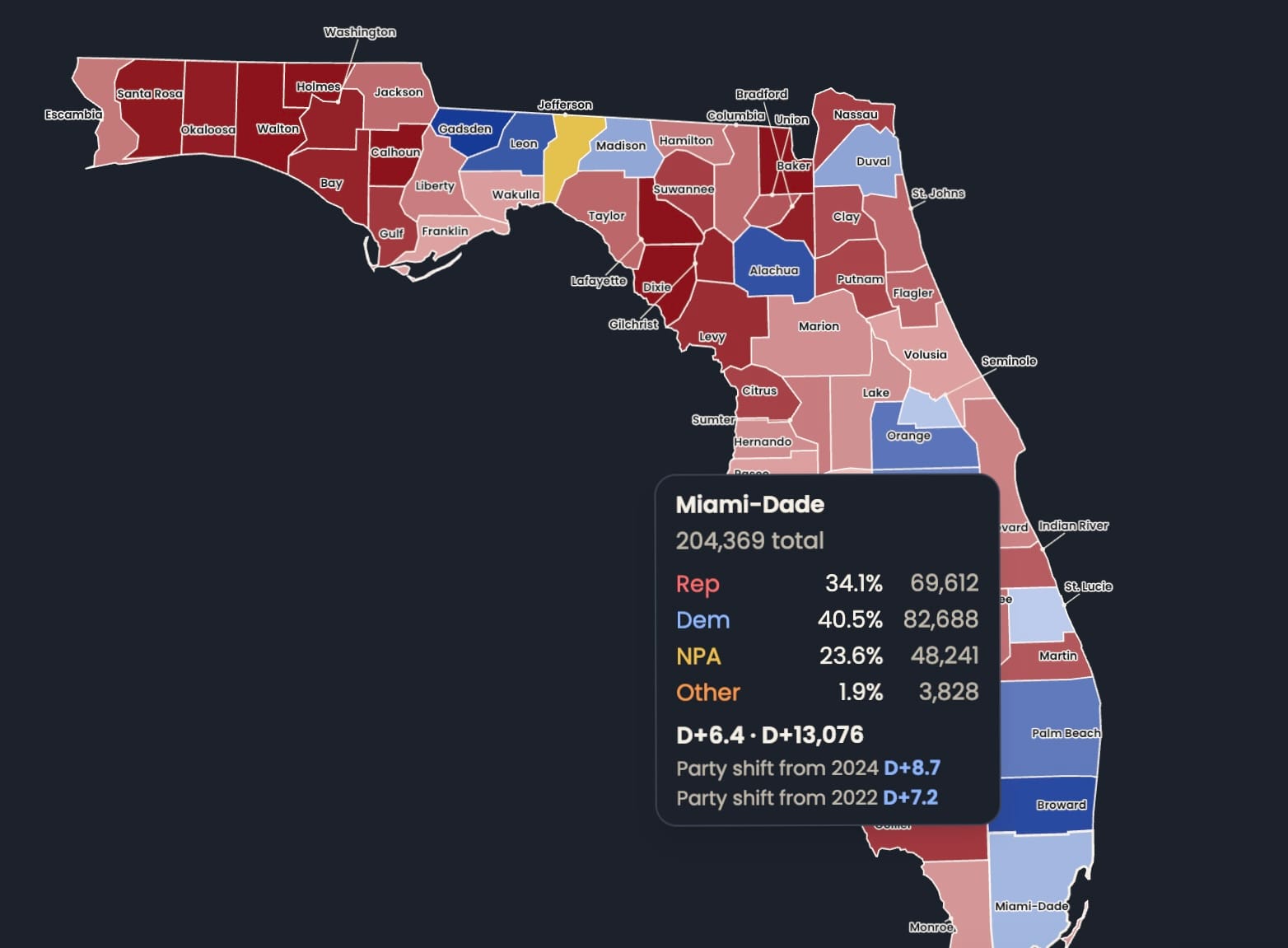
As of Friday afternoon, October 23, Miami-Dade voters had returned 204,369 ballots through mail and early in-person voting, according to a tracker that compiles state data.
Democrats account for 82,688 (40.5%), Republicans for 69,612 (34.1%), no-party voters for 48,241 (23.6%) and minor parties for 3,828 (1.9%). That is a Democratic lead of 13,076 ballots, or 6.4 percentage points.
The tracker also reports a Democratic “party shift” of 8.7 points from 2024 and 7.2 points from 2022 at the same stage, a measure of how much the party margin has moved compared with earlier elections. The state does not publish race, ethnicity or age for early voters, only county and party.
The Democratic lead has been shrinking as in-person voting picks up. State figures through October 20 showed 106,693 early ballots, 89,791 of them by mail and 16,902 in person on the first day of in-person early voting.
Democrats led Republicans by nearly 10 points that morning, and the margin narrowed to about 6.8 points by October 22 and 6.4 on Friday.
That pattern fits the usual rhythm of Florida elections. Democrats have historically leaned on mail voting, and Republicans on in-person early voting and Election Day, so an early Democratic lead tends to shrink.
Florida also ended standing mail-ballot requests after each general election, which makes comparisons with 2022 mail volume unreliable.
Registrations
Miami-Dade’s 1,306,213 registered voters break down as 460,526 Republicans (35%), 414,970 Democrats (32%), 395,233 with no party affiliation (30%) and 35,484 in other parties.
Republicans out-register Democrats by about 3.5 points.
Measured against that baseline, Democrats are over-represented among early voters by about nine points (40.5% of ballots against 32% of registration). But Republicans are only slightly under-represented, at 34.1% of ballots against 35% of registration, a gap of about one point.
The larger shortfall is among no-party voters, who are 24% of early ballots but 30% of registered voters.
In other words, the early Democratic edge is driven less by Republican absence than by Democrats showing up in greater numbers than their registration share, while independents lag. Whether that lasts depends on late deciders, many of them independents.
Why This is a Latino Story
Miami-Dade is overwhelmingly Hispanic. Of the county’s registered voters, 807,216 (about 62%) are Hispanic. Among them, 348,572 are registered Republicans (43%), 181,785 are Democrats (23%), 254,352 have no party (32%) and 22,507 are in other parties.
Republicans are therefore three-quarters Hispanic in Miami-Dade, so any shift in party turnout is largely a Latino story, though the party totals can’t show whose ballots are driving it. Hispanic no-party voters, a pool of about 254,000, are the largest swing group, and they are the segment most under-represented in the early vote so far.
The broader context points the same direction. Trump carried Miami-Dade by 11 points in 2024, after the county voted Democratic as recently as 2016. Since then, national polls put his approval among Hispanic voters at between 24% and 27%, with about 62% to 70% saying immigration enforcement has gone too far.
Cost of living, not immigration, tops the list of Hispanic voters’ concerns in several surveys.
Republican incumbents in the county are navigating this. Rep. María Elvira Salazar, whose district is about 74% Hispanic, ran a TV ad criticizing the administration’s enforcement, and Trump responded by reposting attacks on her.
Rep. Carlos Giménez, whose district is about 73% Hispanic, supports the crackdown but welcomed a reported shift toward targeting criminals. Rep. Mario Díaz-Balart’s seat is viewed as GOP-friendly.
Democratic challengers Eliott Rodríguez and Phil Ehr both tie their opponents to the president.
What to Watch
If Republican in-person and Election Day turnout closes the gap, the early Democratic lead will prove mostly a timing effect. If Democrats keep outperforming their registration share, and no-party turnout stays below its 30% share of registration, the early vote would point to a weaker GOP position.
Precinct-level turnout in Hispanic-majority areas and post-election voter-file analyses, not party counts alone, will say how Latino voters actually moved, and why.
If Democrats outperform their registration share, and no-party turnout stays below its 30% share of registration, the early vote would point to a weaker GOP position. But if Republicans outperform polling as they have done consistently since 2016 nationally, and at local regional elections, Republicans will overwhelm early Democrat turnout — and with a share of the Latino vote, Republican wins can suggest that the immigration impact was overstated by Democrat opposition.