



MIAMI — A campaign rally that drew national attention for its Democratic Socialists of America ties has become the flashpoint in what political observers are calling the last major DSA test of this year’s midterm primary cycle: Tuesday’s Democratic primary in Florida’s newly redrawn 25th Congressional District, a race that now reaches directly into Miami-Dade County.
Candidates & DSA Backers
The primary pits Oliver Larkin, a 34-year-old Fort Lauderdale native, digital marketing consultant, and former union organizer, against Democrat incumbent Rep. Jared Moskowitz.
Larkin got his start in politics as a New Hampshire organizer for Bernie Sanders’ 2016 presidential campaign and is running as an outspoken Democratic Socialist.
Moskowitz, a moderate first elected in 2022, previously represented Florida’s 23rd District before redistricting folded much of his old territory into the new 25th.
The financial gap between them is stark: Moskowitz has raised more than $2.5 million to Larkin’s roughly $550,000, though Larkin has drawn nearly all of his money from individual donors and has taken no corporate PAC contributions, while Moskowitz’s largest single donor bloc — more than $660,000, nearly 48 times his next-largest contributor — comes from groups affiliated with AIPAC, the American Israel Public Affairs Committee.
DSA-backed Larkin has argued for mass amnesty for millions of undocumented migrants, doubling-down on the immigration issue that played such a major role in the defeat of Kamala Harris in the 2024 presidential election. Larkin has also pushed for a wealth tax, defunding the police, and the abolishment of Immigration and Customs Enforcement — positions that have made campaigning difficult for more moderate Democrats.
Moskowitz separately accused Larkin, of running against him because of his religion, in a letter to the South Florida Sun-Sentinel explaining his refusal to participate in a joint interview alongside his opponent — a charge the newspaper’s editorial board called “demonstrably untrue,” while also criticizing Moskowitz for repeatedly avoiding forums with Larkin.
At one candidate forum hosted by the Broward and Miami-Dade Democratic Black Caucuses in Hallandale Beach, Larkin appeared alone after organizers said Moskowitz’s absence stemmed from a “miscommunication” over his invitation; asked what differentiated him from his opponent, Larkin told the room simply: “I’m here.”
A Genuinely Ideological Fight
The race has become a proxy battle over Israel policy as much as anything else. Moskowitz is among the House’s most outspoken pro-Israel members, opposing any conditioning of military aid, vehemently opposing the BDS movement, and leading resolutions condemning the United Nations over what he calls anti-Israel bias.
Larkin, on the other hand, an active DSA member, calls himself openly anti-Zionist, and has called for an end to what he describes as “the genocide in Gaza,” and has voiced support for recognizing a Palestinian right of return alongside an immediate suspension of military aid to Israel.
He has also drawn attention for agreeing with New York Mayor Zohran Mamdani’s assertion that Israeli Prime Minister Benjamin Netanyahu should be arrested, and for referring to Israel as a “religious supremacist regime” — remarks that have made him a lightning rod in a district with one of the nation’s largest Jewish populations.
The Rally: “Chomp the Oligarchy”
Last week, pro-Israel activists in South Florida pressured multiple venues to cancel a planned joint rally between Larkin and Democrat Rep. Rashida Tlaib of Michigan, one of the Democratic Party’s most prominent critics of Israeli policy and a self-described “proud member of the Democratic Socialists of America.”
The event, originally booked at an LGBTQ-friendly venue in Wilton Manors and organized by the Florida Youth Justice Coalition and Gen-Z For Change, was relocated after the initial venue backed out amid public pressure, including from conservative activist Laura Loomer.
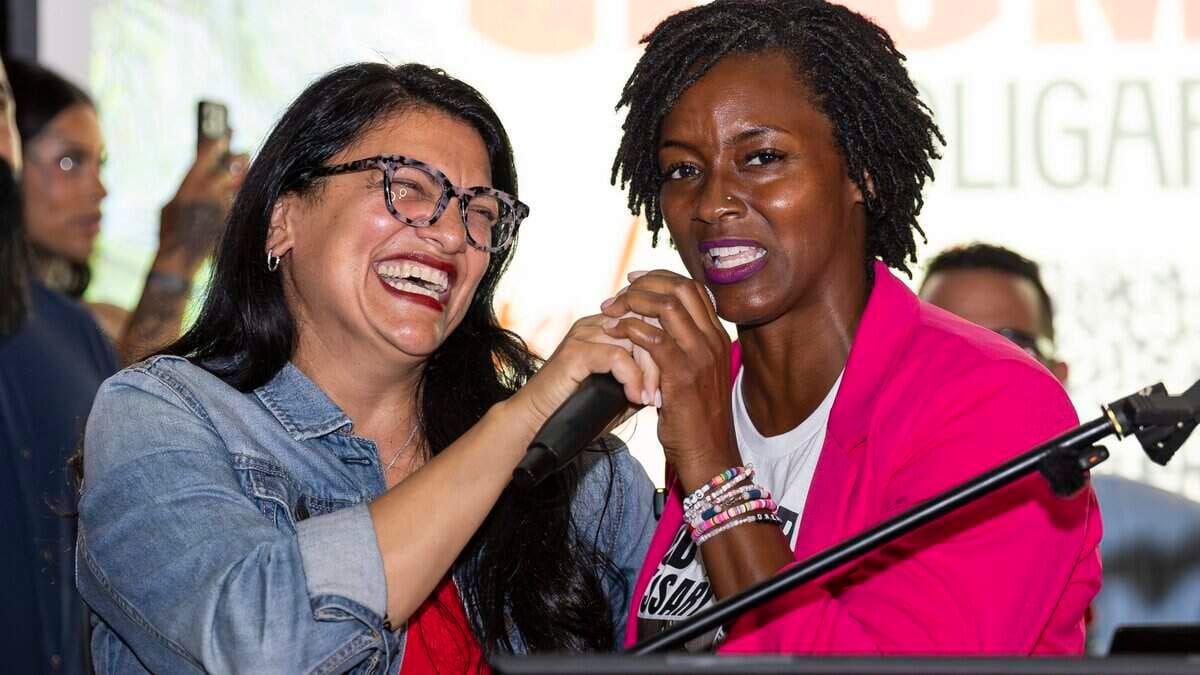
The rally itself, branded “Chomp the Oligarchy,” was scheduled for Friday night at The Venue in Fort Lauderdale, just four days before Florida’s primary, and was organized by the Florida Youth Justice Coalition, Gen-Z For Change, and a local DSA chapter. It was designed to support three candidates at once: Larkin, fellow House candidate Elijah Manley, and State Rep. Angie Nixon, who is separately running for the U.S. Senate.
The controversy began the morning of the event, when State Rep. Michael Gottlieb — chairman of the Florida Legislative Jewish Caucus — posted publicly calling the rally “anti-Jew” and describing Larkin, Manley, and Nixon as part of an “Anti-Israel and Anti-Zionism coalition.”
Gottlieb went further, writing that Tlaib “has by far the deepest record of antisemitic allegations and is being brought here to help these candidates raise funds for their campaigns.” The Venue’s sales manager, Kim Marie, said the venue had been unaware which candidates were involved and canceled the booking that Thursday evening, citing “increased security concerns” amid what she described as “so much uproar.”
Rally organizers relocated the event to a Fort Lauderdale wine bar and proceeded Friday night as planned, with Tlaib appearing to introduce Nixon before her remarks.
The Statement at the Center of the Controversy
The specific remark that has drawn the most attention came from Larkin himself, delivered from the stage to a crowd that responded with a chorus of boos directed at the venue’s cancellation: “What we’ve seen in the last 36 hours is a mobilization campaign to try to intimidate and harass us with a campaign of Islamophobia. A campaign that seeks to excuse AIPAC’s corrupting influence over our elections.”
The line drew immediate pushback from critics who argued it recast a dispute over antisemitism allegations as an attack rooted in anti-Muslim bias, while framing pro-Israel advocacy groups as fundamentally corrupting rather than simply well-organized political actors.
Gottlieb, for his part, rejected any suggestion his objection was about Tlaib’s ethnicity or religion: “I don’t see race or religion in my job in any way, shape or form, nor do I in my personal life. I don’t care that Rashida Tlaib is Palestinian. I care that she’s antisemitic, and I understand that some people are going to say she’s not antisemitic.”
He separately argued that DSA-aligned candidates winning office would fracture the Democratic Party’s cohesion, noting that some commentators pushing back on his post came from families with roots in socialist or communist countries who specifically objected to DSA’s politics.
Larkin, in turn, rejected the “hate rally” characterization directly: “This is not a hate rally. This is a rally to motivate young voters against the billionaire class and the corporate interests that are increasingly in control of both political parties,” he said, calling the venue’s cancellation “very unfortunate” while confirming organizers were “moving forward regardless.”
The Florida Democratic Progressive Caucus went further, stating the cancellation itself was rooted in anti-Muslim sentiment rather than legitimate antisemitism concerns.
Why This Is Now a Miami Story
The district’s new boundaries are central to why this race matters beyond Broward.
Florida’s congressional map, redrawn under Governor Ron DeSantis, reshaped District 25 to run along the Atlantic coast from Palm Beach County through Broward and into Miami-Dade, absorbing large portions of Moskowitz’s former 23rd District along with territory from the 24th.
The result is a district Democratic data consultant Matt Isbell describes as skewing older and more moderate than the urban progressive strongholds that have powered DSA victories elsewhere, with large concentrations of both Hispanic and Jewish voters. “I do not expect him to win the primary because the primary in this area is much older and I think moderate than it was like in a place like Denver or New York City,” Isbell said. “It’s a different type of electorate.”
Part of a Broader National Pattern
Florida’s primary is being watched nationally as the last in a string of 2026 midterm primaries testing how far the DSA’s recent momentum extends, following a string of victories for the party’s left flank elsewhere in the country.
Amid concerns about progressive candidates’ general-election viability, the party is treating Tuesday’s outcome in Moskowitz’s district as one more data point before shifting full attention to November’s general election.
Despite that national attention and Larkin’s fundraising via small-dollar donors, polling has heavily favored Moskowitz heading into Tuesday’s vote, and Republicans have largely stopped attacking him directly, instead looking past the primary toward the general election given his moderate profile in what national Republicans consider a competitive pickup opportunity in President Trump’s home state.
Polls close statewide at 7 p.m. on Tuesday. Should Larkin pull off an upset, his campaign — and the national DSA attention it has already drawn — would carry directly into a November general election now shaped by Miami-Dade voters for the first time under the district's new lines.
Should Moskowitz prevail, as most observers expect, the result would mark a setback for DSA’s 2026 electoral push in one of its final and most closely watched tests of the cycle, in a district redistricting turned into unfamiliar, more moderate terrain than the movement's recent victories elsewhere in the country.