

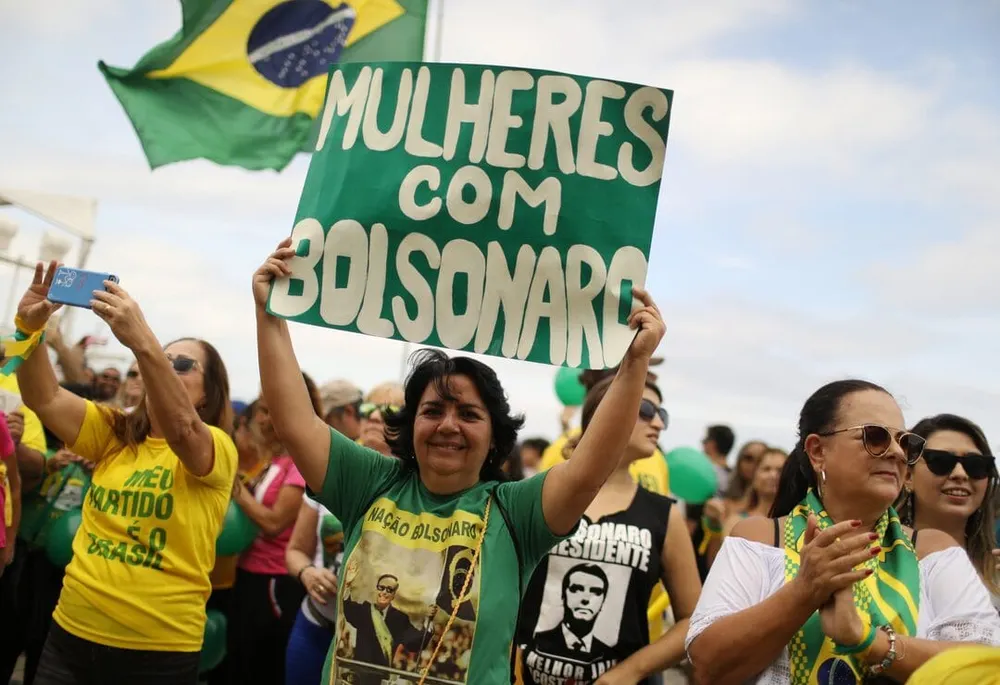
BRASÍLIA — When Brazil’s two leading presidential candidates formally launched their campaigns on Sunday, both made a calculated bet on the same voting bloc: women, who make up nearly 53% of Brazil’s 158 million eligible voters — a majority large enough to decide an election already trending toward a statistical dead heat.
How Lula Made His Pitch
At his rally before more than 10,000 supporters at Vila Euclides Stadium outside São Paulo, President Luiz Inácio Lula da Silva shared the stage with first lady Rosângela da Silva, who served as one of the event’s main speakers.
Lula framed gender equality in explicitly generational terms: “Men need to learn from childhood that they are no better than women. We need to be equal,” he told the crowd, with Rosângela nodding beside him.
He went further than rhetoric, committing to a concrete timeline: Lula said he would formally launch his campaign platform within 10 days, promising it would include specific policies aimed at education and at preventing and punishing violence against women.
How Flávio Bolsonaro Made His
Across the country in Rio de Janeiro, Senator Flávio Bolsonaro staged his own launch rally on Copacabana Beach, flanked not by his father — who remains under house arrest following his coup conviction and did not attend — but by his mother and his wife.
In that setting, Flávio made his own direct pledge to supporters: he would work to combat violence against women, a message aimed at softening a political brand more closely associated nationally with his father’s hardline conservative movement than with gender-focused policy.
The Crisis Behind the Rhetoric
Both candidates’ pledges to combat violence against women land against a genuinely severe and worsening backdrop.
Brazil registered 1,558 femicides in 2025, a 3.8% increase over the prior year, and recorded its highest-ever first-quarter total in early 2026 — 399 femicides between January and March, up 7.5% from the same period in 2025, according to Brazil’s Justice and Public Security Ministry. That works out to an average of roughly four women killed every day.
Separately, the Fórum Brasileiro de Segurança Pública found that 37.5% of Brazilian women aged 16 and older reported experiencing some form of violence in the past year — the highest rate the think tank has recorded since it began tracking the issue in 2017, representing an estimated 21.4 million women.
It’s worth being precise about what these numbers do and don’t establish regionally: Brazil records the highest raw number of femicides in Latin America, a reflection in part of its position as the region’s most populous country, but not the highest rate. That distinction belongs to Honduras, where an estimated seven women are killed per 100,000 due to their gender, compared to roughly 1.4 per 100,000 in Brazil.
Still, Brazilian researchers describe the trend as a genuine structural failure rather than a statistical artifact. Melina Fachin, director of the Federal University of Paraná’s law school, called the latest record “the snapshot of a structural and persistent tragedy,” arguing that Brazil’s legal framework is comparatively advanced but consistently fails at implementation.
Reporting on the crisis has found that in 78% of fatal cases, there were prior documented instances of physical aggression, threats, or stalking — and that in 74% of femicides, the killing followed the woman’s decision to end the relationship.
President Lula restored Brazil’s Ministry of Women’s Affairs on his first day back in office, a move Americas Quarterly has described as catering to allied parties ahead of this election — underscoring that both candidates’ rhetoric on the issue carries real political calculation alongside whatever policy substance follows.
Why This Matters for a Race This Close
The pivot toward women reflects the mathematical reality of an election that has tightened sharply in recent weeks. A Quaest poll published Friday, conducted on August 10-13, found Lula’s runoff lead over Bolsonaro had narrowed to 43% to 40%, effectively a statistical tie once the survey’s two-point margin of error is factored in, down from a five-point Lula lead in Quaest’s own polling just five days earlier.
In a race this close, a decisive shift among any bloc representing more than half the electorate carries outsized weight, and both campaigns appear to be treating women voters as a group whose support is neither locked in nor evenly split by default.
A Contest Playing Out on Both Sides at Once
What makes the dynamic notable is that neither candidate is simply targeting women as an isolated demographic — both are using family staging and personal framing to make the appeal feel authentic rather than purely tactical.
Lula’s choice to have Rosângela speak directly to the crowd, and Flávio’s decision to appear with both his mother and his wife rather than his father, suggest each campaign understands that credibility on this issue depends partly on visible personal association, not policy promises alone.
Whether Lula’s forthcoming 10-day platform rollout or Flávio’s more general pledge proves more persuasive to undecided women voters may become one of the more closely watched threads of the race’s final stretch, particularly given how narrow the overall contest has become.
With campaign advertising set to begin airing on Brazilian television and radio at the end of August, both camps are expected to sharpen their messaging to women voters considerably once the broader electorate starts paying closer attention.
Lula’s promised platform details, once released, will offer the first concrete test of whether his campaign’s rhetoric translates into policy specific enough to move a bloc that split by default.