

PANAMA CITY — U.S. Secretary of War Pete Hegseth told coalition partners in Panama this week that Washington intends to extend its lethal anti-cartel campaign from the waters of the Caribbean directly onto land targets in Latin America — a significant expansion of a military effort that has killed more than 200 in over 60 strikes on suspected drug boats over the past year.
Land Plans
Speaking during a military demonstration in Panama on August 12, Hegseth described the shift directly: “It will be ‘like you saw with the strikes on the drug boats.’ Same effect on land. And so we’re working with Ecuador. We’re working with Colombia. We’re working with partners to bring the fight to the... organizations on land.”
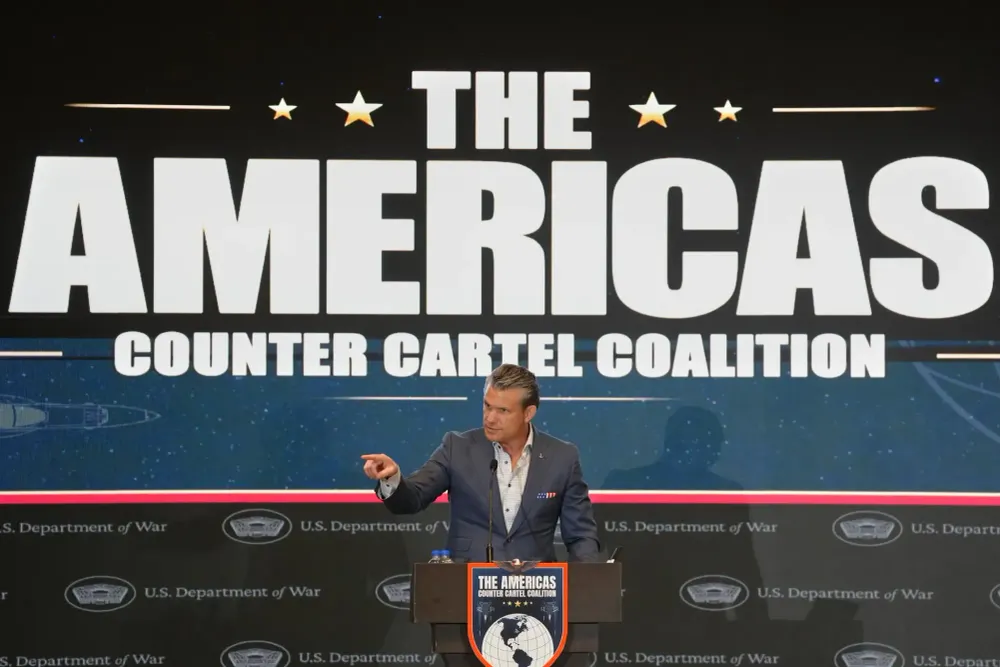
At the formal Americas Counter Cartel Coalition conference held the same day on August 12, he framed the broader campaign in stark terms, comparing narco-traffickers to some of the deadliest terrorist organizations in recent history: “When we say we will dismantle the cartels, we mean it, and I know the nations of this coalition feel the exact same way... and will take concrete steps — sometimes risky steps, courageous steps — in partnership.”
A Formal Campaign Plan by November
Hegseth announced that coalition leaders, including SOUTHCOM Commander Gen. Francis L. Donovan, agreed during the Panama meetings to refine what officials are calling “priority network campaigns” — designating lead nations for specific operations against specific criminal networks — with a full, formalized campaign plan due to be completed by November 2026.
The move builds directly on the Joint Security Declaration signed in March, which first laid out expanded bilateral and multilateral cooperation on border security, counter-narco-terrorism, critical infrastructure protection, and coalition membership across the hemisphere.
Colombia’s Expanded Role
Hegseth used the visit to formally welcome Colombia into the coalition, following President Abelardo de la Espriella’s inauguration, confirming that Colombia has authorized joint military operations against drug traffickers as part of its accession — a more specific commitment than the general membership language Sociedad Media has covered previously.
That authorization arrives alongside the $1 billion in U.S. security assistance already pledged to Colombia's new government.
Rhetoric to Match the Escalation
Hegseth’s remarks in Panama carried some of the most aggressive rhetorical framing yet applied to the anti-cartel campaign. He invoked what has been described as the “Donroe Doctrine” — an explicit echo of the 19th-century Monroe Doctrine — to justify defending the Western Hemisphere from what he characterized as external threats.
He also urged coalition allies to withdraw from the International Criminal Court, a notably aggressive diplomatic request layered on top of the security cooperation agenda.
Separately, Hegseth emphasized Panama Canal security specifically, telling reporters: “I look forward to strengthening our partnership to keep the Panama Canal secure and disrupt cartel operations throughout the region” — a reference that lands amid Trump’s own past threats to “take back” the canal, and Panama’s decision under President José Raúl Mulino to distance itself from prior canal-related agreements with China.
A Coalition Now Spanning 19 Countries
The Americas Counter Cartel Coalition, popularly known as the Shield of the Americas, now counts 19 member nations following its March 5 founding declaration and March 7 inaugural summit in Doral, Florida — where SOUTHCOM maintains its headquarters.
SOUTHCOM’s own 2026 posture statement identifies countering foreign terrorist organizations as a central priority, and states the command will expand support for regional forces fighting groups including the ELN and FARC dissidents in Colombia, using intelligence, special operations forces, and unmanned systems.
Not Universally Welcomed
The expanded U.S. military presence has not gone unopposed inside Panama itself. The National Front for the Defense of Economic and Social Rights (FRENADESO) publicly rejected Hegseth’s visit and the deepening American military footprint in the country, even as the Mulino government has otherwise moved to align closely with Washington’s regional security agenda.
A Legal Shadow Already Hanging Over the Program
The land-operations expansion inherits scrutiny that has already attached to the maritime campaign it’s modeled on.
Reporting on the Caribbean and eastern Pacific boat strikes — which the Associated Press counts at more than 60 strikes and over 200 people killed over the past year — has documented serious, unresolved questions about the evidence used to identify strike targets and the legal basis for the strikes themselves.
Extending that same operational model onto land, against a different and less clearly bounded set of targets, is likely to raise similar questions with added complexity, given that ground operations typically carry different rules of engagement, sovereignty considerations, and legal frameworks than strikes conducted in international or territorial waters.
With the formal campaign plan due by November and lead-nation designations still being worked out among coalition members, the practical scope of these land operations — which countries, which criminal networks, and under what legal authority — remains to be defined in detail.
Given the pace at which the coalition has already moved this year, from a March declaration to a 19-country membership and now an explicit pivot toward ground combat operations, the coming months are likely to bring considerably more clarity, and probably controversy, as the plan takes final shape.