
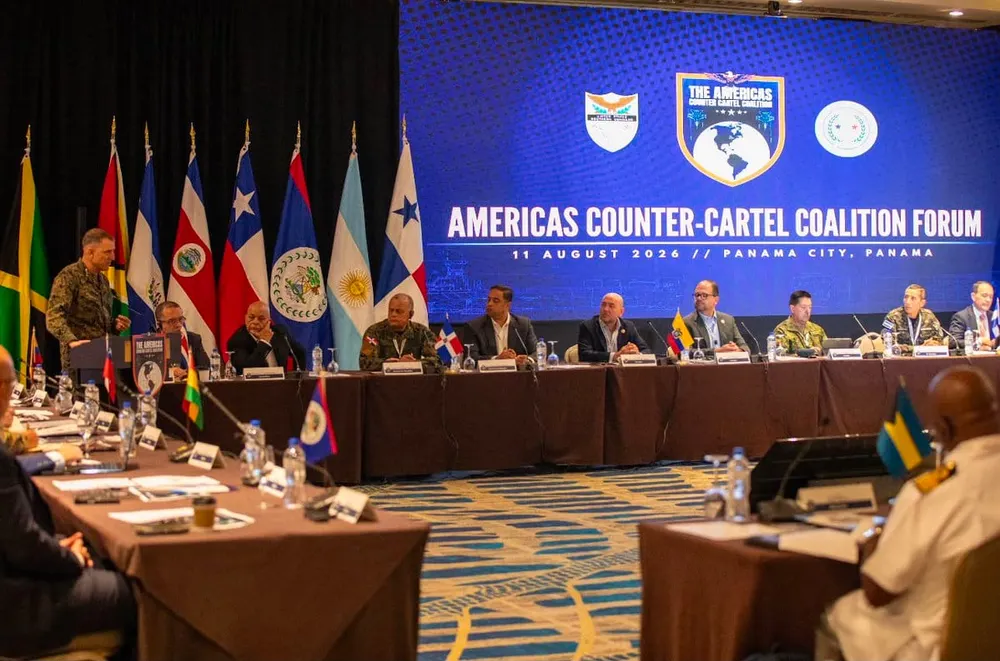
PANAMA CITY — Defense and security officials from 18 to 19 Western Hemisphere nations gathered in Panama City on Tuesday for the Americas Counter Cartel Coalition Forum, where U.S. Southern Command’s top general delivered one of the bluntest calls to arms Washington has issued yet in its regional anti-cartel campaign — a gathering that also showcased how quickly Peru and Colombia’s newly elected right-wing governments have moved to formalize their place inside it.
New Outlooks
SOUTHCOM Commander Gen. Francis L. Donovan told the assembled delegations that the forum “signals a decisive shift in our regional fight against cartels and narco-terrorists,” framing the coalition’s mandate in explicitly operational terms.
“We cannot afford to just meet and discuss,” Donovan said. “We must take action together, working shoulder-to-shoulder to apply total systemic friction on these terrorist networks and safeguard our hemisphere.”
In remarks quoted separately, Donovan added: “The time has come to combat the foe... We have a chance to decide. Are we willing to bring the fight to the enemy? I believe we are.”
U.S. Secretary of War Pete Hegseth traveled to Panama for the forum as well, meeting separately with Panamanian President José Raúl Mulino and holding a bilateral meeting with senior Colombian officials.
Peru’s Defense Minister, Luis Enrique Arroyo Sánchez, described the threat the coalition is organizing against in multidimensional terms: narcotrafficking, weapons trafficking, human trafficking, illegal mining, and cybercrime, operating simultaneously “in land, maritime, air, and cyber domains.”
Panama’s Public Security Minister, Frank Ábrego, emphasized the need for deeper interoperability and information sharing: “Security today is interconnected and multidimensional. It requires greater cooperation, shared information, and mutual trust among our nations.”
The Architecture Behind the Forum
The coalition, formally called the Americas Counter Cartel Coalition (A3C) and popularly known as the “Shield of the Americas,” traces back to a Joint Security Declaration signed March 5, 2026, and an inaugural summit two days later in Doral, Florida, where President Trump stood alongside the leaders of a dozen Latin American countries.
Its founding signatories included Argentina, Bolivia, Costa Rica, the Dominican Republic, Ecuador, El Salvador, Guyana, Honduras, Panama, Paraguay, and Trinidad and Tobago. The coalition now counts roughly 18 member nations, with Kristi Noem serving as the White House’s special envoy for the initiative and Donovan as SOUTHCOM commander overseeing its military dimension.
On August 4, SOUTHCOM formally stood up Joint Task Force Western Hemisphere (JTF-WHEM) as the coalition’s operational “executing arm,” replacing the earlier Joint Task Force Southern Spear, which had operated under the II Marine Expeditionary Force since October 2025. Donovan described the new task force’s mission bluntly: to “locate, close in on, and destroy threats” to the U.S. and its regional partners, declaring that Washington is “changing the game” in its approach to cartels.
Peru’s New Role
Peru’s path into the coalition moved with striking speed. Just three days after Keiko Fujimori’s July 28 inauguration, Foreign Minister Carlos Espá announced Peru had begun the formal process of joining, telling an audience in Lima: “We will continue the progress achieved with our incorporation into the Shield of the Americas. We will deepen our excellent relations with the United States, a strategic partner, ally and friend.”
Espá, who previously worked at the U.S. Embassy in Peru, said the government would simultaneously work to strengthen cooperation with neighboring countries against transnational crime. Fujimori herself had already raised Peru’s interest directly with Secretary of State Marco Rubio before taking office. Her incoming defense minister, Rafael Jorge Belaúnde Llosa — a graduate of Peru’s Superior War School with a master’s degree in national defense and security — notably breaks with Peruvian tradition, which had long reserved the defense post for a senior police official rather than a military-security specialist.
Colombia’s More Complicated Status
Colombia’s position is less settled than Peru’s, and reporting on it has been genuinely inconsistent.
President Abelardo de la Espriella pledged during his campaign and reiterated at his August 7 inauguration that Colombia would join the Shield of the Americas, framing membership as part of a broader security overhaul that would reinforce Colombian forces with “tactical drone squadrons with artificial intelligence and anti-drone systems” backed by U.S. technical, financial, and military intelligence assistance.
Multiple outlets reported in early August, however, that Colombia — alongside Mexico — had in fact declined to formally join the coalition as of that point, even as Peru’s own foreign minister said Bogotá “may add” itself to the framework once de la Espriella settled into office.
Colombia did participate in this month’s PANAMAX 2026 exercise, a separate SOUTHCOM-sponsored multinational exercise focused on simulated threats to the Panama Canal, running August 3-6 with 18 partner nations, including Colombia.
Whether Colombia’s participation in PANAMAX and Hegseth’s bilateral meeting with Colombian officials in Panama this week reflects an accession already underway, or simply continued negotiation toward one, remains genuinely unclear from available reporting.
A Regional Realignment, Formalized
Both countries’ moves fit inside a broader pattern that has defined 2026: seven right-wing leaders have won election across Latin America since Trump returned to office in January 2025, including Fujimori, de la Espriella, Chile’s José Antonio Kast, and Argentina’s Javier Milei. Notably, Peru and Colombia themselves had maintained reduced diplomatic relations, at the level of chargé d’affaires, since 2022 — a rupture both Fujimori and de la Espriella have agreed to formally repair from the first day of their governments, with the two neighboring countries reportedly already planning further bilateral security cooperation of their own.
Reading Between the Lines: A Signal to Cuba?
Some regional analysts have suggested Donovan’s Panama remarks, while never explicitly naming Cuba, may function as an indirect warning to Havana as well.
One outlet noted the timing — arriving amid a broader U.S. strategy against narcoterrorism, the precedent set by Maduro’s January capture in Venezuela, and the documented historical record of Cuban officials’ alleged ties to international drug trafficking — gives Donovan’s call to “combat the foe” a resonance that extends beyond the cartels named explicitly in coalition materials.
With JTF-WHEM now operational and the coalition’s membership continuing to expand just months after its founding, the Panama forum marks a further institutionalization of what began as a political declaration in Doral.
For Peru, formal accession appears to be actively underway. For Colombia, the question of full membership remains open, even as de la Espriella’s government continues signaling its intent and participating in adjacent SOUTHCOM-led exercises — a distinction likely to become clearer as both governments’ security postures take fuller shape in the weeks ahead.