


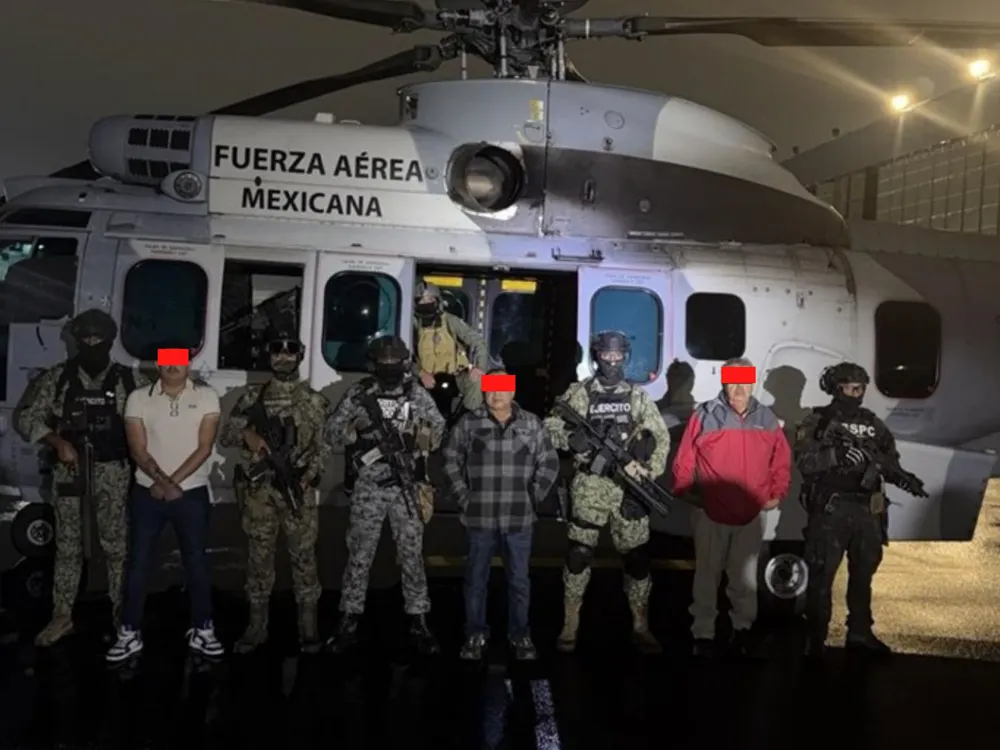
MEXICO — The capture of one of Michoacán’s most wanted cartel leaders was supposed to be a milestone in Mexico’s effort to secure its avocado industry. Instead, according to state prosecutors, it triggered a fresh wave of threats against the very businessmen and inspectors that industry depends on.
What Happened In Michoacán
Michoacán’s deputy state prosecutor for intelligence and criminal investigation, Israel Vega Rodríguez, confirmed that following the arrest of Alfonso Fernández Magallón — known as “Poncho la Quiringua,” leader of the Cártel de Los Reyes — a series of threatening phone calls went out to various avocado businessmen in the state. “What we have is that, following the detention of this criminal leader known as ‘Poncho la Quiringua,’ a series of calls went out to different avocado businessmen, which they brought to the attention of U.S. authorities after receiving these threats,” Vega Rodríguez said at a press conference.
He clarified that no formal complaint has been filed with the state prosecutor’s office as of this writing, and that authorities have not yet confirmed whether the threats originated directly from organized crime or from opportunists exploiting the tense atmosphere his arrest created.
Who Poncho la Quiringua Was
Fernández Magallón led the Cártel de Los Reyes, part of Cárteles Unidos — an alliance of smaller criminal cells, including the Cártel de Tepalcatepec, formed specifically to resist the expansion of the Cartel de Jalisco Nueva Generación (CJNG) into Michoacán. U.S. authorities link him to drone attacks against Mexican military personnel, including a January 19, 2025 attack in Cotija and two more on June 15 and July 1, 2026, in Tingüindín and Jacona.
The U.S. State Department had offered a reward of up to $5 million for information leading to his capture since August 2025, and he had been under federal indictment in the District of Columbia since July 2023 on drug conspiracy and firearms charges.
A Story Already in Progress
This threat campaign is not an isolated incident — it’s the latest chapter in a security crisis that has directly disrupted Michoacán’s avocado export economy over the past two weeks.
President Claudia Sheinbaum had already confirmed that sanitary inspectors responsible for certifying avocado and chili exports to the U.S. received threats from a criminal group, which led the U.S. Embassy to suspend its inspection activities in Michoacán on August 5.

That suspension forced more than 60 packing plants to close temporarily and prompted an emergency meeting between the U.S. and Mexican governments.
As of this Tuesday, Sheinbaum reported that 45 of those plants had already resumed operations, with the remainder expected to follow by the end of the week — normalization that, notably, was achieved in under 48 hours this time, faster than the two previous occasions the U.S. has taken this kind of suspension action.
In direct response to the security situation, Mexico’s Defense Secretariat deployed 1,557 troops to Michoacán, reinforcing avocado-producing zones, packing centers, transport routes, and SENASICA inspection checkpoints specifically to inhibit extortion against producers.
The operation also included establishing a Regional Intelligence Fusion Center in Uruapan to coordinate the Army, National Guard, the Secretariat of Security and Civilian Protection, the Navy, and Mexico’s National Intelligence Center, along with 17 fixed security bases in Tingüindín, Tocumbo, and Peribán, plus 29 more across Cotija and neighboring municipalities, with roughly 870 troops assigned to those posts specifically.
A Persistent Cycle
Vega Rodríguez’s confirmation that new threats emerged specifically after Fernández Magallón’s arrest points to a familiar and difficult dynamic in Michoacán’s fight against cartel extortion: removing a single leader does not necessarily calm the underlying pressure campaign against legitimate businesses, and may in some cases accelerate it, whether through remaining cartel structures asserting continuity or opportunists exploiting the resulting uncertainty.
With agreements now in place to provide dedicated security to threatened inspectors and a permanent coordination table established to safeguard both exports and personnel, Mexican and U.S. authorities are treating the arrangement as durable — but Tuesday’s disclosure that threats followed directly on the heels of the industry’s most high-profile arrest in months suggests the underlying vulnerability driving the crisis has not gone away simply because one of its most wanted leaders is now in custody.
What Comes Next
Michoacán’s prosecutor’s office says it continues investigating the threats, though the case remains open absent any formal complaint.
Meanwhile, the broader security operation protecting the avocado sector continues under the framework established in the wake of the U.S. suspension — a arrangement now being tested by exactly the kind of destabilization it was designed to prevent.