

MEXICO CITY — Mexico City’s Public Security Secretariat (SSC-CDMX) recorded at least 16 separate demonstration points across the capital on Monday, August 31, as unions, collectives, and advocacy groups mobilized simultaneously on the same day millions of students across the country returned to school for the 2026-2027 academic year.
IMSS-Bienestar Nurses Block Centro Médico
Among the most disruptive protests, nurses and healthcare workers affiliated with IMSS-Bienestar maintained a blockade of a major avenue near Centro Médico, one of Mexico City’s largest hospital complexes.
The demonstration is the latest in a wage dispute that has run for weeks: healthcare workers across the IMSS-Bienestar system have been protesting since at least mid-August over unpaid wages dating to August 15, pending bonuses, and shortages of basic medical supplies needed to treat patients.
In Mexico State alone, union representatives from Section 9 of the National Union of Health Secretariat Workers (SNTSA) say the payment delays have affected roughly 9,000 workers, a dispute tied to lingering confusion over which authority — state or federal — is now financially responsible for payroll following the transfer of health services from Mexico State’s own health institute to the federal IMSS-Bienestar system.
Film & Entertainment Workers March to Interior Ministry
At 11:00 a.m., members of the “Movimiento Plural de Maquineros/Siembra Cultura, A.C.” — representing camera operators and other technical workers in the film and entertainment industry — marched from the Hemiciclo a Juárez monument toward the Interior Ministry (Secretaría de Gobernación).
The group is demanding an end to what it describes as arbitrary actions affecting their livelihoods within the entertainment industry, along with formal recognition that their work is lawful.
Feminist Collectives Protest at Tepalcates Metro Station
Also, feminist collectives from the eastern Mexico State region gathered at the Tepalcates metro station, demanding progress on femicide cases and justice for victims of gender-based violence.
Organizers indicated the possible involvement of additional human rights organizations as the protest developed, along with the potential use of road blockades as a pressure tactic.
Beginning at 9:00 a.m., the organization Fundar, joined by other civil society groups, held a press conference outside Mexico’s Supreme Court of Justice (SCJN), part of a broader push tied to human rights and legal reform demands, though specific details of Fundar's requests were not immediately elaborated in initial reporting.
Across the Capital
The SSC-CDMX’s official agenda described the day’s demonstrations as spanning a wide range of causes beyond the specific protests detailed above, including demands for better labor conditions, justice, human rights, union freedom, an end to evictions, and greater recognition for minority communities.
Separately, a march departed from the Rosales area along Paseo de la Reforma, heading toward Juárez and Eje Central Lázaro Cárdenas in the Cuauhtémoc borough, prompting authorities to recommend Eje 1 Norte, Avenida Chapultepec, and México-Tenochtitlán as alternate routes.
A separately planned disruption — a large-scale blockade by transportation companies grouped under the Trolemex consortium, threatened for the same day along routes connecting Mexico City’s eastern boroughs with the Mexico State municipalities of Chalco, Valle de Chalco, and Ixtapaluca — was called off before Monday.
The six transport companies involved, protesting what they describe as roughly 510 million pesos in losses over 15 months tied to the Chalco-Santa Martha Trolebús line’s operation, reached an agreement with Mexico State’s Mobility Secretariat (Semov) on August 29 to advance their formal incorporation into the Trolebús project, averting what officials had warned could become a significant disruption to the first day of the school year specifically.
Impact on Public Transit
The day’s demonstrations did disrupt Mexico City’s public transit system independent of the canceled megabloqueo.
Metrobús Line 3 suspended service between the Cuauhtémoc and Obrero Mundial stations due to the social mobilizations, operating instead only between Tenayuca and Balderas, and separately between Pueblo Santa Cruz Atoyac and Etiopía.
A Recurring Source of Friction for Sheinbaum
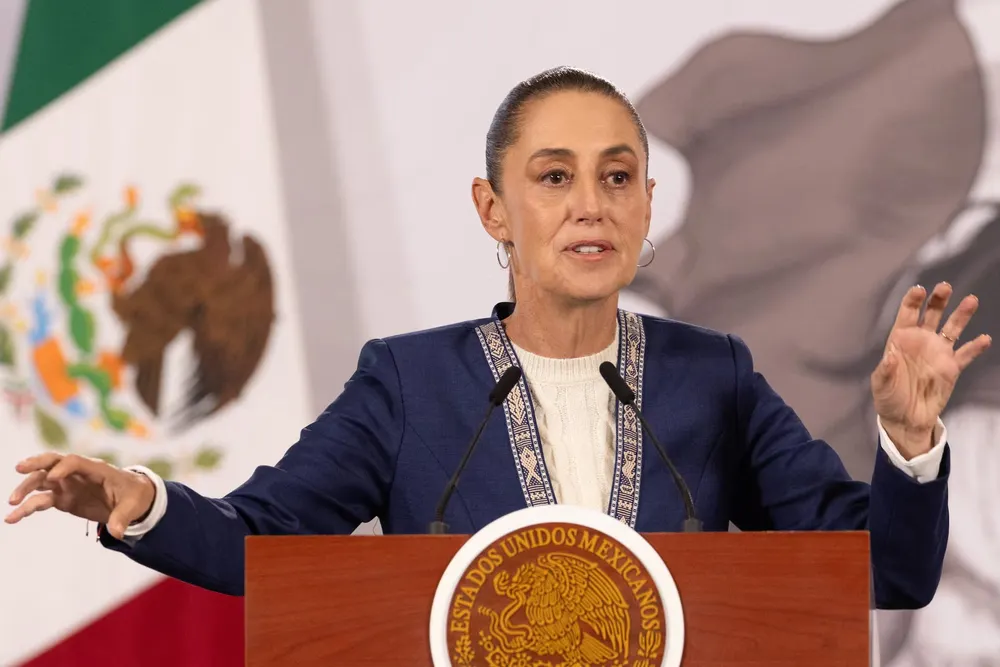
The IMSS-Bienestar protests occupy an uncomfortable position for the progressive-leaning President Claudia Sheinbaum’s government, striking directly at the healthcare system her administration has repeatedly held up as a signature achievement of what she calls the “Fourth Transformation” — the broader political project she inherited from former President and left-wing MORENA founder Andrés Manuel López Obrador.
Sheinbaum has personally encountered these demonstrations multiple times over the past year, often at the very events meant to showcase the program’s progress: during a June 2025 hospital expansion ceremony in Puebla, health workers interrupted her remarks chanting “basificación, basificación, basificación” — demanding permanent job status — prompting her to respond on the spot with a pledge to regularize outstanding positions.
A similar scene played out weeks earlier when workers from Ixtapaluca, Mexico State, confronted her directly over the same demand.
As recently as August 16, at the inauguration of a new IMSS-Bienestar general hospital in Ciudad Madero, Tamaulipas, Sheinbaum used the occasion to promise a broader rescue of Mexico’s public health system, framing the effort explicitly around national sovereignty and a rejection of what she describes as decades of neoliberal privatization under prior administrations.
That framing has made the protests politically awkward in a specific way: they are not conservative or opposition-driven mobilizations, but grievances arising from within the same public healthcare workforce Sheinbaum’s government has positioned as central to its progressive governing identity.
Workers have staged demonstrations outside the National Palace itself, including a February 2026 protest in the Zócalo demanding dialogue over medical supply shortages, unfair labor conditions, and the reinstatement of a doctor dismissed after publicly denouncing shortages within the institution.
Sheinbaum’s government has consistently responded by emphasizing that dialogue “remains open” and touting the pay increases some workers have received under the transition to IMSS-Bienestar, while acknowledging — as she did again following Monday’s protests — that a portion of positions still awaiting permanent regularization remain a work in progress.
The persistence of the dispute across multiple states and more than a year of intermittent protest activity suggests the friction is unlikely to resolve quickly, even as Sheinbaum continues to cite the program as evidence of her administration’s commitment to expanding public health access.