


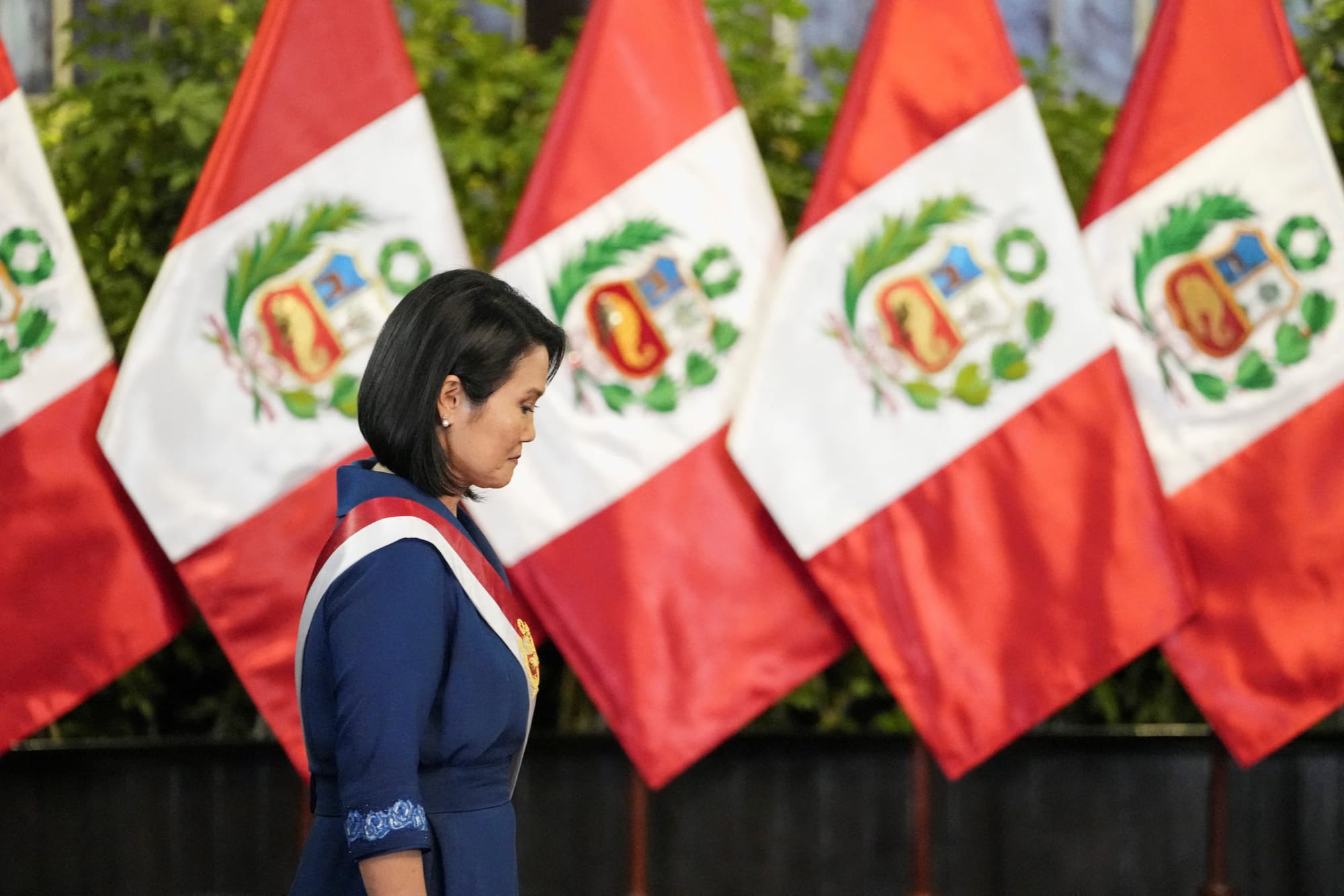
LIMA, PERU — President Keiko Fujimori has announced the most sweeping overhaul of school discipline in Peru in years. It brings back expulsions and the conduct grade, tightens rules on phones and appearance, and promises to remove “ideology” from textbooks. The government says the changes will restore order in classrooms after years of unruly behavior plagued the country’s public school system.
Fujimori presented the draft Guidelines for School Discipline Management on Monday at a public school in Chaclacayo, east of Lima, alongside Education Minister José Antonio Chang.
“Order is not only in the streets,” she said. “Order also has to return to our schools, to our classrooms.”
The draft sorts misconduct into three tiers. Teachers handle minor faults, such as repeated distraction, with warnings, repairing damage or brief removal from class. Serious faults include misusing phones, vandalism, psychological aggression, possessing banned substances and inciting dangerous “viral challenges.” Very serious faults include bullying, cyberbullying, sexual violence, extortion, discrimination and carrying weapons.
Directors can suspend students for up to three school days, no more than four times a year, or place them in conditional enrollment. Expulsion is reserved for three suspensions in a year, a very serious offense or systematic misconduct.
Families have three business days to request reconsideration, and the school has five to respond. A 0-to-20 conduct grade returns, with anything below 11 counted as failing.
“The worst-behaved students will not be in the classrooms,” Fujimori said. “We are not going to disturb the peace of the great majority of students because of a few badly behaved ones.” She added that victims should not be the ones who leave: “What cannot happen is that the victim ends up leaving school and the aggressor stays.”
An expelled student would not lose the right to schooling. If a family can’t find a place elsewhere, the local education authority must guarantee one, though the student cannot stay at the school where the victim studies.
The reforms point to spreading violence within public schools as a reason for the government’s new focus. The Education Ministry recorded 11,805 school violence reports between January and August, including 5,187 physical, 4,559 psychological and 2,059 sexual cases.
Metropolitan Lima accounted for 4,072.
The case that pushed the issue is at the Navy-run Liceo Naval Almirante Guise. In September, a 16-year-old said classmates sexually assaulted him on a school bus, and a court ordered six students detained. Minister Chang said the measure follows that case. He said the new rules take effect this year, calling them “indispensable.”
The rules also change a legal framework that critics of the old system say tied schools’ hands. A 2018 decree required keeping both the victim and the aggressor in the same school, and in 2022 the ministry argued that expulsion conflicted with the law promoting violence-free school coexistence.
Dress Codes
For public schools, the draft also restricts makeup, painted nails, dyed hair, tattoos and skirts above the knee. Fujimori said boys must wear short hair. Private schools set their own appearance rules, and Chang said students who want dyed hair can look for a private school that accepts it.
A separate decree published October 3 now restricts phone use in schools unless a teacher authorizes it.
Ana Andrade Pacora, a former vice minister of pedagogy, called the measures wrong and said they would set Peru back decades. She called the girls’ clothing rules sexist and said that appearance is not respect for others. Critics also note the split: the appearance rules apply to public schools, which educate about 6.7 million students, roughly 72% of the total, while families who can afford private schools face no equivalent restrictions.
Critics of the reforms also argue that hair and skirt length do little to address extortion or sexual violence.
President Fujimori framed the package as restoring teacher authority, saying teachers had been “cornered” and could no longer correct students.
“The teacher is respected,” she said. She also announced a review of school materials. “There will not only be a haircut, but also a cut of ideology in school textbooks,” she said, and Minister Chang said future textbooks will be free of ideology.
Neither has said what would be removed.
The guidelines would also create a new Unit for the Protection of the Educational Community within the ministry, repeal the SíseVe violence-reporting system, and set up re-entry schools and digital or hybrid classes for students who are suspended or expelled.
Fujimori also announced school construction, satellite internet for every school, teacher retraining and a training school for directors.
The draft is open for public comment until October 27. After a supreme decree approves it, schools would have 30 days to adapt their internal rules. Several details remain unsettled. One provision treats repeated unjustified lateness as serious, while another lists it as minor. Reports also differ on whether the text itself bans long hair for boys or whether that comes from Fujimori’s remarks. And it is unclear what would replace SíseVe, the system that produced the violence figures the government is citing.
The announcement follows the unified military-police command Fujimori presented a week earlier, and it carries the same message: order, discipline and authority. Whether it makes classrooms safer will depend less on dress codes than on how schools use the new tools, and how much support victims receive.