

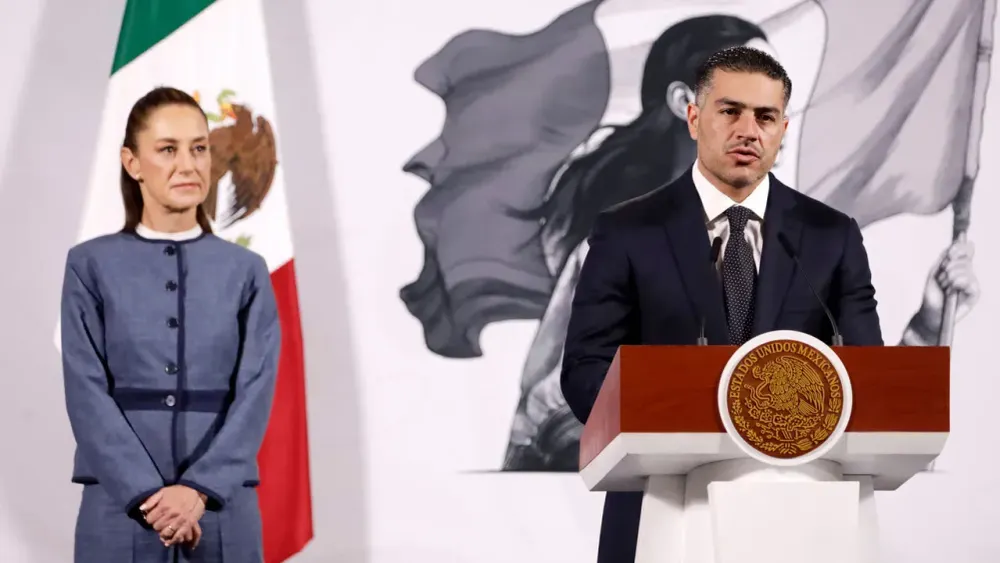
MEXICO CITY — President Claudia Sheinbaum revealed at her Friday, August 14 morning press conference, or Mañanera, that her government initially planned to decline an invitation for Security Secretary Omar García Harfuch to attend a DEA-organized security conference in Argentina — before a unanimous cabinet vote reversed that decision days before the event.
What’s Happening in Buenos Aires
García Harfuch traveled to Buenos Aires for the 40th International Drug Enforcement Conference (IDEC), running August 18-20 and co-hosted by the U.S. Drug Enforcement Administration and Argentina’s Ministry of National Security.
The conference, first established in 1983 under the theme “Justice Through Strength and Unity,” gathers between 400 and 600 senior security and counter-narcotics officials from roughly 100 countries to discuss strategies against transnational organized crime and drug trafficking, along with intelligence-sharing between national authorities.
Why Mexico Almost Said No
Sheinbaum was candid about her government’s initial instinct. “De principio habíamos dicho que no, porque ustedes saben la historia de relación de la DEA con México, sobre todo en los años recientes” — “At first we had said no, because you know the history of the DEA’s relationship with Mexico, especially in recent years,” she told reporters at Palacio Nacional.
That history includes a series of tense episodes between the DEA and the two most recent Mexican administrations, including controversies over the agency's operational conduct inside Mexican territory and questions about transparency with Mexican counterparts.
However, Sheinbaum’s initial order to withhold a Mexican delegation to the Argentine conference was viewed negatively by members of her own cabinet.
Why She Changed Her Mind
That cabinet ultimately convinced Sheinbaum to put the question to her cabinet directly — consulting roughly 15 senior officials, including military, naval, and civilian representatives, on whether Harfuch should attend.
Officials confirmed that the event would draw security secretaries from around the world, not just Latin America, which she considered a meaningful opportunity. The deciding factor, she said, was that broader international audience: “It’s better for the world to know what’s being done in Mexico, and that it’s being done well.”
The cabinet’s vote was unanimous in favor of sending him.
The political optics, internationally, in not sending a delegation to one of the world’s most recognizable international forums against drug trafficking — while simultaneously being challenged at by those same drug trafficking organizations the government has declared to combat seemed to devastating a contradiction to bear for the Mexican cabinet to accept.
“Coordination Without Subordination”
Sheinbaum was explicit that the decision to attend a DEA-organized event should not be read as Mexico deferring to Washington. Sheinbaum invoked the oft-repeated phrase, “coordination without subordination,” that has become her administration’s standing formula throughout 2026 for describing security cooperation with the United States: working operationally alongside American agencies while explicitly rejecting any framing that Mexico takes direction from them.
She pressed the point further from the podium, asking pointedly: “¿Por qué vamos a bajar la cabeza? ¿Por qué nos vamos a arrodillar? ¿Por qué vamos a tener miedo?” — “Why should we lower our heads? Why should we kneel? Why should we be afraid?”, positioning her country as one defending its national sovereignty against organized crime.
García Harfuch Proposal
Once in Buenos Aires, García Harfuch used his remarks to lay out Mexico’s security strategy under Sheinbaum, highlighting a reported 51% reduction in homicides and citing drug seizure figures from Mexico’s armed forces, according to Infobae’s coverage of his presentation.
He framed the shared objective in structural terms rather than purely enforcement-focused ones:
“The common objective must be to keep fentanyl, methamphetamine, and any other type of drug from reaching the streets, and above all, to have fewer people lose their lives to those drugs,” he said, adding that Mexico’s goal, “It’s not just about seizing drugs, it’s about destroying the industrial and logistical capacity of criminal organizations.”
Optics
This episode fits within a recurring dynamic in Sheinbaum’s approach to U.S. security cooperation throughout 2026: visible, real engagement with American law enforcement and defense institutions, paired consistently with public rhetoric emphasizing Mexican sovereignty and pushing back against any suggestion of subordination.
The same tension has surfaced repeatedly this year across her government’s handling of cartel-related security operations, cross-border enforcement cooperation, and now, directly, in the decision over whether her own security chief should appear at a DEA-branded international forum.
With García Harfuch’s conference appearance now complete, attention turns to whether the reception among the 100 countries present translates into any concrete follow-up cooperation, and whether Sheinbaum’s government continues applying the same “coordination without subordination” framing to future invitations from U.S. agencies.
Sheinbaum’s willingness to publicly narrate the internal deliberation — including her government’s initial reluctance — also marks a notably transparent account of how a sensitive foreign-relations decision actually got made inside her cabinet.