


MIAMI —There is a pattern so consistent it has become predictable. A crisis breaks out somewhere in Latin America — a coup attempt, a currency collapse, an election that goes the wrong way, a president who gets arrested or captured or impeached — and within weeks, the capital moves.
It moves through wire transfers, suitcases, and private banking accounts. It moves through real estate transactions closed in cash, at prices that make no concession to local incomes. It moves through the private banking floors of Brickell Avenue, where JPMorgan, UBS, Andbank, and a dozen other institutions have been expanding their Latin American wealth management operations for years because the clients keep arriving and the assets keep growing.
It moves to Miami.
In 2025, international buyers — led overwhelmingly by Latin Americans — acquired more than 5,300 properties in Miami, up from approximately 4,000 the previous year. The total investment reached $4.4 billion, making Miami the number one market in the United States for foreign residential real estate investment.
Florida captured 21% of all international home sales in the country.
Cross-border mergers and acquisitions activity involving Latin American buyers reached a record $4.7 billion in the Miami metro area in 2025, with preliminary 2026 data indicating an additional 18% increase. Political instability across Venezuela, Argentina, and Brazil, combined with currency depreciation pressures, is accelerating capital flight into U.S.-domiciled businesses — with Miami serving as the preferred gateway.
The numbers are extraordinary. What they do not capture is the cost, not to the investors arriving with capital, but to the city that receives it.
The Geography of Latin American Capital Flight
The capital flowing into Miami from Latin America does not come from a single country or a single crisis. It comes from all of them — simultaneously and continuously — driven by a combination of political instability, currency volatility, and the structural reality that for Latin America’s wealthy, Miami is not a foreign city. It is the northern extension of a world they already know.
Colombia leads all foreign buyers in Miami real estate with 15% of total transactions. Argentina follows at 14% — $366.8 million in purchases. Mexico, Brazil, and Venezuela round out the top five.
The pattern is consistent: when political or economic conditions deteriorate at home, Latin American investors accelerate their Miami purchases, using the city’s real estate as a hard-dollar hedge against currency depreciation and country risk.
Data from the Miami Association of Realtors indicates that international buyers — led by Latin Americans — acquired 49% of all new luxury units in South Florida through mid-2025. Of those buyers, 68% paid entirely in cash. And 91% acquired their properties for investment or second-home purposes — not as primary residences.
The cash buyer percentage is the most telling figure. In a market where most residents are competing for homes with mortgages, interest rates, and debt-to-income ratios, nearly 70% of Latin American buyers are bringing liquidity that the local market cannot match. They are not competing on the same terms. They are not subject to the same constraints. And the prices they are willing to pay — informed by what they are fleeing, not by what Miami wages can support — are the prices that then define the market for everyone else.
JPMorgan’s team in Miami — dedicated to clients from Argentina, Chile, Paraguay, Uruguay, Peru, Ecuador, and Bolivia — has expanded approximately 10% in recent years.
“We saw a significant geographic portfolio reallocation to Miami related to the fact that our clients have found more compelling opportunities to multiply their wealth in the U.S. than in some of their countries,” said Ezequiel Lazcano, head of Latin America South at JPMorgan’s private bank.
Andbank, a private banking firm with a significant Miami presence, has been attracting $150 million in inflows per year to its Miami wealth management operation — mostly from Colombia, Chile, and Peru, where shifts toward left-leaning governments sparked capital flight as investors searched for safer havens.
2026: The Crisis Multiplier
Every year brings new crises that accelerate the capital flow. 2026 has brought more simultaneously than almost any year in recent memory — and the effect on Miami's financial infrastructure has been measurable.
Venezuela’s post-Maduro transition — following the U.S. military capture of Nicolás Maduro in January — has produced a new wave of Venezuelan capital movement. The uncertainty about what the Rodríguez government represents, whether the transition will hold, and whether assets in Venezuela are safe has pushed a second generation of Venezuelan capital northward.
Doral — where nearly 80% of residents are of Hispanic origin and the highest concentration of Venezuelans per capita in the United States lives — has become the operational hub of this movement. The flow of wealth into private banking offices in Miami that serve Doral’s Venezuelan community grew by 10% annually from Venezuela, Mexico, and Argentina, according to industry data.
Colombia’s May 31 presidential election — with a left-wing candidate leading the polls and a right-wing candidate proposing to make Álvaro Uribe her Defense Minister — has injected new uncertainty into Colombian capital allocation decisions.
Colombian investors who moved assets to Miami during Petro’s first term are not moving them back until after the vote. Colombian investors who had been watching from Bogotá are accelerating their Miami positioning ahead of whatever comes next.
Argentina under Milei presents a different dynamic. The libertarian president’s fiscal reforms have stabilized some of the Argentine macro picture — but the structural uncertainty of a country on its fourth IMF program in a decade does not disappear with one favorable debt renegotiation. Argentine buyers remain the second-largest foreign investor group in Miami real estate precisely because they have learned, through four decades of economic instability, not to trust any Argentine government's stability for long.
Peru has impeached nine presidents in a decade. Brazil is heading into an election between an 80-year-old president with two recent brain surgeries and the son of a convicted coup plotter.
Ecuador and Colombia are in a trade war that has degenerated into presidential accusations of guerrilla incursions. These are not abstract geopolitical events. Each one of them is a data point that a Latin American wealth manager uses to justify moving another tranche of client assets into dollar-denominated Miami real estate.
What the Capital Does to the City
The money that arrives from Latin America does not stay in Brickell. It moves through the entire market.
Miami-Dade County commercial sales volume rose 30% in 2025, with the largest increase in the multifamily sector. Foreign investors are playing a significant role. Despite an extraordinary volume of new multifamily construction — 9,802 units completed in 2025 — rents continue to grow and now average $2,385 monthly, the second highest in the nation after the San Francisco Bay Area.
Luxury condo prices in Miami-Dade County have increased at a compound annual growth rate of approximately 9 to 12% since 2020. The branded residence segment has outperformed the broader market by 5 to 8 percentage points annually.
These numbers describe a luxury market that is performing well for the people participating in it. They do not describe what is happening to everyone else.
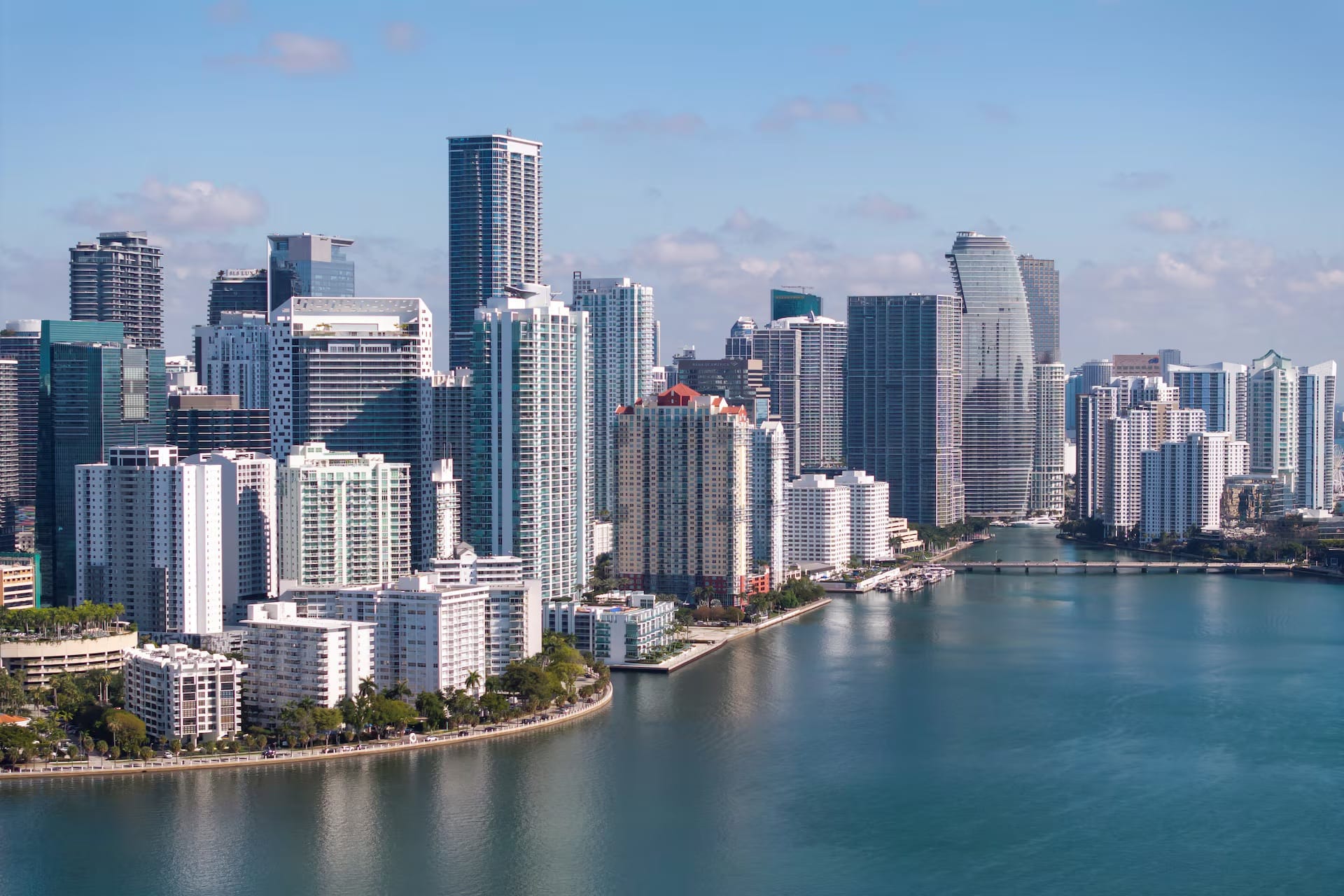
The median home sale price in Miami is $675,000 — 54% above the national average. Average rent runs $2,732 per month for an apartment. The city’s minimum wage is Florida’s — $13 per hour. The fastest-growing jobs in Miami-Dade pay less than $19 per hour. The arithmetic does not work for a working-class family, whether the capital is coming from Bogotá or Brickell.
Weston — in Broward County, one of Miami’s most significant Latin American wealth enclaves — illustrates the bifurcation most clearly. It has become the epicenter of wealth migration for Venezuelans, Colombians, and Argentinians. More than 53% of its residents are foreign-born, many of whom arrived with capital to invest in franchises and real estate. The community they have built is prosperous, educated, and culturally Latin American. It is also priced out of reach for the working-class Venezuelan service worker, the Colombian delivery driver, the Argentine restaurant employee who cannot afford to live in the community their compatriots built.
The climate gentrification pressure documented in Sociedad Media’s reporting on Miami’s cost of living adds another layer: higher-elevation historically Latino neighborhoods — the ones that sit above Miami’s flood risk zone — are being targeted by wealthy buyers seeking climate-resilient land. The communities being displaced are not the wealthy Latin Americans arriving with capital. They are the working-class Latino families who arrived a generation earlier, before the money followed them.
The Paradox at the Heart of Miami
Miami’s relationship with Latin American capital is the defining economic paradox of the city’s identity. It is simultaneously the mechanism of Miami’s extraordinary financial rise and the force most directly displacing the Latino community that made the city what it is.
The Cuban exile who arrived in the 1960s with nothing and built a business in Little Havana did not arrive with capital. The Venezuelan professional who fled Chávez in the 2000s did not pay cash for a Brickell condo. The Colombian entrepreneur who relocated to Coral Gables after Petro’s election did not price out the working-class Hialeah family. But the accumulated effect of decades of capital flight — the cumulative weight of every crisis that sent money northward — has produced a city where the Latino community is simultaneously the dominant cultural and demographic force and the population most burdened by housing costs, wage stagnation, and economic displacement.
Miami is the capital of Latin America. That designation has an economic meaning that is visible in every private banking expansion on Brickell, every cash purchase in Sunny Isles, and every new pre-construction tower marketed simultaneously in Bogotá, Buenos Aires, and Caracas. It also has a human meaning that is visible in the families in Hialeah and Kendall who are paying more than 75% of their income on rent while the city’s financial architecture grows more magnificent and more inaccessible around them.
Every crisis in Latin America sends money to Miami. The city absorbs it, invests it, builds with it, and grows wealthier with it. The question it has not answered — and that none of its political leaders have seriously attempted to answer — is the impact it is having on the majority of residents who have lived here long before the money arrives.