

CECOT — On the morning of April 23, hundreds of men sat chained, shaved, and silent, dressed in white cotton, seated in rows of plastic chairs inside the main hall of the Terrorism Confinement Center — CECOT — in southeastern El Salvador. Guards in full black armor and riot shields watched from the perimeter. A witness’s voice came over a loudspeaker describing acts of murder and torture in clinical, devastating detail.
Some 220 defendants were present in the hall. Hundreds more appeared by video link from their cells. Together, the 486 alleged members of the Mara Salvatrucha — MS-13 — one of Latin America’s most brutal gangs, are accused of collectively carrying out more than 29,000 murders over the span of a decade. Among those on trial are approximately 20 alleged leaders and dozens of gang lieutenants.
Prosecutors accuse two of the most prominent — Borromeo Henríquez, known as “The Little Devil of Hollywood,” and Carlos Tiberio Ramírez, known as “Snaider of Pasadena” — of approximately 9,000 crimes between them.
President Nayib Bukele has compared the proceedings to the Nuremberg trials — the post-World War II tribunals that prosecuted Nazi leaders for crimes against humanity. “These individuals caused mourning and pain to our society for many years,” said CECOT director Belarmino García.
The comparison is deliberate and calculated — part of a media strategy that has made CECOT one of the most recognizable symbols of strong-handed security policy in the world. The trial is the latest episode in that strategy. What is happening beyond El Salvador’s borders as a result of it is the bigger story.
What is CECOT — For Those Who Don’t Know
CECOT opened in February 2023 as the centerpiece of Bukele’s state of exception — a security emergency declared in March 2022 after a particularly violent weekend in which at least 87 people were murdered. The prison can hold 40,000 inmates and is the largest in Latin America.
As of late 2024, it held between 15,000 and 20,000 people.
Inmates wear all-white uniforms. Their heads are shaved every five days. They are allowed outside their cells for 30 minutes per day — for exercise, Bible study, or online court hearings. There is no education, no recreation, no visitation, and no phone calls, and members of rival gangs are not separated.
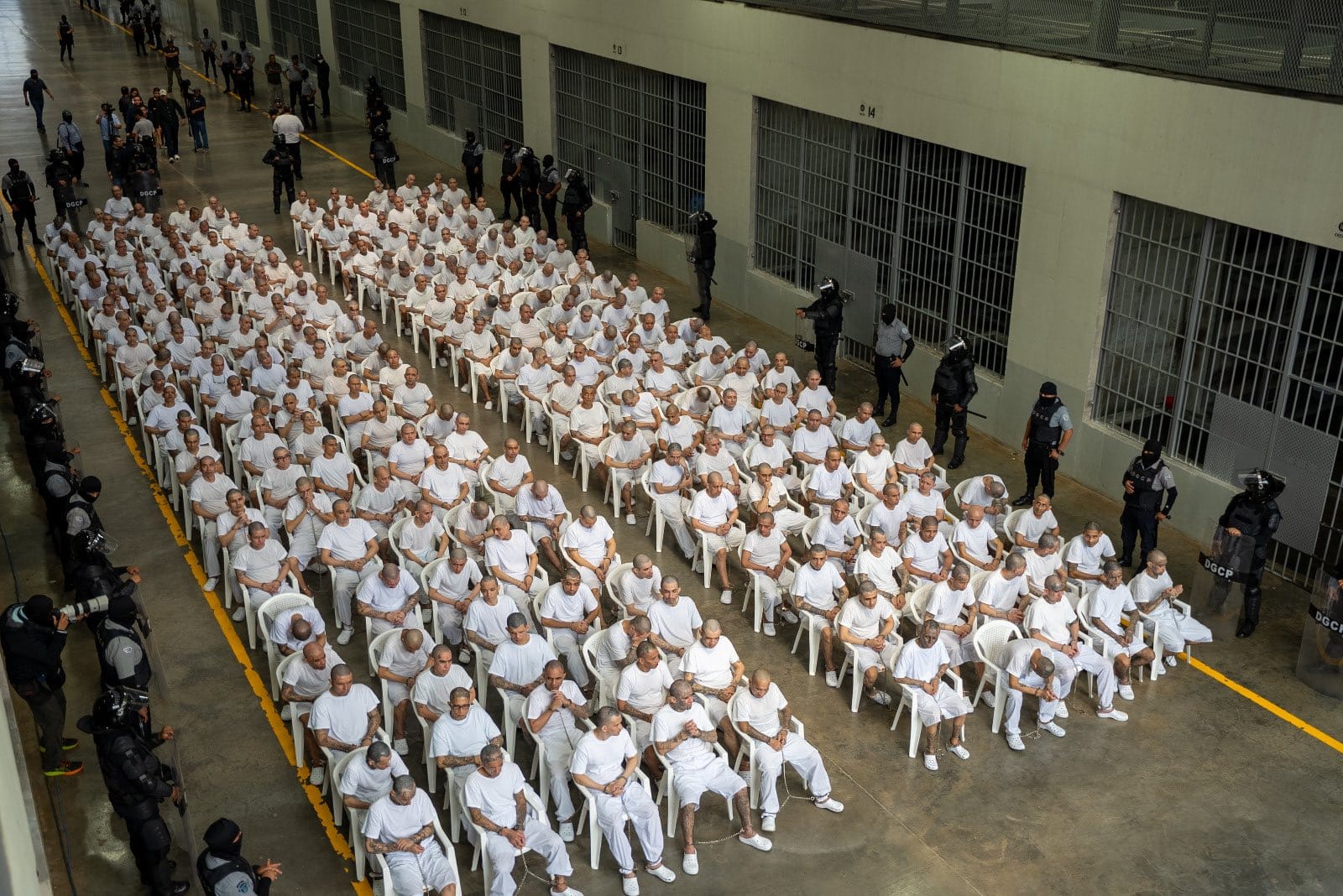
The mass trial underway this week reflects CECOT’s broader judicial architecture: defendants are tried en masse, with no opportunity to present counter-evidence or see the evidence against them. Many have already been sentenced to centuries-long terms. Others have yet to be convicted of anything.
International organizations have noted that people held in CECOT only appear before courts in online hearings, often in groups of several hundred at a time. Families and lawyers do not have access. The Salvadoran government has described detainees as “terrorists” and said they “will never leave.”
The results Bukele points to are real. El Salvador was once the murder capital of the world. Salvadoran residents, once self-imprisoned within the confines of their own homes, for fear of retribution, extortion, and robbery, are now free to visit the streets and gather among family and friends. Supporters say Bukele has made it one of the safest countries in the Western Hemisphere, and the numbers back up that claim. The homicide rate has fallen dramatically since the state of exception began, to the lowest rates in the entire region.
But critics say the cost of that transformation is what is being debated — inside El Salvador, before the Inter-American Commission on Human Rights, and in the courts of the United States.
The Human Rights Record
The security results and the human rights record are not mutually exclusive. They are simultaneous, and both are documented.
From 2022 through mid-2025, 470 people died in Salvadoran state custody — 94% of whom were not gang members, according to human rights organization Socorro Jurídico. Cristosal, an international human rights group based in El Salvador, documented the deaths of four children — two of whom had lived in prison with their mothers, and two of whom were miscarriages.
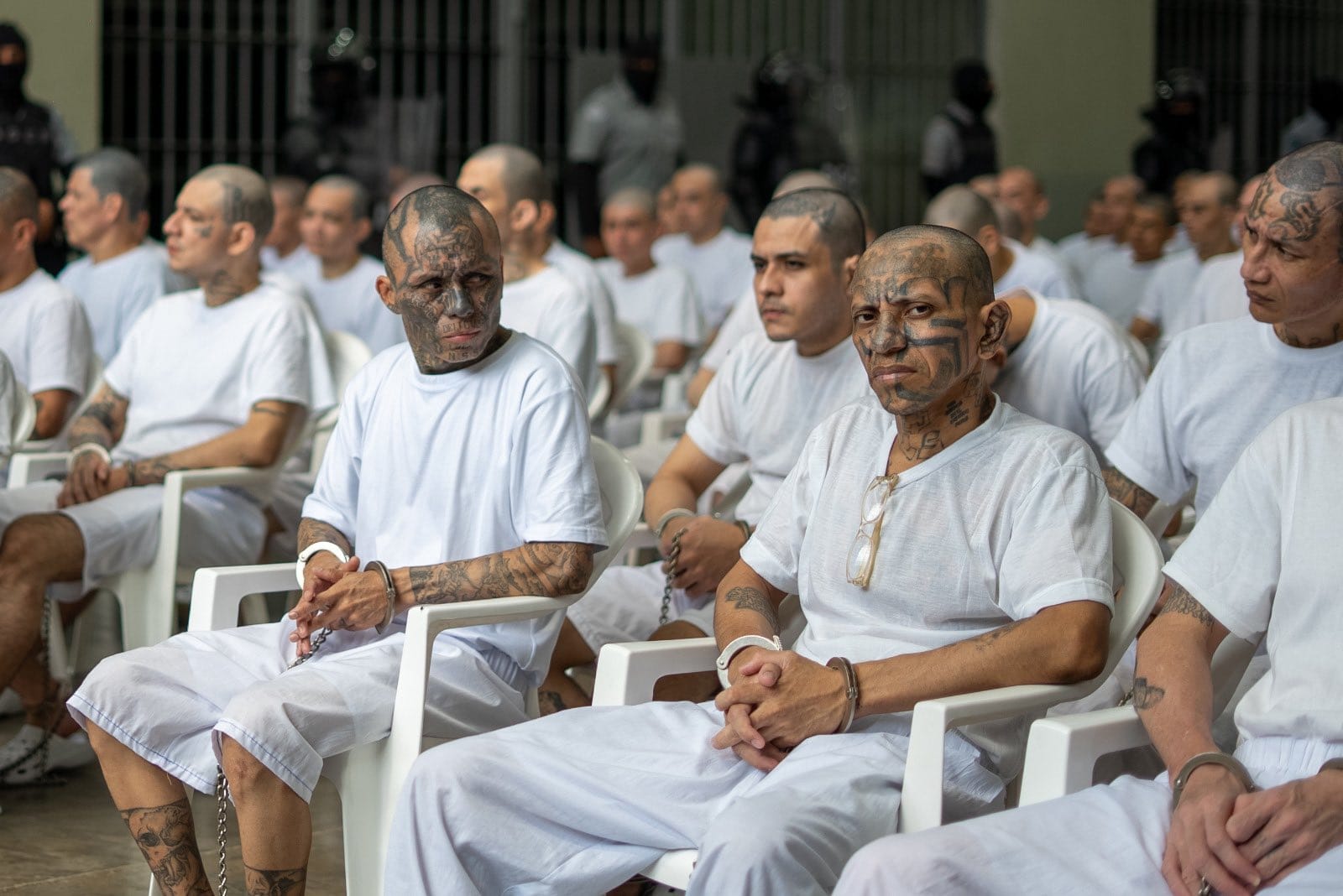
Since the state of exception began, approximately 85,000 Salvadorans have been imprisoned — most without evidence that they committed the crimes they were accused of. The government has acknowledged that many caught in the dragnet were later declared innocent.
It has not released comprehensive data on how many.
Inside CECOT, skin disease is rampant. Lights remain on 24 hours a day. Access to toilets and hygiene is severely limited. The overcrowding exceeds international standards by significant margins. The Inter-American Commission on Human Rights and Amnesty International have both filed formal complaints about the conditions and the lack of due process.
In March 2026, a group of human rights organizations filed a petition with the Inter-American Commission on Human Rights on behalf of CECOT detainees — asking the Commission to declare that El Salvador’s agreement with the United States violated its human rights obligations. That petition remains pending.
The tension between CECOT’s security outcomes and its human rights record is not a minor editorial footnote. It is the central question that every government now building a replica facility is choosing to answer — or choosing not to answer.
CECOT — x 4
CECOT’s influence has spread far beyond El Salvador’s borders — and it is accelerating.
In January 2024, Ecuador’s President Daniel Noboa announced plans to build two prisons modeled on CECOT with a capacity for 12,000 inmates each. One of them — El Encuentro — opened in November 2025. Sociedad Media covered Ecuador’s 15-month gang war in depth — the prison is part of the same security architecture that has driven the country’s homicide rate from among the lowest in the region to among the highest, and back down again under Noboa’s state of emergency.
In June 2024, Honduras’s President Xiomara Castro announced construction of a prison capable of holding 20,000 inmates modeled on CECOT. In October 2025, Guatemala’s President Bernardo Arévalo announced a CECOT-inspired facility with a capacity of 2,000 inmates. Costa Rica’s President Rodrigo Chaves toured CECOT in December 2025 — and construction on Costa Rica’s own High-Containment Center for Organized Crime began in 2026.
Four countries. Four replicas. All announced or under construction within two years of CECOT’s opening.
What they are copying is the architecture of mass incarceration and maximum isolation — the shaved heads, the white uniforms, the 30-minute exercise windows, the permanent surveillance, the elimination of rehabilitation. What the regional replication does not appear to include — at least not in any public announcement — is the accountability framework, the independent oversight, or the legal safeguards that international human rights standards require and that CECOT has been documented to lack.
The countries building CECOT replicas are, in effect, copying the model’s aesthetics and its security claims while leaving behind the questions about due process and custodial death rates that the original has generated. Whether those questions will follow the model across borders — through the Inter-American Commission, through UN human rights bodies, through the domestic courts of each country — is the unresolved dimension of the replication story.
The trend is indicative of the greater vision for a new Latin American security outlook that has become part of the region’s shift to right-wing populist governments following decades of rampant crime and corruption. The people and inhabitants of Central & South America have grown tired of criminal unaccountability and view the reintroduction of right-leaning governments with traditionally strong-on-crime policies as the only way out of the criminal quagmire.
Ecuador voted to the right. Argentina voted to the right. Honduras voted to the right. Costa Rica votes to the right. El Salvador voted to the right. So did Chile, Paraguay, and by all intents and purposes, Peru appears on the cusp of doing the same in their presidential election on June 7.
Washington’s Role
The United States did not build CECOT. But it has used it, endorsed it, and made it a symbol of the bilateral security relationship it has been constructing across Latin America.
Trump sent 140 alleged Venezuelan gang members to CECOT — a move that U.S. courts later ruled unlawful. U.S. Homeland Security Secretary Kristi Noem visited the facility and posed for photographs in front of inmates. When Bukele visited the White House, Trump told him:
“You’re doing incredibly for your country. We appreciate working with you because you want to stop crime, and so do we.”
The endorsement is not incidental. It is structural. The Donroe Doctrine — Washington’s explicit reassertion of hemispheric dominance — has a military dimension visible in Operation Daga Atlántica in Argentina, a diplomatic dimension visible in the Falklands memo and the Cuba blockade, and an intelligence dimension visible in CIA operations in Mexico. CECOT and its regional replicas are the civilian detention architecture of the same realignment — the place where the people the doctrine's security operations capture are held, tried in mass proceedings, and sentenced to terms measured in centuries.
Bukele called the proceedings underway this week at CECOT “Nuremberg.” The comparison is historically inexact in ways that are worth noting — the Nuremberg trials involved individual charges, individual evidence, and individual verdicts for specific crimes against humanity. What is happening inside CECOT is a mass proceeding in which 486 defendants are collectively accused of 29,000 crimes.
Whether that distinction matters — whether the 94% non-gang-member custodial death rate, the 85,000 arrested without warrants, and the hundreds of families who have not heard from their relatives since 2022 represent an acceptable price for El Salvador’s homicide reduction — is a question that four governments are currently answering by building their own versions of the answer.
The trial continues. The construction continues. And the model spreads.
Sociedad Media is monitoring El Salvador’s mass trial, the spread of the CECOT model across Latin America & the Donroe Doctrine’s security architecture. For tips and reporting, contact info@sociedadmedia.com


