


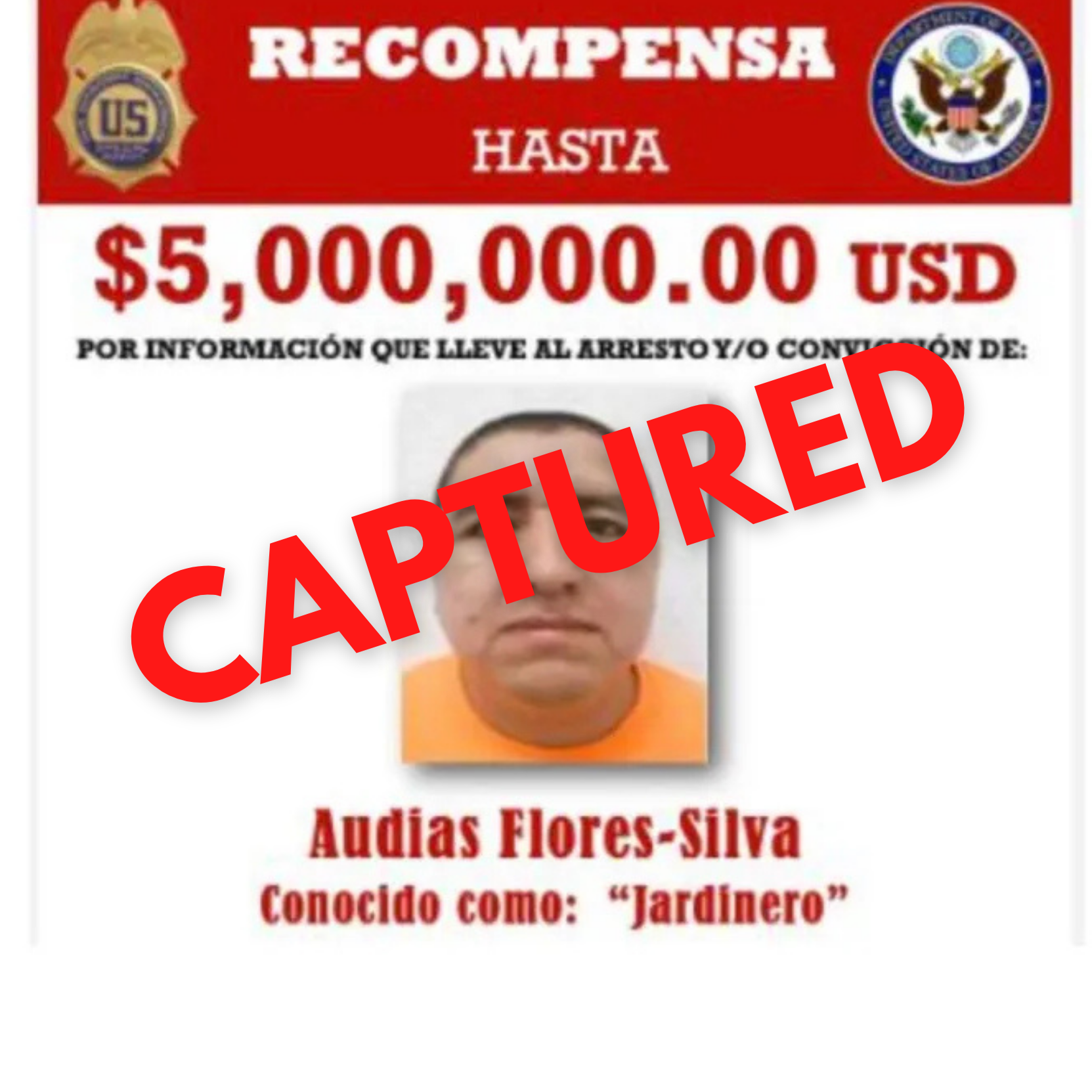
On the night of April 27, Mexican Navy special forces encircled a cabin in the mountains near Puerto Vallarta. Inside and around it: approximately 30 pickup trucks and more than 60 armed guards protecting the man Mexico and the United States had been hunting for nineteen months — Audias Flores Silva, known as “El Jardinero” — “The Gardener,” the CJNG’s second-in-command and the man who had positioned himself to inherit the Jalisco New Generation Cartel, CJNG, after his boss was killed in February.
When the troops moved in, the guards scattered — apparently as a deliberate distraction. The troops searched. And they found Audias Flores Silva not in a firefight, not on the run, but concealed in a roadside drainage ditch.
The operation concluded without a single shot being fired. Flores Silva was taken into custody and transferred to the Attorney General’s Office the same day.
It was the most significant cartel arrest in Mexico since El Mencho’s death — and it happened in a way that said as much about the operation’s precision as it did about the state of the organization El Jardinero had been trying to lead.
Nineteen Months of Silence
Mexico’s Secretary of the Navy, Raymundo Pedro Morales Ángeles, said the operation began in October 2024, when the Mexican Navy activated intelligence efforts focused on Flores Silva as a priority target. From that moment on, a discreet and sustained systematic follow-up was carried out based on field intelligence, intelligence gathering, and international cooperation. After more than a year and a half of analysis and preparation, Mexican authorities tracked down Flores Silv’s precise location and his movement patterns.
“Thanks to this analysis, the precise identification of the target was achieved on April 25, 2026,” Morales Ángeles stated. Two days later, federal forces moved in on their subject.
The operation’s architecture — nineteen months of surveillance, a precise location fix forty-eight hours before the arrest, and a zero-casualty takedown of a target protected by sixty armed guards — reflects a level of operational patience and intelligence integration that has not always characterized Mexico’s anti-cartel operations. The contrast with February’s El Mencho operation — which ended with the cartel founder’s death in a firefight — was deliberate and significant.
A live arrest produces intelligence. A dead target does not.
Also detained in the operation was another suspected CJNG operative known as “El Güero Conta” — a second capture that suggests the intelligence developed over nineteen months extended beyond El Jardinero himself.
Who is “El Jardinero” — “The Gardner”
Audias Flores Silva spent more than two decades building one of the most operationally significant structures within the CJNG — and accumulating a biography that reads as a catalogue of the cartel’s impunity during its years of expansion.
Mexico’s Secretary of Security and Citizen Protection, Omar García Harfuch, described Flores Silva as “a highly relevant criminal operator who, for more than two decades, consolidated a regional structure with the capacity to coordinate the production and trafficking of drugs.”
Washington designated Flores Silva in June 2025 as a Specially Designated Global Terrorist, identifying him as the operator of hidden drug laboratories producing methamphetamine and other narcotics bound for the United States.
He carried a $5 million U.S. bounty, and in 2020, was formally charged by a federal court in Washington, D.C., for conspiracy to distribute drugs and crimes related to the use of firearms.
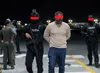
Mexican Navy’s surveillance footage of “El Jardinero’s” capture in Nayarit state, Mexico on Monday, April 27, 2026. Source: X
His record inside Mexico was equally documented — and equally unpunished for years. Mexican authorities detained him in 2016 for alleged involvement in a police ambush in Jalisco — and released him three years later. He subsequently served five years in a U.S. prison for drug trafficking before returning to Mexico, where he resumed his position within the CJNG’s command structure.
The revolving door — detained in Mexico, released, convicted in the United States, returned — is a pattern that has defined the CJNG’s most senior operators for years. It is also the pattern that Washington has been pressing Mexico to break, through the USMCA review leverage, the CIA’s Chihuahua operations, the U.S. military training authorizations, and the FTO designation threat.
“El Jardinero’s” arrest — executed by Mexican Navy special forces with the kind of operational precision that reflects sustained U.S. intelligence cooperation — is the most concrete result of that pressure to date.
The Succession Crisis Deepens
“El Jardinero’s” arrest does not resolve the CJNG’s leadership vacuum. It deepens it.
When El Mencho died in February, “El Jardinero” moved immediately — mobilizing “personnel, weapons and resources with the aim of taking over the power of the criminal organization,” according to the Secretary of the Navy. He was, in effect, already acting as though he had inherited the cartel. His arrest two months later means the CJNG has now lost both its founding leader and the man most visibly positioned to replace him in the span of sixty days.
According to InSight Crime, other possible successors within the cartel’s structure include Juan Carlos Valencia González, known as “El 03”, and Ricardo Ruiz Velasco, known as “Doble R.” García Harfuch added that “there are three or four people who are or were second in command to ‘El Mencho,’ and this one was one of them. So it’s not that he was second in command over the others — he is one of the other commanders who are in charge of the Jalisco cartel.”
The distinction matters. “El Jardinero” was not the undisputed heir — he was the most visible of several commanders attempting to consolidate authority in the vacuum “El Mencho” left in February. His removal does not end the succession contest. It eliminates one of its most prominent candidates and leaves the remaining contenders — “El 03,” “Doble R,” and others whose names have not yet surfaced publicly — to continue the internal struggle for dominance without the organizational coherence that a single recognized leader would provide.
That internal fragmentation is not necessarily good news for the communities caught between competing CJNG factions. “El Mencho’s” death unleashed a wave of violence across 20 Mexican states as cartel units jockeyed for position. A second leadership blow without resolution carries the risk of a second wave.
The Retaliation That Did Not Come
In February, when El Mencho was killed, the CJNG’s response was immediate and broad — roadblocks, fires, shelter-in-place notices, and flight cancellations across multiple states. The country braced for the same after El Jardinero’s arrest.
But this time, it did not materialize at the same scale.
CJNG gunmen blocked roads near Reynosa, Tamaulipas, in apparent retaliation — a swift show of force. But the response stayed more contained than the February wave, concentrated mostly in Nayarit, where the arrest occurred. Puerto Vallarta, adjacent to the operation site, moved into guarded normalcy rather than shutdown. There were no confirmed deaths in the immediate backlash.
The difference between February’s response and April’s is partly operational — a live arrest carries different symbolic weight than a death — and partly organizational. A cartel in the middle of a succession crisis, having just lost its second most prominent commander, may lack the command coherence to mount a coordinated retaliatory response across multiple states simultaneously.
The absence of a unified order from the top means the absence of a unified response on the ground.
That operational fragmentation is itself a massive sign for what could come later. The CJNG that blocked twenty states in February in response to “El Mencho’s” death and the CJNG that blocked roads in Tamaulipas in April in response to “El Jardinero’s” arrest are not the same organization. Something has changed — and what has changed is the center of gravity that held the cartel’s distributed command structure together.
Washington’s Reading
The DEA’s response to the arrest was immediate and specific.
DEA Administrator Terrance C. Cole said the capture of Flores Silva was “a step toward a fentanyl-free America. He was expected to succeed “El Mencho” as leader of CJNG, but law enforcement had other plans. Results like this make our nations safer.”
The framing — “law enforcement had other plans” — is a statement about the bilateral security cooperation that produced the arrest as much as it is about “El Jardinero” himself.
The nineteen-month surveillance operation that Mexico’s Navy ran explicitly included “international cooperation” as a component. Washington’s intelligence infrastructure — the same one that has been operating in Mexico through CIA officers in Chihuahua, through the U.S. military training authorizations in Campeche and Toluca, and through the bilateral Security Implementation Group — was part of the architecture that put El Jardinero in a drainage ditch on the night of April 27.
The CJNG’s next leader — whoever it is — will know that too.
Sociedad Media is monitoring the CJNG leadership crisis, U.S.-Mexico security cooperation, and organized crime developments across Latin America. For tips and reporting, contact info@sociedadmedia.com