


Separately, Brookings Institution senior fellow Vanda Felbab-Brown told Time that Sheinbaum may be leveraging the incident as a bargaining chip ahead of the July 2026 USMCA formal review — noting that “the easiest solution would have been to say this was a training mission,” but Sheinbaum chose to make it a bigger issue for domestic political and diplomatic reasons.
Sociedad Media is monitoring.
MEXICO CITY — For months, Mexican President Claudia Sheinbaum has maintained a clear and consistent public position: there are no joint operations between U.S. and Mexican forces on Mexican soil. Collaboration exists, she has said repeatedly, but it takes the form of information sharing — not American boots, not American agents, not American intelligence officers operating in the field.
On Sunday, four people died in a ravine in the mountains of rural Chihuahua, and that position became impossible to sustain.
Three people briefed on the matter confirmed to CNN that two of the four killed were CIA officers who had been collaborating with Mexican officials on expanded counternarcotics operations. Two Mexican officials from Chihuahua’s State Investigation Agency — identified as the agency’s first commander, Pedro Román Oseguera Cervantes, and officer Manuel Genaro Méndez Montes — also died in the crash.
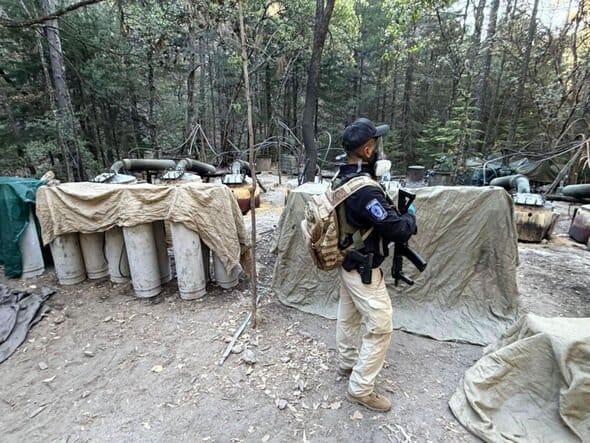
The group was returning from a drug raid in the municipality of Morelos — where authorities had located one of the largest clandestine methamphetamine processing facilities ever found in Mexico — when their vehicle skidded on a remote mountain road connecting Chihuahua to Sinaloa, fell into a ravine, and exploded.
The accident did not create a diplomatic problem between Washington and Mexico City. It exposed one that had been quietly deepening for the better part of a year.
Mexico’s Response
Sheinbaum’s public position on U.S. forces operating in Mexico has been unambiguous and repeated. “We have been clear that there is collaboration and coordination with the United States, but there are no joint operations on the ground,” she said as recently as Monday.
That position has carried particular political weight given the context — Trump has repeatedly offered to take direct action against Mexican cartels, an intervention Sheinbaum has called “unnecessary,” and his administration has already launched joint military operations in Ecuador.
The Trump administration's military actions in Venezuela and Iran have intensified the debate inside Mexico over the extent of U.S. involvement in Mexican security operations.
When news of the crash broke Sunday, Sheinbaum said her government had been unaware that Chihuahua state authorities were working with U.S. embassy personnel. She said any collaboration between state governments and the United States without federal authorization would constitute a violation of Mexican law, and she called for a meeting between U.S. Ambassador Ronald Johnson and Mexico’s foreign minister.
The U.S. Embassy’s initial statement did not identify the Americans or specify which agency they worked for, describing them only as personnel “supporting Chihuahua state authorities’ efforts to combat cartel operations.”
What Was Actually Happening
The gap between those public statements and the operational reality in Chihuahua is significant — and not entirely surprising given what has been reported about the CIA’s expanding role in Mexico and greater Latin America.
The CIA has significantly expanded its operations in Mexico under Director John Ratcliffe. The Trump administration has broadly worked to shift a wide range of counterterrorism authorities and resources to counter-cartel work along the U.S.-Mexico border and inside Mexico itself.
The CIA began covertly flying MQ-9 Reaper drones over Mexico to spy on drug cartels and also undertook a review of its authorities to use lethal force against drug cartels in the country.
CIA spokesperson Liz Lyons confirmed the agency’s posture in a statement:
“From day one, Director Ratcliffe made securing our southern border and countering drug cartels in Mexico and regionally a top agency priority to support President Trump’s directive to end narco-trafficking. Director Ratcliffe is determined to put CIA’s unique expertise to work against this multifaceted challenge.”
Sheinbaum had already allowed the CIA to expand surveillance flights over Mexico, which had begun during the Biden administration. Under her leadership, Mexico deployed 10,000 troops to the U.S. border, increased fentanyl seizures, and extradited 55 senior cartel figures to the United States.
The distinction Sheinbaum has drawn — between surveillance and information sharing on one hand, and operational ground presence on the other — is precisely the line that Sunday’s crash makes difficult to maintain. The CIA officers who died had been in Mexico for months and were assigned to an office in Monterrey, from which they operated across multiple states.
That is not the profile of a surveillance program. It is the profile of an embedded operational presence.
The Federalism Problem
One important variable that remains unresolved is where, exactly, the breakdown in communication occurred — if there was one.
The Chihuahua attorney general initially said the CIA officers were “participating in routine training work,” then backtracked, clarifying that “there were no U.S. agents in the operation to secure the narco-lab” and that the embassy officials had joined the group after the operation.
The Chihuahua attorney general also said the investigation had involved months of work with Mexico’s federal military — suggesting at least some level of federal involvement — but Sheinbaum’s Security Cabinet subsequently confirmed the army had participated in the same operation while Sheinbaum herself said she had not been informed.
Whether this reflects a genuine intelligence gap between the Chihuahua state government and the federal administration in Mexico City, deliberate compartmentalization, or something else is not yet established.
What is clear is that the official accounts from the Chihuahua state government, the Sheinbaum administration, and the U.S. Embassy have not aligned — and the contradictions have not been resolved.
U.S. Fears of Mexican Corruption
There is a question embedded in Sheinbaum’s demand for an explanation that her own framing does not address: whether bypassing Mexico City was a deliberate operational choice rather than a breakdown in protocol.
The United States has documented concerns about cartel penetration of Mexico’s federal law enforcement and intelligence institutions that span decades and multiple administrations — concerns that are not rhetorical, but grounded in specific, and documented with high-profile cases.
The arrests of former Mexican Defense Secretary Salvador Cienfuegos and former Public Security Minister Genaro García Luna — whom the United States arrested in December 2019 — and his associates in various branches of the Mexican government illustrate how deeply criminal infiltration has reached into Mexico’s highest-ranking security institutions.
García Luna, who oversaw Mexico’s federal police under President Felipe Calderón, was convicted in the United States in 2023 of taking tens of millions of dollars in bribes from the Sinaloa Cartel.
The Mexican government has historically refused to honor U.S. requests that all Mexican officials who participate in joint task forces and special interdiction units be subjected to stringent vetting — including polygraph examinations. Top Mexican officials on such task forces consistently declined to participate in the same vetting procedures applied to lower-ranking personnel. Given the extensive corruption of even the top layers of Mexico’s federal law enforcement agencies and military forces, this critical deficiency has resulted in vital intelligence leaking out and difficulties in sustaining longer-term intelligence and interdiction operations.
Brookings Institution senior fellow Vanda Felbab-Brown, one of the leading experts on U.S.-Mexico security cooperation, has written that laws requiring all U.S. intelligence cooperation to flow through federal channels “maximize the potential for leakage of sensitive intelligence on corruption, organized crime, and criminal infiltration to corrupt officials and criminals.”
In that context, the CIA’s decision to work directly with Chihuahua’s State Investigation Agency — bypassing the federal government — may reflect not a failure of coordination but a deliberate calculation by U.S. officials: that routing sensitive counter-cartel intelligence through Mexico City carried a higher operational risk than working at the state level, where the personnel could be more directly vetted and the circle of knowledge kept smaller.
Duncan Wood, a fellow at the Wilson Center, told Time that “any Mexican leader is naturally going to express concern and also surprise when U.S. operatives are discovered in Mexico, even though the fact is they know that this happens all the time.”
The surprise Sheinbaum expressed may have been genuine, or it may have been the appropriate political response to a practice that operates — by design — below the visibility of Mexico’s presidential palace.
None of this resolves the legal question Sheinbaum has raised. Under Mexican law, foreign security cooperation requires federal authorization regardless of the operational rationale for bypassing it. But it does complicate the narrative that the CIA’s presence in Chihuahua represents a straightforward violation of an agreed framework. The framework itself was built to accommodate a reality that both governments understand: that in Mexico, the chain of custody for sensitive intelligence does not always safely reach the top.
The Broader Stakes
The incident lands at a moment of acute sensitivity in U.S.-Mexico relations that extends well beyond the immediate question of who knew what in Chihuahua.
As early as November 2025, the Trump administration had begun detailed planning for a new mission to send American troops and CIA officers into Mexico for ground operations targeting drug cartels, including drone strikes on drug labs and cartel leadership. The mission was not imminent at that time, but planning was underway.
Separately, the CIA was conducting an internal review of its legal authorities to use lethal force against drug cartels inside Mexico — a review former CIA officials said was driven by clear signals from the Trump administration that it wanted national security agencies to escalate pressure on cartel networks.
In February 2026, the State Department designated six Mexican drug cartels as foreign terrorist organizations, giving U.S. spy agencies and military units sweeping legal authorities to conduct espionage and covert operations targeting those networks inside Mexico.
Sheinbaum’s position — that Mexico retains sovereign control over what happens on its own territory and that Washington’s offers of direct intervention are unnecessary — has been the central load-bearing argument of her security doctrine.
Sunday’s crash in Chihuahua did not disprove that argument. But it confirmed that the operational reality on the ground has been developing independently of whatever has been said at the presidential level on either side of the border.
The meeting between Ambassador Johnson and Mexico’s foreign minister has been called. The questions it will need to answer are not small ones.