

ASUNCIÓN, PARAGUAY — Somewhere over the Paraguay River, two ends of a 1,294-meter bridge are separated by just 21 meters of concrete. When engineers complete what they call the “kiss of the segments” — the moment the two sides physically meet — Brazil and Paraguay will be connected by road for the first time in history, and South America’s most consequential infrastructure project in a generation will reach the point of no return.
The Capricorn Bioceanic Corridor is moving through its final stretch on the border between Paraguay and Brazil, with just 21 meters remaining to complete the physical link of the Bioceanic Bridge, according to Paraguayan government authorities. The structure, built over the Paraguay River, connects Carmelo Peralta in Alto Paraguay with Puerto Murtinho in Brazil’s Mato Grosso do Sul — the central piece of a logistics corridor that will link the Atlantic Ocean with the Pacific across four South American countries.
The “kiss of the segments” — the structural union of the two bridge ends — was scheduled for May 31, 2026. Full delivery of the completed bridge, including paving, signage, lighting, and safety barriers, is expected in August 2026. The formal inauguration of the corridor is targeted for the second half of the year.
What It Is & Why It Matters
The Capricorn Bioceanic Corridor is a 2,400-kilometer road route connecting Brazil’s Atlantic interior with Pacific ports in northern Chile. The route traces back to the 2015 Asunción Declaration, signed by the presidents of Argentina, Brazil, Chile, and Paraguay as a commitment to improve physical integration across the Southern Cone. It runs from the port of Santos on Brazil’s Atlantic coast west through the Brazilian interior, across Paraguay’s Chaco and northwestern Argentina, and onward to the Chilean ports of Antofagasta and Iquique.
The corridor’s strategic logic is straightforward and powerful. Completion of the route will reduce the maritime distance of Brazilian exports to Asia by more than 9,700 kilometers. For trips to China, travel time could be reduced by between 12 and 17 days — a reduction of approximately 23%. The initial forecast is for 250 trucks to circulate per day across the bridge alone.
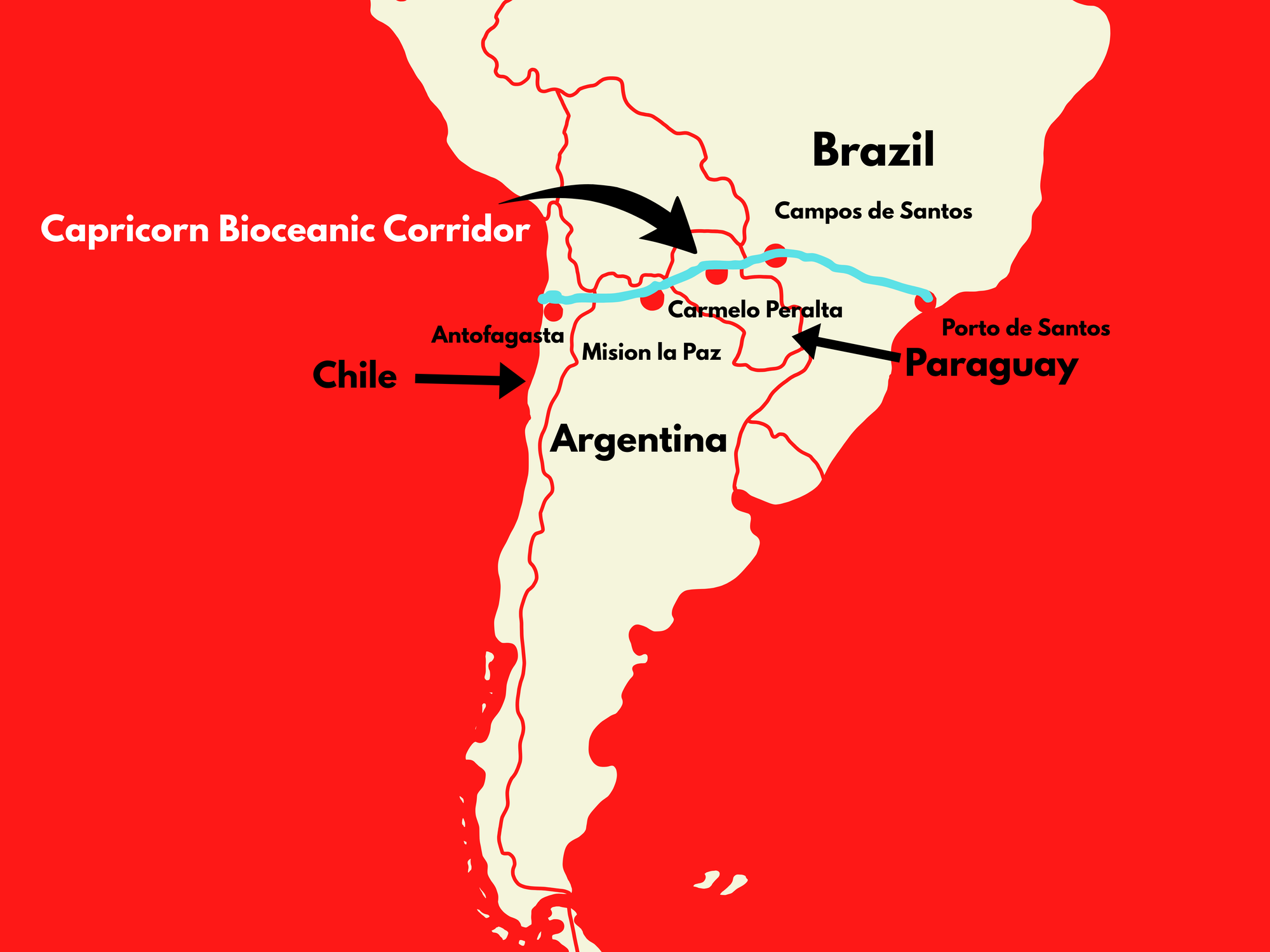
For landlocked Paraguay — one of only two landlocked countries in South America — the implications are transformational. The opening of the bioceanic corridor will provide Paraguay with a second outlet toward overseas markets, this time via the Pacific coast. The administration of President Santiago Peña has positioned the corridor as a central piece of its regional integration agenda. The port city of Puerto Murtinho on the Brazilian side, with a population of roughly 15,000, is already being repositioned as a future hub for Brazilian foreign trade.
The Engineering Behind It
The Bioceanic Bridge is not a routine infrastructure project. The bridge alone has consumed approximately 14,000 tons of steel — 13,200 tons for the main structure, 300 tons for post-tensioning, and 680 tons for tie rods — alongside roughly 60,000 cubic meters of concrete and 10,500 linear meters of piles.
The project involves approximately 280 workers, both Brazilian and Paraguayan. Construction began in January 2022. The total investment amounts to approximately 684.6 billion guaranis — roughly $500 million reais — according to the Paraguayan government, with substantial funding provided by the Itaipú Binacional Entity.
In the central section, the free span was carefully designed to preserve navigation on the Paraguay River, allowing vessels to continue passing under the bridge. The 1,294-meter structure is 21 meters wide — sufficient to accommodate two lanes of heavy truck traffic in each direction.
The Bottlenecks That Remain
Completing the bridge is not the same as opening the corridor. Analysts and officials directly involved in the project are candid about what comes next.
“The forecast for the bridge’s completion remains for the second half of 2026. However, there is still a long way to go until we can fully enjoy the benefits of the route. There are customs issues and legislation to be resolved among the countries involved,” said Artur Falcette, Secretary of Semadesc of Mato Grosso do Sul.
At the center of the remaining work is the creation of an integrated system for inspection, customs control, and legal certainty at the borders — considered essential to ensure predictability for the international flow of goods and stability for commercial operations.
Each of the four countries — Brazil, Paraguay, Argentina, and Chile — must harmonize their customs and regulatory frameworks before trucks can move freely from Santos to Antofagasta.
On the Brazilian side, access roads to the bridge contracted through the National Department of Transport Infrastructure are not expected to be completed until late 2026. The bridge may be finished in August. The full corridor will take longer.
The Trade Picture
The Bioceanic Corridor arrives at a moment of significant flux in South American trade architecture. The route will allow agricultural, mining, and industrial goods to cross from the Atlantic coast to the Pacific in less time and with lower logistics costs — opening a land alternative to the Panama Canal and the southern tip of the continent for cargo moving between South America and Asia.
The vast plains and towering Andes of South America are seeing a transformation in 2026, as the Capricorn Bioceanic Corridor moves steadily toward completion — creating a new artery for commerce and opening up a wealth of opportunities for businesses looking to participate in this monumental undertaking.
The EU-Mercosur trade agreement, signed in January 2026, adds further weight to the corridor’s commercial logic. South America is actively hedging its trade relationships — between Washington, Brussels, and Beijing — and a functioning transcontinental road route that moves goods directly to Pacific ports without passing through a U.S.-controlled canal represents genuine strategic infrastructure for a region determined to keep its options open.
For investors and executives with exposure to agriculture, mining, logistics, and energy across Brazil, Paraguay, Argentina, and Chile, the Bioceanic Corridor is not a distant project. It is infrastructure that will be operational before the end of this year — and that will begin reshaping freight economics and investment calculations across the Southern Cone the moment the first trucks cross.
The kiss of the segments is 21 meters away.


