

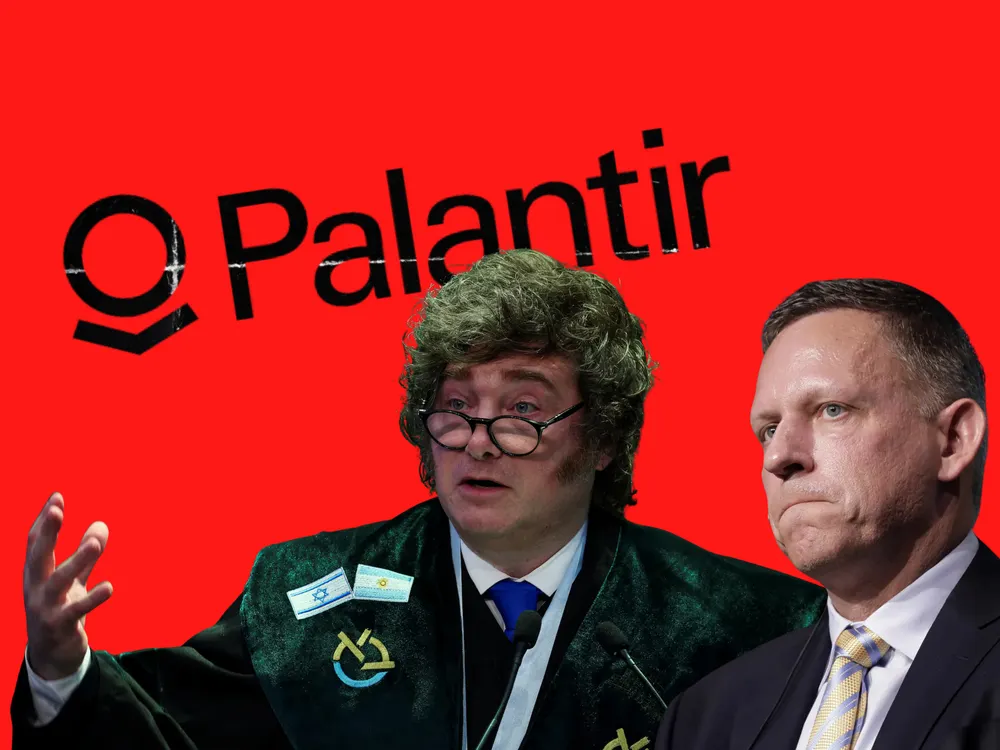
Peter Thiel arrived in Buenos Aires on April 12. He watched Boca Juniors play River Plate at the Monumental Stadium, and bought a $12 million mansion in Barrio Parque — a 17,200 square foot complex, designed by celebrated Argentine architect Alejandro Bustillo, with six en-suite bedrooms and a marble staircase. Thiel then had a private lunch with Santiago Caputo, the most powerful unelected figure in Javier Milei’s conservative populist government. He then attended a dinner at the home of Deregulation Minister Federico Sturzenegger alongside Foreign Minister Pablo Quirno. And on April 23, met with President Milei himself, at the Casa Rosada.
Milei called it “a wonderful meeting.” In an interview after Thiel left the government house, Milei said they had discussed wealth taxes, the agribusiness sector, and the future of liberalism.
“He is an anarcho-capitalist, just as I am philosophically,” Milei said. “He acknowledged the achievements and asked how they can be sustained over time.” No specific investment opportunities were discussed, Milei added — though Thiel has interests “in the agribusiness sector.”
Thiel is reportedly planning to stay in Argentina for at least two months. Associates are actively scouting additional properties beyond the Barrio Parque mansion he has already purchased.
The official story is a meeting between two libertarian ideological allies — a Silicon Valley billionaire and a Rock music-enthused South American president who, together, share a contempt for taxation, a belief in radical deregulation, and a political alignment with Donald Trump’s Washington and the expanding securitization of the Western Hemisphere.
That story is accurate as far as it goes. It does not go very far.
Who Peter Thiel is — and What He Brings With Him
Peter Thiel is not primarily a philosopher of libertarianism, though he is that. He is the co-founder of PayPal, the first major external investor in Facebook, and the co-founder — with early backing from the CIA’s venture capital arm, In-Q-Tel — of Palantir Technologies.
Palantir has become the central nervous system of the United States’ intelligence and defense apparatus. Its Gotham platform is used by militaries and counter-terrorism analysts, including the U.S. Intelligence Community and the Department of Defense. Its data analytics tools are utilized across battlefield intelligence, border security, and a range of government monitoring applications. Today, Palantir is playing an active intelligence role in both the Russia-Ukraine war and the U.S. conflict with Iran.
The Pentagon has expanded Palantir’s role significantly in 2026 — formalizing Project Maven, the military’s AI targeting and surveillance platform, as a long-term department-wide program. The most recent contract modification for Maven is valued at up to $795 million.
The Department of Government Efficiency (DOGE) asked Palantir to help speed up deportations by creating a master database. As of May 2025, the second Trump administration had spent $113 million on existing and new Palantir contracts with the Department of Homeland Security and the Pentagon.
Palantir’s involvement in immigration enforcement is a documented dimension of its government work — one that has generated significant public controversy in the United States — but represents one application within a much broader portfolio of government intelligence and defense contracts.
Days before the Milei meeting, Palantir published a 22-point manifesto entitled “The Technological Republic” — positing that Silicon Valley “has an affirmative obligation to participate in the defense of the nation” and that “the question is not whether AI weapons will be built; it is who will build them and for what purpose.”
The manifesto also stated that some cultures “remain dysfunctional and regressive” and that “we must resist the shallow temptation of a vacant and hollow pluralism.”
It is in this context — not the agribusiness conversation — that Thiel’s week of private meetings with Milei’s inner circle carries weight beyond ideology.
The Question Argentina is Asking
Argentine congressman Juan Marino filed a formal request for information with the Foreign Ministry in the days following the Casa Rosada meeting, asking for details on Thiel’s meetings with government officials — and specifically whether the implementation or purchase of Palantir’s AI security and defense tools was discussed.
Neither the Argentine government nor Thiel’s representatives have responded to that inquiry. The Foreign Ministry has not confirmed or denied whether Palantir’s products were on the agenda.
The question is not unreasonable given the sequence of events.
Thiel’s week in Buenos Aires included a private lunch with Santiago Caputo — Milei’s chief political strategist and the architect of his electoral campaigns — and a dinner at the home of the minister responsible for Argentina’s deregulation agenda, attended by the foreign minister and a senior economist.
The informal gathering centered on artificial intelligence.
A week of meetings at that level of government, centered on AI, by the co-founder of the world’s most dominant government AI contractor, does not require any conspiratorial reading to generate legitimate questions about what was discussed.
The Alignment Picture
Thiel’s Buenos Aires arrival also does not exist in isolation from the broader trajectory of Milei’s government over the past month.
This week, Milei signed Decree 264/2026 — a Necessity and Urgency decree bypassing congressional approval — to authorize U.S. Armed Forces personnel and equipment onto Argentine soil for Operation Daga Atlántica and a naval PASSEX exercise with the USS Nimitz. The U.S. State Department has been floating a review of its diplomatic support for British sovereignty over the Falkland Islands, with Argentina positioned as the beneficiary.
And now one of Silicon Valley’s most politically connected billionaires — a close ally of Trump, a major donor to right-wing causes globally, and the co-founder of the company that provides the Pentagon’s AI targeting infrastructure — has purchased a residence in Buenos Aires and spent a week meeting privately with Milei’s closest advisers.
The relationship between Thiel and Milei predates this visit. In May 2024, they met at the Casa Rosada alongside businessman Alec Oxenford, who now serves as Argentina’s ambassador to the United States. They also crossed paths at the Milken Institute forum in Los Angeles, where Milei urged international business leaders to invest in the country.
This was Thiel’s second visit to the government house. His net worth exceeded $9 billion in 2026, according to Forbes and Bloomberg, though some estimates place it significantly higher.
What distinguishes this visit from a billionaire’s ideological tourism is the combination of Palantir’s specific capabilities, the classified nature of what was apparently discussed, and the formal congressional inquiry that the Argentine government has not answered. Whether Thiel’s extended Buenos Aires residency produces investment commitments, technology contracts, or simply a deepening of the personal relationship between two of the hemisphere's most committed libertarian political figures — the answer will become visible in the months ahead.
For now, Argentina’s congress has asked the question that the Casa Rosada has not answered. What, exactly, did Milei and the co-founder of the CIA’s favorite data company talk about?
Sociedad Media is monitoring U.S.-Argentina relations and the deepening alignment between Buenos Aires and Washington. For tips and reporting, contact info@sociedadmedia.com