

Petro Arrives in Caracas — and Two Governments Agree to Fight Their Border Together
CARACAS — Colombian President Gustavo Petro arrived at the Miraflores Palace on Friday, April 24, becoming the first foreign head of state to set foot in Venezuela since U.S. forces captured Nicolás Maduro on January 3 and ended more than two decades of Chavista rule. The visit — months in the making, once canceled at the last minute, ultimately secured only after Petro publicly announced he would go to Caracas himself — produced a set of agreements that neither government could afford to leave unsigned.
The meeting concluded with the signing of the final act of the Third Meeting of the Colombia-Venezuela Neighborhood and Integration Commission, led by Venezuelan Foreign Minister Yván Gil and his Colombian counterpart Rosa Yolanda Villavicencio, reporting progress across seven key areas, including health, the environment, and tourism.
The security dimension was the most consequential. Rodríguez announced that both governments had committed to tackling organized crime along their shared border — one of the longest in the region at over 2,200 kilometers — developing joint military plans and immediate mechanisms for intelligence sharing.
Petro described the joint effort as aimed at “freeing border areas from the mafias engaged in a range of illegal businesses, starting with cocaine, illicit gold, human trafficking and rare minerals.”
The energy agenda was equally substantive. The summit underscored the urgent need for electrical interconnection to stabilize western Venezuela, and both sides discussed mutual natural gas supply chains and the prospect of joint exports to third-party markets.
Rodríguez confirmed that bilateral trade between the two countries reached $1.2 billion in 2025, with both sides expressing intent to deepen economic ties.
The meeting’s diplomatic symbolism was inseparable from its substance. Petro and Rodríguez represent opposite ends of the political spectrum in how they have handled Washington. Petro, a critic of the January 3 operation who has been vilified by Trump, and Rodríguez, a pragmatic collaborator who has opened Venezuela’s oil sector to U.S. companies and accepted the easing of sanctions as the price of survival.
That two leaders with such different relationships to Washington sat down together in Caracas and produced a formal bilateral framework is itself a signal: the post-Maduro transition is producing new alignments that do not follow the hemisphere’s existing political fault lines cleanly.
On the same day, the new head of the U.S. diplomatic mission in Venezuela, John Barrett, met with Rodríguez at Miraflores — with state broadcaster VTV airing footage of the encounter. Washington’s presence, in other words, was felt in Caracas on Friday even when its representative was not in the room where the most consequential meeting was taking place.
The Petro-Rodríguez agreements are a framework, not a guarantee. Whether joint military operations on the Catatumbo and wider border region actually materialize — and whether they address the presence of the Segunda Marquetalia, whose Venezuelan sanctuary has been documented by Colombian prosecutors — will be visible in the weeks and months ahead. For now, the two governments have put their names on a document that commits them to trying.
Venezuela Purges its Supreme Court — and the Most Wanted Justice is Gone
CARACAS — Venezuela’s post-Maduro institutional purge reached the country’s highest court this week, as six justices of the Supreme Tribunal of Justice were formally notified of their forced retirement — including Maikel Moreno, the former chief justice who spent nearly a decade as the judicial enforcer of Chavista authoritarian rule and who carries active U.S. criminal charges and a $5 million American bounty on his head.
Venezuelan lawyer and former prosecutor Zair Mundaray announced that the six members forced out include Henry José Timaure, president of the Civil Chamber; Carmen Alves of the same chamber; Malaquías Gil Rodríguez of the Political-Administrative Chamber; and Maikel Moreno Pérez of the Criminal Chamber — a U.S.-sanctioned former chief justice who served in that role from 2017 to 2022 before remaining on the bench as a sitting justice.
The removals were framed administratively as retirements — a mechanism that allows the Rodríguez government to clear the bench without formally prosecuting the outgoing justices. It is a purge dressed as a personnel procedure.
Moreno’s biography tracks the arc of Chavista institutional rot. Before ascending to the bench, he was indicted for murder, imprisoned for two years, released, and eventually reoriented his career toward law and intelligence under the Chávez administration. He rose through the system as a reliable instrument of political persecution — and presided over Venezuela’s highest court as an extension of executive rather than judicial power.
The U.S. Treasury sanctioned him in 2018. The State Department charged him with money laundering in 2020 and put a $5 million bounty on his head. He spent four more years on the bench after that.
The judicial restructuring follows Rodríguez’s public announcement of a “judicial reform” and a declaration that Venezuela must move toward ”another justice that does not criminalize violence.” The National Assembly, chaired by Jorge Rodríguez — Delcy’s brother — activated a preliminary commission to designate new TSJ magistrates, framing the vacancies as the result of “resignation and retirement.”
Reports from Venezuelan journalists indicate that up to 12 of the TSJ’s 20 principal magistrates could ultimately be removed — a near-total reconstitution of the country’s highest court under Rodríguez’s authority.
The TSJ purge is the third pillar of a power consolidation strategy that Rodríguez has executed with notable speed since January, following the replacement of seventeen ministers and the installation of her brother as National Assembly president. Executive, legislative, and now judicial power are being aligned under the same political authority. The circle, as Venezuelan legal observers have noted, is closing.
His removal does not mean accountability. The retirement mechanism provides no pathway to prosecution for the years of judicial corruption and human rights violations that occurred under his oversight. A U.S.-sanctioned, bounty-carrying former chief justice has been quietly shown the door — and that, for now, is the extent of the reckoning.
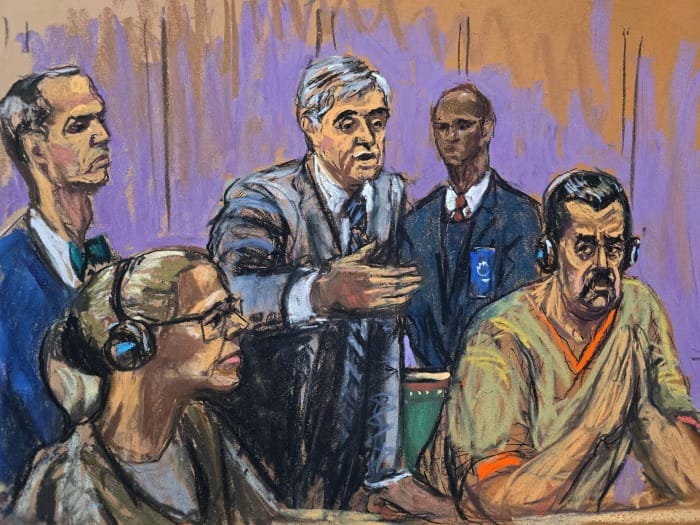
Maduro is Fighting to Keep His Case Alive in New York — Using the Constitution Against His Captors
NEW YORK CITY — Nicolás Maduro is in a cell at the Metropolitan Detention Center in Brooklyn. People close to Maduro’s situation say that he reads the Bible. He is also allowed fifteen-minute phone calls, has been in U.S. custody since January 3, when American forces captured him at his home in Caracas and flew him to New York to face drug trafficking charges that have been pending since 2020.
Maduro and his wife Cilia Flores returned to a New York courtroom last week as they seek to have their drug trafficking indictments thrown out over a geopolitical dispute over legal fees. The hearing centered on whether Maduro should be allowed to use Venezuelan government funds to pay for his defense. His lawyers argued that the U.S. is violating his constitutional rights by blocking government money from being used for the couple’s legal costs.
The argument is as unusual as the case itself. Maduro’s defense team, led by lawyer Barry Pollack, is not primarily arguing that their client is innocent — at least not yet. They are arguing that the conditions under which he is being prosecuted are unconstitutional: that U.S. sanctions, by blocking Venezuelan government funds from reaching his legal team, are effectively denying him the Sixth Amendment right to counsel of his choice.
Pollack contended that if Maduro were assigned public defenders, investigating and preparing the case would drain legal resources meant for people who cannot afford their own attorneys — an absurd outcome in a case of this geopolitical magnitude.
Prosecutor Kyle Wirshba argued the opposite — that allowing Venezuelan government funds to pay Maduro’s legal fees would undermine the very sanctions regime that the U.S. has used as a national security and foreign policy instrument for years. “This is a unique case that has not come before the judiciary before,” Wirshba told the court.
He is right about that. No case like this has come before any U.S. court before — because no former head of state has ever been captured by U.S. military forces and arraigned in a Manhattan federal court while his successor government operates in his country with Washington’s tacit blessing. The legal terrain is genuinely uncharted.
There was Manuel Noriega of Panama, but the circumstances were very different - not to mention, Noriega was already on the run.
Judge Alvin Hellerstein has yet to set a trial date. As the hearing closed, Maduro held up two fingers in a “V” — the gesture that has become a symbol of resistance in Venezuela, portrayed in murals across Caracas with the slogan “Nosotros Venceremos” — We Shall Overcome. “Hasta mañana,” Maduro said, before officers escorted him out.
The charges against him are severe. The indictment charges Maduro with narco-terrorism conspiracy, cocaine importation conspiracy, and weapons offenses — alleging that he and co-defendants including Diosdado Cabello conspired to distribute cocaine while providing support to designated foreign terrorist organizations including the FARC, ELN, Tren de Aragua, and the Sinaloa Cartel.
If convicted, he faces life in prison.
In Caracas, the government he built continues without him. Delcy Rodríguez has replaced his defense minister, purged his loyalists from the Supreme Court, and opened the oil sector to the country that captured him. His murals still cover the city’s walls. His case is still open in New York. And every few weeks, a motorcade moves through Lower Manhattan to a courthouse where the legal argument over how to prosecute him continues — one procedural hearing at a time.


