

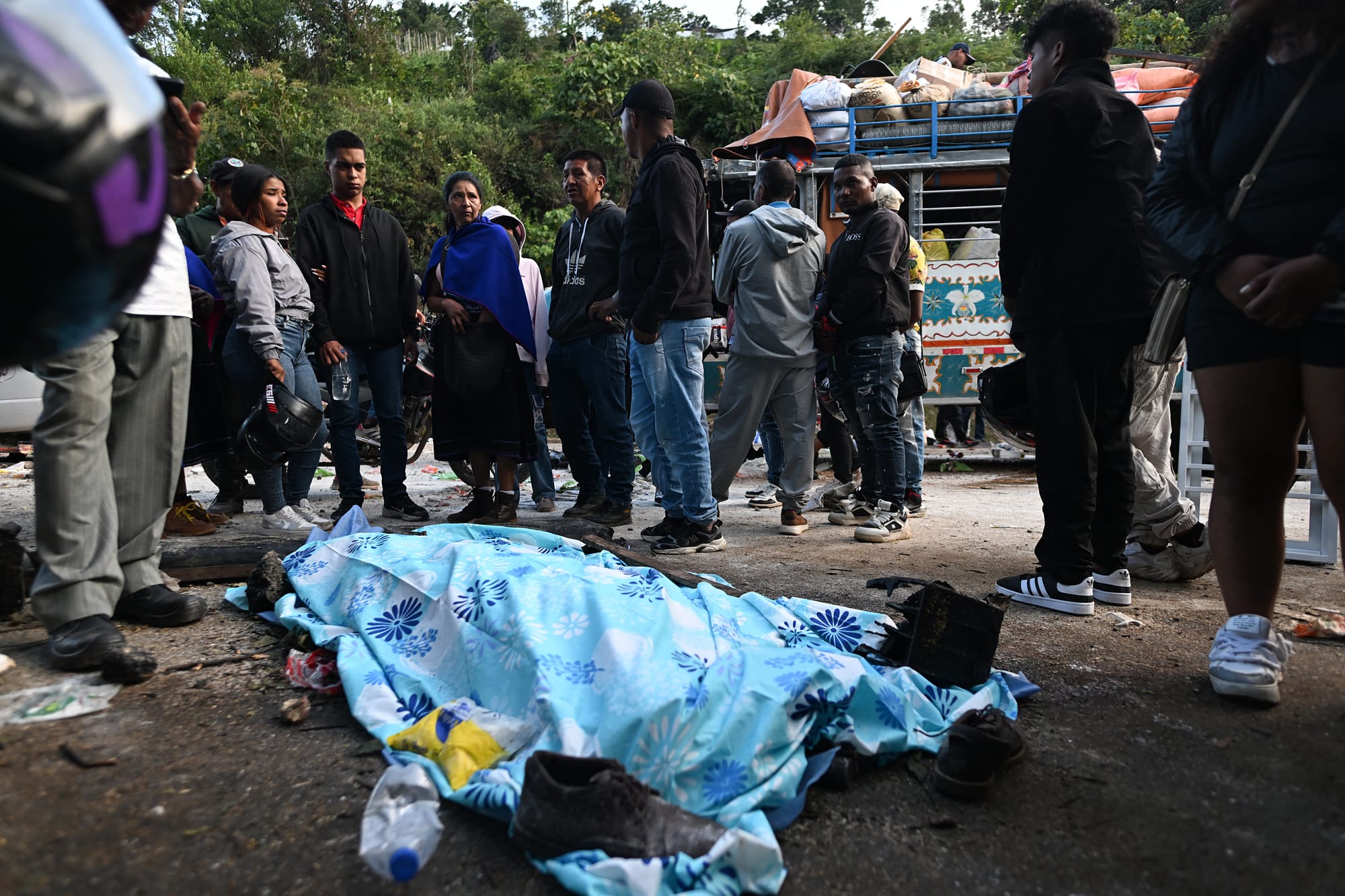
BOGOTÁ — On Saturday morning, Colombia came under attack when a cylinder packed with explosives fell onto a bus traveling along the Pan-American Highway in Cajibío, Cauca. At least 20 people died. At least 38 were injured. Five of them were children. The road — one of the most important arteries in southwestern Colombia, the corridor that connects the Andean interior to the Pacific port of Buenaventura — was torn apart.
It was the deadliest single attack in a 48-hour wave of violence that also included an explosive assault on the Pichincha Battalion in Cali, a bomb attack on the Agustín Codazzi Battalion in Palmira, and a grenade and rifle assault on a police substation in Jamundí. Eleven separate armed incidents in two days — all in Valle del Cauca and Cauca, and all attributed to FARC dissident factions with presidential elections 34 days away.
Colombia’s army commander General Hugo López called the bus bombing a “terrorist act” and attributed it to the network of a man known as “Iván Mordisco” — one of Colombia’s most wanted commanders — and the Jaime Martínez faction of FARC dissidents.
Cauca Governor Octavio Guzmán called it an “indiscriminate attack against the civilian population” and demanded a “decisive, sustained” response from the national government against what he described as a “terrorist escalation.”
Valle del Cauca Governor Francisca Toro called for immediate reinforcement of public security forces, enhanced intelligence operations, and “decisive actions” in the face of a threat she described as having reached “terrorist-level” scale.
Colombia votes in 34 days.
What happened in Cauca this weekend is not a new crisis. It is the latest, deadliest expression of one that has been building for years — and that the candidates now competing for the presidency have sharply different ideas about how to stop.
The Geography of Violence
Cauca and Valle del Cauca serve as a critical hub for illicit activities of illegal armed groups vying for control over sea and river access routes leading to the port of Buenaventura — a key transit point used to traffic drugs to Central America and Europe.
The port of Buenaventura processes the majority of Colombia’s Pacific trade. It is also the country’s most important cocaine export gateway — a fact that has made the corridor between the Andean coca-growing regions of Cauca and the Pacific coast one of the most violently contested territories in the hemisphere. Control of that corridor means control of logistics, of revenue, and of political power in a region where the state has historically been absent.
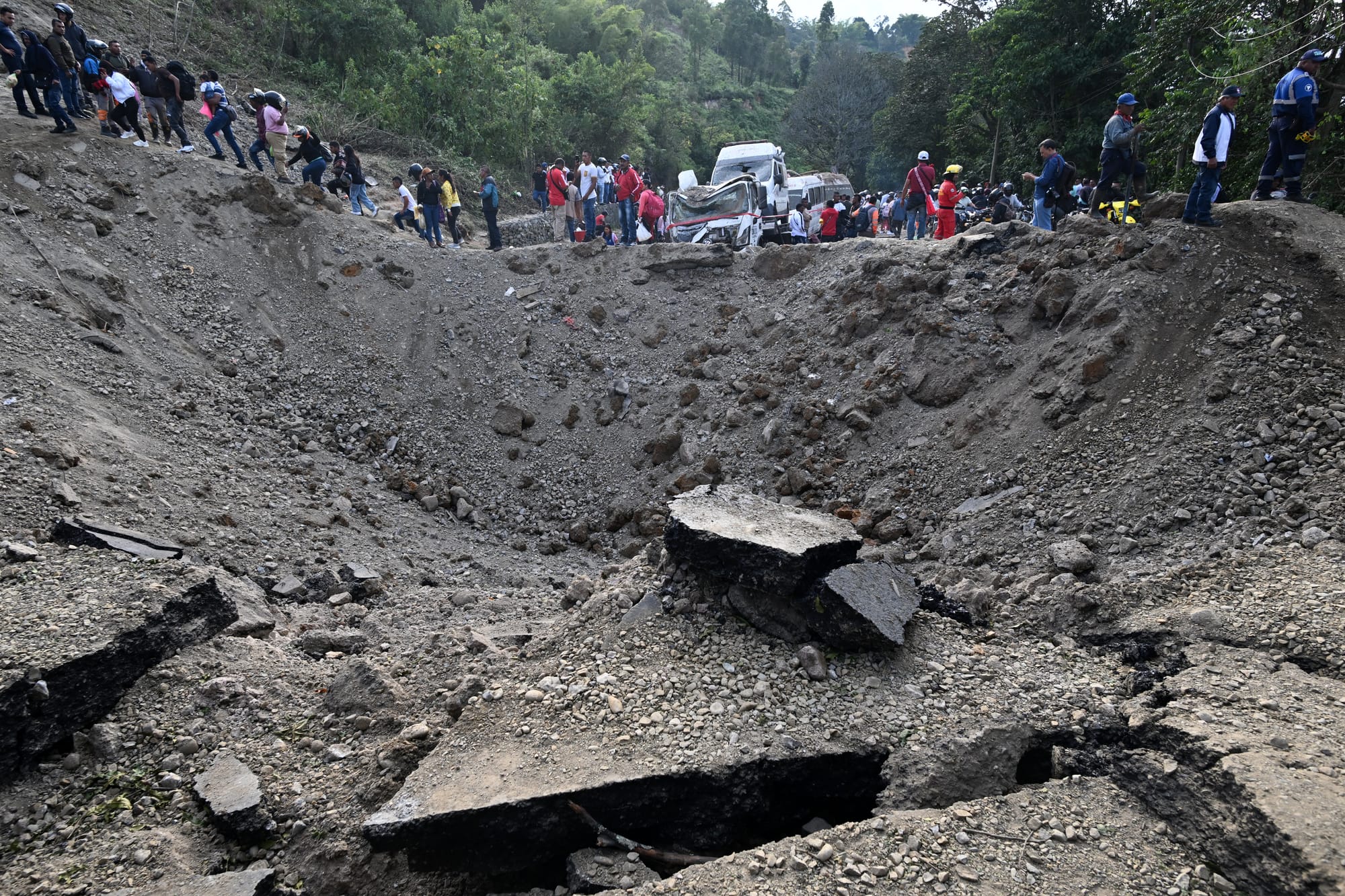
The FARC dissident factions operating in this territory are not remnants of the peace process. They are its rejection. When the Revolutionary Armed Forces of Colombia signed the 2016 peace agreement with the Santos government, a significant faction of the movement’s middle and lower command rejected the deal and returned to arms — arguing that the state had not fulfilled its commitments and that the conditions that produced the insurgency in the first place had not changed. They were not entirely wrong about the latter.
What emerged from that rejection was a set of armed organizations — including the structures commanded by Iván Mordisco and the Jaime Martínez faction — that have continued fighting, taxing, and killing in the territories where the original FARC had operated, in many cases filling the vacuum left by the demobilized fighters who put down their weapons and found that the state had not arrived to replace them.
Petro’s “Total Peace"’ strategy — the defining security policy of his government — attempted to negotiate simultaneously with all of these groups, including the ELN and the FARC dissidents. The results have been mixed at best, catastrophic at worst, ceasefires have been declared and broken, negotiations have started and collapsed. And the violence in Cauca, the Catatumbo, and the Pacific corridor has not decreased — it has intensified.
Paloma Valencia & the Return of “Seguridad Democrática”
The attacks in Cauca arrived the same day that the most explicitly security-focused candidate in the May 31 race made her most audacious campaign announcement yet.
Paloma Valencia, senator and presidential candidate of the Centro Democrático party, announced at a campaign event in Santa Rosa de Osos, Antioquia, that she wants former President Álvaro Uribe Vélez to serve as her Defense Minister if she wins the presidency.
“I want President Uribe defending democratic security,” Valencia told the crowd, asking the people of Antioquia to convince the former president to accept the role.
The proposal is constitutionally viable — Colombian law does not prohibit a former president from serving as a cabinet minister — but politically charged in a way that few campaign announcements in the current cycle have been.
Valencia’s platform, which she calls “Seguridad Total,” would end Petro’s Total Peace policy, restore high-mountain military battalions to the Andean cordilleras, and deploy helicopters, drones, and surveillance technology against armed groups.
“With me, Total Peace — where they coddle criminals — ends, and Total Security arrives,” she said.
Uribe has not publicly responded to Valencia’s proposal. His involvement in her campaign has been clear throughout — he backed her in the March primary, and Valencia previously floated him as a potential vice-presidential candidate before settling on the Defense Ministry framing.
The Uribe brand remains the most powerful in Colombian conservative politics: his “Seguridad Democrática” policy, implemented between 2002 and 2010, significantly reduced homicide rates and weakened the FARC militarily — while also generating documented human rights violations, including the “falsos positivos” scandal in which soldiers killed civilians and dressed them as guerrillas to inflate body counts.
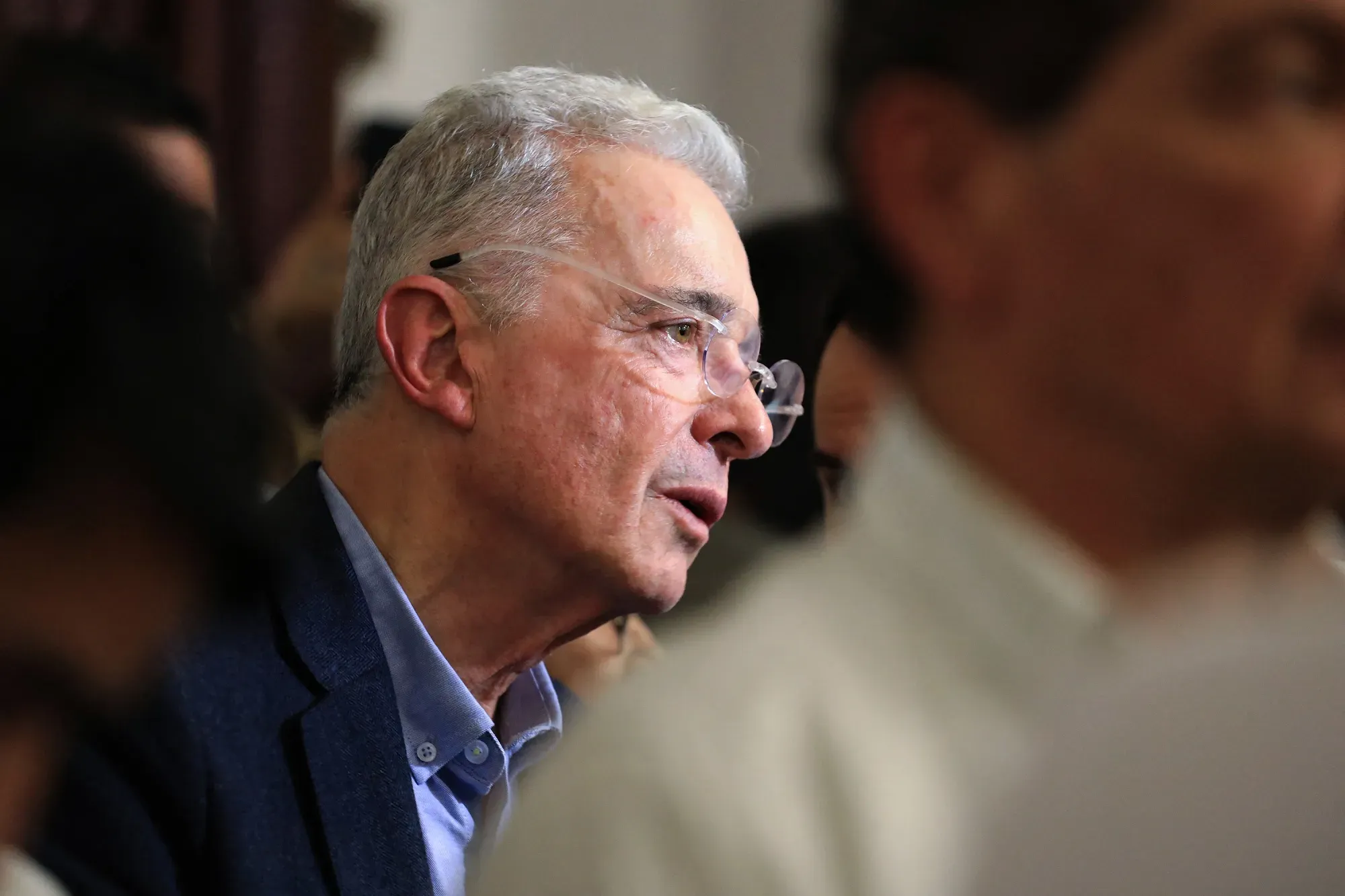
Uribe still faces ongoing legal proceedings. Valencia has said these do not preclude his appointment, citing the constitutional presumption of innocence.
The ELN has reportedly identified Valencia as a target. Intelligence intercepts suggest the organization may be planning an attack using a car bomb in Bogotá — a threat that Uribe himself made public, with reports indicating the phrase “Objetivo Paloma” appeared in intercepted communications between two ELN fronts.
The threat against a major presidential candidate, in the same week as the Cauca massacres, is a direct echo of the political violence that defined Colombia’s darkest decades — and a signal of what the security landscape may look like between now and May 31.
Recent Polling Gives Conservatives a Scare
While the security crisis dominates headlines, a major new survey published Sunday has reshuffled the electoral landscape in ways that complicate every campaign's assumptions — particularly on the right.
The latest Invamer poll for Noticias Caracol and Blu Radio — conducted between April 15 and 24 with 3,826 respondents across 149 municipalities — places left-wing candidate Iván Cepeda of the Pacto Histórico at 44.3% of first-round voting intention, his strongest result of the campaign cycle and a jump of 7.2 percentage points since February.
In second place, right-wing Abelardo de la Espriella of the Defensores de la Patria movement holds 21.5%, up from 18.9% in February. Paloma Valencia sits third at 19.8% — but her trajectory is arguably the most significant in the race: she has nearly doubled her support since February, when she registered just 10%.
The runoff projections are where the race becomes genuinely unpredictable. In a head-to-head between Cepeda and Valencia, Invamer projects Cepeda winning 51.2% to Valencia's 46.6% — a margin of less than five points, well within the territory of competitive uncertainty. Against De la Espriella, Cepeda's advantage widens to 54.6% versus 42.6%.
The poll also found that 50.2% of respondents prefer a candidate opposed to the current government — a majority anti-Petro electorate that is, for now, fragmented across three opposition candidates and unable to coalesce behind a single figure.
That fragmentation is the structural problem confronting the right in this election. Valencia has the strongest runoff performance against Cepeda of any opposition candidate — but she is running third in the first round, which means she needs to close the gap with De la Espriella before May 31 to guarantee her place in the June 21 runoff.
The security crisis in Cauca, arriving the same weekend as these poll results, is precisely the kind of event that reshapes voting intentions in the final stretch of a Colombian presidential campaign. For Valencia, who has staked her entire platform on the security question and proposed Uribe as Defense Minister, the Cajibío bombing is not just a tragedy — it is a test of whether the electorate will consolidate behind her vision of the answer.
Petro, Venezuela, & What the Caracas Meeting Means for the Election
Four days before the Cauca bombing, President Gustavo Petro became the first foreign head of state to visit post-Maduro Venezuela, meeting acting President Delcy Rodríguez at Miraflores Palace in Caracas. The two governments signed a bilateral integration agreement covering border security, energy, trade, and military intelligence cooperation — committing to joint operations against the armed groups operating along the 2,219-kilometer shared frontier.
For the May 31 election, that meeting carries direct implications that neither Petro’s opponents nor his supporters have fully acknowledged.
The Petro-Rodríguez agreement on border security is the most substantive bilateral security initiative Colombia has undertaken with Venezuela in years — and it comes at precisely the moment when the armed groups operating along that border are escalating their attacks inside Colombia. The Segunda Marquetalia — the FARC dissident faction whose Venezuelan sanctuary has been documented by Colombian prosecutors and which is accused of ordering the assassination of Senator Miguel Uribe Turbay in June 2025 — is among the organizations that the joint military plans are supposed to target.
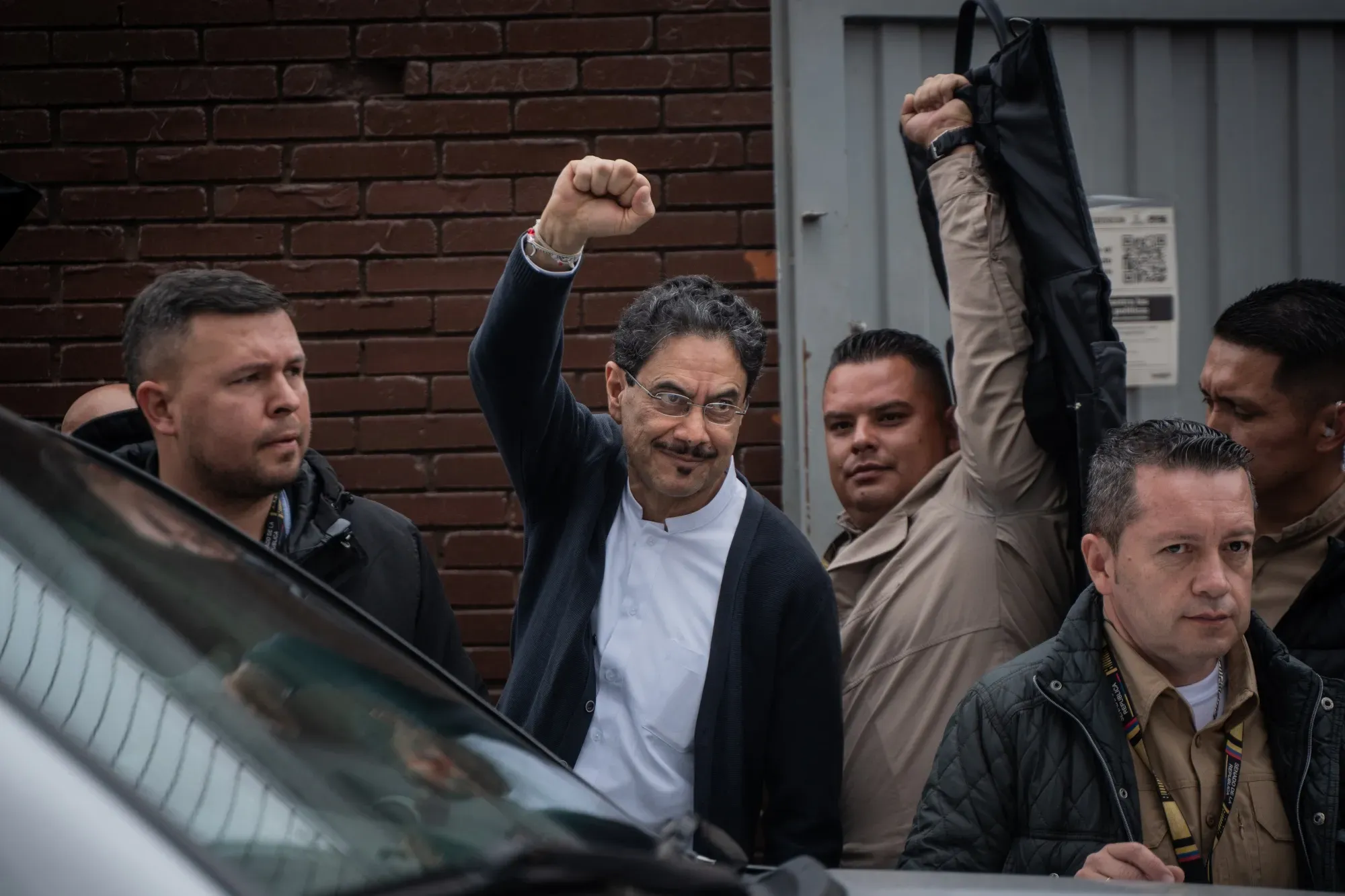
Whether those plans produce operational results before May 31 is unlikely. But Petro’s willingness to engage Rodríguez — a government that the Trump administration has backed and that Washington regards as a legitimate interlocutor — represents a pragmatic pivot from the position he held earlier in the post-Maduro transition, when he criticized the U.S. operation and maintained distance from the new Caracas leadership.
For the right-wing candidates in the race — Valencia, and potentially others — the Caracas meeting is an opportunity to attack Petro’s Venezuela record. For the incoming government, whoever wins, it is an inherited framework: Colombia’s relationship with Venezuela’s post-Maduro government, and the border security architecture that Petro just formalized, will shape the security options available to the next president from day one.
Ecuador & Trade War’s Security Dimension
Colombia’s security crisis does not exist in isolation from its trade war with Ecuador — a conflict that has now reached a 100% tariff wall and $2.8 billion in collapsed bilateral commerce.
The border communities most directly affected by the Ecuador crisis — Ipiales, Nariño — are the same communities that sit in the corridor most heavily contested by FARC dissident factions. The economic devastation of the trade war has deepened the conditions that armed groups exploit: unemployment, displacement, and the absence of legal economic alternatives that makes illicit economies the only viable option for communities abandoned by both the market and the state.
According to the Ipiales Chamber of Commerce, smuggling has surged by up to 70% since tariffs began climbing, more than 5,000 jobs have been lost, and 12,000 families are affected — with estimated losses running to $5.5 million per day.
The armed groups that tax smuggling networks have benefited directly from the trade war’s collapse of formal commerce. The next president will inherit both the diplomatic conflict with Ecuador and its security consequences simultaneously.
What May 31 Will & Will Not Resolve
Colombia’s presidential election on May 31 will produce a winner. It will not produce a solution.
The structural conditions driving the violence in Cauca — the absence of state presence, the coca economy, the armed group competition for corridor control, the unfulfilled commitments of the 2016 peace process — will not be resolved by an election. What the election will determine is the framework within which the next government attempts to address them: Petro’s Total Peace model extended or abandoned, Uribe’s Seguridad Democrática revived or rejected, the Venezuela border security framework honored or renegotiated, the Ecuador trade war resolved or deepened.
Valencia’s proposal to put Uribe in the Defense Ministry is not a policy detail. It is a statement about which framework she intends to pursue — and it has arrived, with striking timing, on the same day that FARC dissidents killed 14 people on a highway in Cauca, demonstrating with lethal precision exactly why the security question will decide this election.
The candidates are making their arguments. The armed groups are making theirs.
Colombia votes in 34 days.
Sociedad Media is monitoring Colombia’s May 31 presidential election, the security crisis in Cauca and Valle del Cauca, and U.S.-Latin American relations. For tips and reporting, contact info@sociedadmedia.com


