

Rodríguez confirmed that bilateral trade has reached $3.2 billion, up from $200 million three years ago. Both leaders agreed to a joint military and intelligence cooperation plan focused on the Catatumbo region, targeting narcotrafficking, illicit gold, and human trafficking networks operating along the shared frontier.
Notably, Diosdado Cabello — Venezuela’s Interior Minister and one of the most powerful figures in the post-Maduro apparatus — was present in the room for the expanded delegation session, signaling the security dimension carried the highest institutional weight on the Venezuelan side.
Sociedad Media will continue monitoring.
MIAMI — Colombian President Gustavo Petro arrived in Caracas on Friday for a midday meeting with Venezuela’s acting President Delcy Rodríguez — a visit that marks a diplomatic first and a regional inflection point: the first official head of state to set foot in Venezuela since the United States captured former dictator Nicolás Maduro on January 3, ending more than two decades of hard-line Chavista rule.
The meeting is formally designated the “III Meeting of the Colombia-Venezuela Neighborhood and Integration Commission” and is taking place at Miraflores Palace in Caracas. The foreign ministers of both countries — Colombia’s Rosa Yolanda Villavicencio and Venezuela’s Yván Gil Pinto — are expected to sign a final communiqué in the presence of both leaders.
Petro announced the visit during a forum of left-wing leaders in Barcelona, Spain, last week, saying publicly:
“If Muhammad will not come to me, I will go to the mountain.”
The remark was a direct reference to Rodríguez’s failure to respond to Petro’s prior invitation and to the cancellation of their planned March meeting at the Colombian border.
The visit did not come easily. The two leaders had planned to meet on March 13 at the Atanasio Girardot International Bridge on the shared Venezuela-Colombia border. Caracas canceled at the last minute, citing force majeure, while the press waited at the crossing.
No further explanation was provided at the time.
On Thursday evening, Miraflores finally confirmed the Caracas meeting after technical delegations from both countries spent the morning in preliminary talks at the Casa Amarilla.
What Venezuela Looks Like Now
Venezuela is a country undergoing one of the most consequential political transformations in the Western Hemisphere in decades.
Rodríguez assumed the role of acting president on January 5, two days after the U.S. military operation that resulted in Maduro’s capture. Since taking office, she has replaced seventeen ministers, detained three businessmen, and is navigating the post-Maduro transition under the growing influence of the Trump administration, which brokered the easing of sanctions on Venezuelan oil.
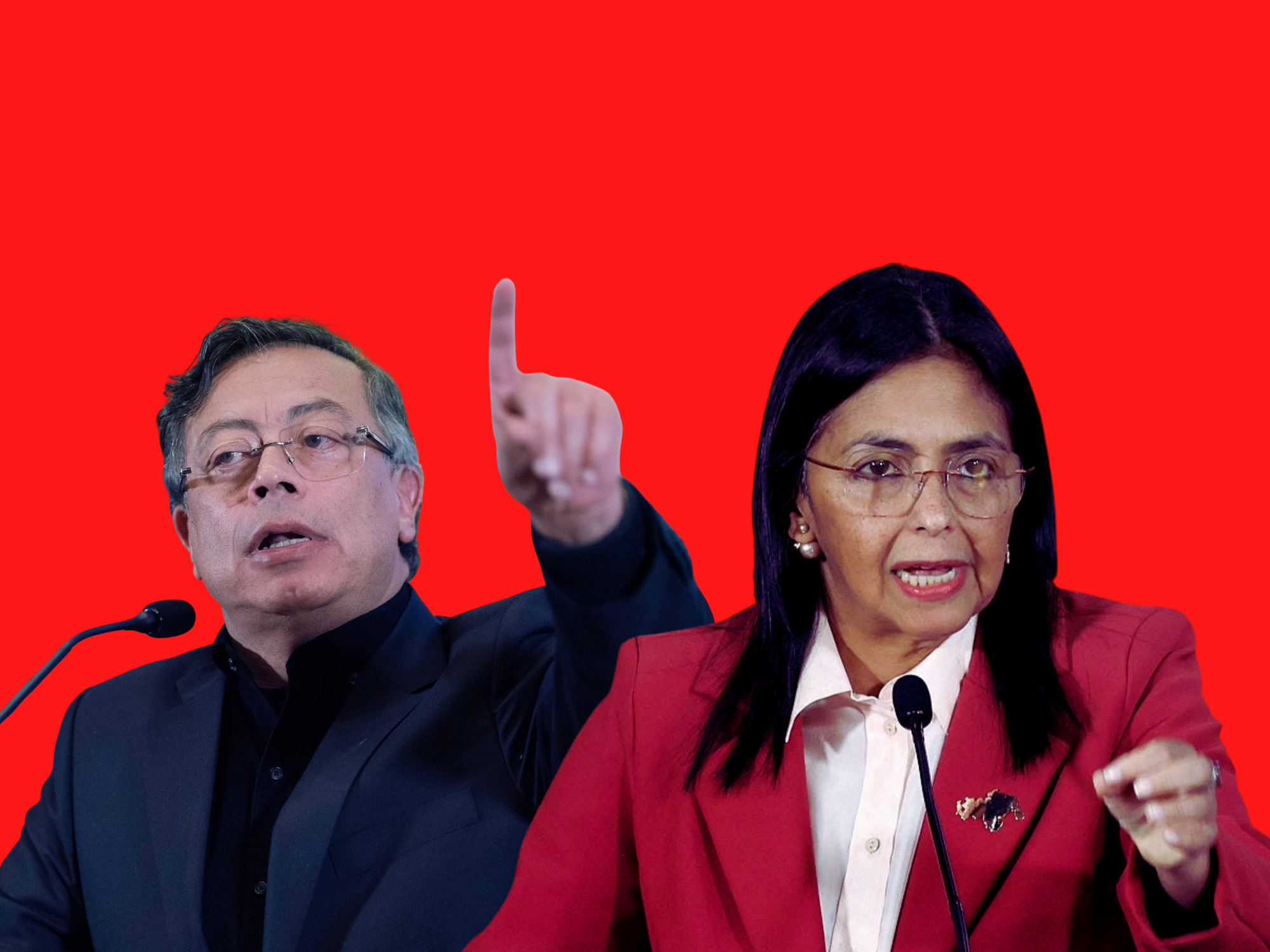
The political purge inside Venezuela has been swift and opaque. The Chavista institutional structure remains formally intact — the same party, the same military command, the same constitutional framework — but the power dynamics beneath it have shifted in ways that outside observers, including Colombia’s government, are still mapping.
Rodríguez is not Maduro. She is also not a departure from the system that Maduro built. What she represents for the bilateral relationship with Colombia is precisely what Petro’s delegation has come to assess.
The Agenda: Catatumbo, Gas & Intelligence
Petro instructed his Defense Minister Pedro Sánchez to lead the Colombian delegation with an emphasis on military and police authorities, with the specific purpose of structuring a joint border security plan. “The issue is security and a joint plan,” Petro said during a televised cabinet meeting. “If there’s no intelligence, bombs fall where they shouldn’t. If shots are fired without intelligence, they end up killing civilians — as has already happened in Colombia.”
The Catatumbo region is the focal point. Colombia and Venezuela share a 2,219-kilometer border stretching from the Caribbean to the Amazon — a corridor where the Ejército de Liberación Nacional (ELN), FARC dissident fronts, and narco-trafficking networks operate in active territorial dispute.
The Catatumbo — spanning Norte de Santander on the Colombian side and bordering Venezuela’s Táchira state — is the most volatile stretch of that frontier, where armed groups compete for control of coca cultivation, drug trafficking routes, and smuggling networks.
The security agenda carries a dimension that neither government has addressed publicly but that Colombian prosecutors have established on the record: the Segunda Marquetalia — the FARC dissident faction accused of ordering the assassination of Senator Miguel Uribe Turbay in June 2025 — operates with its strategic rearguard in Venezuelan territory.
Sociedad Media has covered the latest developments in that investigation, including the arrest of a key suspect in Buenos Aires this week, here.
Whether Petro’s delegation will raise the Segunda Marquetalia’s Venezuelan sanctuary directly with Rodríguez is one of the most consequential unknowns of Friday’s meeting — and one whose answer, if it exists, is unlikely to appear in any joint communiqué.
Beyond security, economic interests are also on the table. Colombia has pressed for the reopening of the Antonio Ricaurte binational gas pipeline against a backdrop of rapidly declining domestic natural gas production. Colombia has also expressed interest in entering Venezuela’s electricity sector — a key piece of the oil sector reactivation being promoted by Washington following the easing of sanctions.
Why This Meeting Matters Beyond the Bilateral
The significance of Petro’s visit extends well beyond the specific issues on the agenda.
Colombia is 37 days from a presidential election. The May 31 vote will determine whether Petro’s foreign policy orientation — which has maintained engagement with Venezuela even through the Maduro years — continues under his successor or is reversed by a market-oriented government more aligned with Washington’s approach.
The next Colombian president will inherit this bilateral relationship exactly as it is being reshaped by Maduro’s removal and the post-Maduro transition.
The Trump administration’s conversations with Petro in February 2026 centered on the U.S. role in Venezuela's economic reintegration and the possible lifting of remaining sanctions — a point that generates strong opposition from Venezuelan democratic opposition leaders, particularly María Corina Machado.
Petro is navigating a narrow channel: maintaining the bilateral relationship with Caracas that Colombia’s border security requires, while not being seen as legitimizing a post-Maduro government that the democratic opposition — and Washington’s preferred Venezuelan interlocutors — regard with deep suspicion.
The fact that Petro is the first foreign head of state to visit post-Maduro Venezuela is, in itself, a statement. It says that Colombia’s relationship with Venezuela is too proximate, too complicated, and too consequential to be managed from a distance — regardless of the ideological distance between the two governments or the political dynamics that Maduro’s removal has created.
Colombia and Venezuela are not simply neighboring states. They share the most militarized, most trafficked, and most violent frontier in South America — a border where the decisions made in Bogotá and Caracas about security cooperation, intelligence sharing, and joint military operations have immediate, measurable consequences for the communities living along it.
Petro went to Caracas because the border issues cannot wait for the politics to resolve themselves.
What Comes Next
The signing of the final communiqué of the III Neighborhood and Integration Commission will produce a formal diplomatic record of what was agreed. What it will not capture is the intelligence dimension — the specific operational coordination on Catatumbo, the questions about the Segunda Marquetalia’s Venezuelan sanctuary, the backchannels between military commands that Petro explicitly said his delegation was there to establish.
Those outcomes will be visible, if at all, in what happens on the border in the weeks ahead — in whether joint operations against armed groups increase, in whether the ELN and FARC dissident movements find their Venezuelan rear lines under new pressure, and in whether the gas pipeline agreement moves from negotiation to implementation.
Colombia votes on May 31. Venezuela is still writing the rules of its post-Maduro transition. The meeting now underway at Miraflores is the first attempt by two governments — one departing, one newly enacted — to establish what the relationship between them will look like in a region that has changed dramatically in the past four months and has not yet finished changing.
Sociedad Media is monitoring. This article will be updated as outcomes emerge.
🚨🇨🇴🇻🇪 | ALERTA/SUDAMÉRICA: Colombia's Gustavo Petro llega a Caracas para reunirse con la presidenta en funciones Delcy Rodríguez 🇻🇪
— Sociedad Media (@sociedadmedia) April 24, 2026
La visita marca la primera de un jefe de Estado a Venezuela desde el operativo estadounidense en Caracas que resultó en la captura del exdictador… pic.twitter.com/woHlvuaiy2


